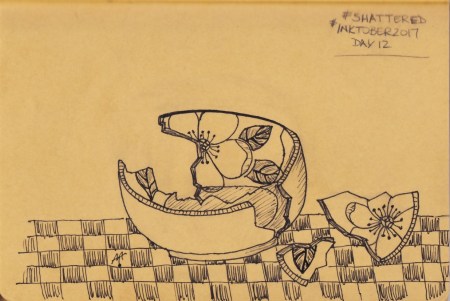
InkTober 2017: Day 12 – Shattered

I try hard to care for the things I own, especially things gifted to me by someone who cares for me. Unfortunately, sometimes we can’t protect the things we love and in the worst cases they may shatter into too many pieces too small to be repaired. Moreover, things aren’t all that can shatter. People and their lives can be shattered. Whether it’s because of actions they take themselves or circumstances beyond their control such as illnesses and injuries, accidents, or the loss of a job.

I recently broke a small painted terracotta bowl. It was one of a set of five gifted to me by one of my former teachers. Whenever I use these bowls, I do so with great care because of who gave them to me. Mrs. W is a retired teacher from my old high school. She didn’t teach me then but we developed a friendship many years after I graduated. What I learned about her during that time is that she is one of the kindest most generous people alive. She genuinely cares for people, even people she’s never met but support through whatever she can donate to charities.

Some years ago, I was a direct recipient of her care at a time when I was going through an unbearably difficult situation. I didn’t have to ask for her help. When she learned I was in need I didn’t have to ask for anything because her offer was immediate. During that time, and since, she mothered me, she fed me, and she listened to me; because she knew that was what I needed. For that reason, as small as they are, the bowls she gave me connect me to those moments and embody their deep emotions; and breaking one of them felt like creating a crack in our connection.

I probably feel so strongly about breaking that bowl because I don’t see Mrs. W as often as I might like, so keeping them as an intact set has been important to me. Moving forward I must be mindful to take better care of them, and the many other things she gifted me, with much care and love.


InkTober 2017: Day 11 – Run

Today is a high pain day, so this will be a short post.

I’ve written in past posts that I used to be a runner. Running was a big part of my life at different times in my life. When I was young, it was about fun, school rivalry and competition, and winning. Winning a race was always a good, actually a euphoric feeling. One of the best wins came in junior high school when I won a major City race in a field my coach decided to test me in. I couldn’t believe I won that race because I wasn’t supposed to; I wasn’t even supposed to run it. So winning it gave the skinny little girl that I was a huge boost in self-confidence.

As I got older running became one of my biggest teachers. It taught me about toughness and self-reliance. When you’re out alone, in terrible weather, running a long route you have no one to rely on but yourself and you have to be tough to make it to the finish. Through this, I learned to respect the limits of my body. It’s one thing to tell yourself you can push through a little extra pain, but when that pain is indicative of an injury, you have to listen to your body. You have to stop, allow yourself to heal, and then try again at another time, which isn’t something I’ve always respected and ended up paying a price for it.

Running also taught me about healthy competition. The biggest message being that I am always my biggest competitor. Personal bests are called personal bests for a reason. That reason being that we shouldn’t be comparing ourselves to the accomplishments or the abilities of others: that’s a certain path to unhappiness. Furthermore, when we dig deep, it should be about self-improvement without harsh self-criticism. And the solitude, in which runners often exist – and introverts like me crave – gives one the time and opportunities for self-reflection to work through many internal conflicts and big life issues.

I miss having the ability to run for all these reasons and so many more. If you’re a runner I hope you’re taking advantage of every moment of this freeing activity that you have.


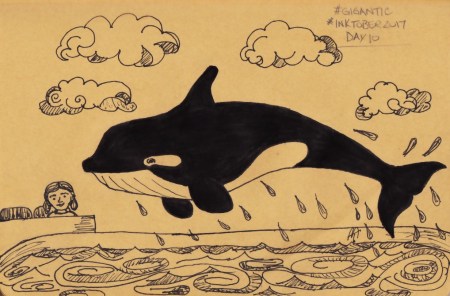
InkTober 2017: Day 10 – Gigantic

When I was a kid, a staple – and frequent – summertime activity for my family (immediate, extended, and adopted) was a daytrip to Niagara Falls. The adults would pack the cars with coolers of food and drinks, extra clothes for the kids in case of sudden weather changes or accidents, and eventually the kids – me included. We would drive the distance to the Falls in caravan-like formation after all family members converged on a specified meet up spot in the City. In the days before air-conditioning was a standard feature in most cars, the 60 to 90 minute drive, always felt like a sweltering eternity; even with all windows open and air rushing in as we sped along the highway.

Once we arrived at the Falls, the adults would scout out a grassy spot to lay out food and other supplies; and where all the kids could safely play. Once fed, we would go for a long walk to watch gallons of water rush over the steep cliffs of the Falls. Far below us, boats that looked like toys floating along the Niagara River took tourists as close to the bottom of the Falls as safely as possible; while the kids in our group counted the rainbows we could see in the water’s rising mist. After an hour or two, we would pile back into the cars to head to one of two nearby locations: a huge amusement park with loud colourful rides where the kids could run wild or Marineland to watch choreographed shows with trained marine animals: dolphins, sea lions, and whales.

I loved going to both of those places but my favourite was Marineland. Watching the gigantic whales perform the tricks their trainers taught them never bored. Unfortunately, when I was a kid, it never occurred to me that those beautiful creatures were suffering. They were, after all, there to entertain us during as many of those daytrips we took each summer. My brain wasn’t mature enough to understand that holding them captive in their tanks was abuse because, as small as I was, it looked to me that they had enough room to swim and move about freely. But those animals, mammals just like you and me, weren’t free to move where they wished: They were fished from the oceans, ripped from their families, and forced to work for food for years, even decades.

Wow! Where did those thoughts come from? I’ve never used words like these to describe the plight of animals held in marine enclosures before. I wasn’t even aware I felt this deeply about this issue. Had I felt like this when I was a child, my parents would have had tremendous difficulty getting me in the car those many times all those summers ago for those trips. Instead, I was excited and electrified at the possibility that one of those Killer Whales (Orcinus orca) at Marineland might get close enough to where I sat to splash me with enough water to soak me to the bone.

Looking back, I still treasure those summertime trips. However, as an adult, I’ve never visited Marineland and writing this post might have just shed some light on why. Still, in my own way, I’ve upheld the tradition of taking visitors to see the majesty of Niagara Falls, much like my parents used to. Whenever friends and family from other countries come to visit me, I always include a trip to the Falls and surrounding wineries in our plans because I think it’s a sight that shouldn’t be missed. Now I’m wondering if I should, one day, return to Marineland, not for the entertainment, but to see if the conditions we hold these beautiful animals in have improved or…

To be truthful, I have no desire to visit again. Furthermore, I don’t know what I’d do if it’s all still the same. What would you do?