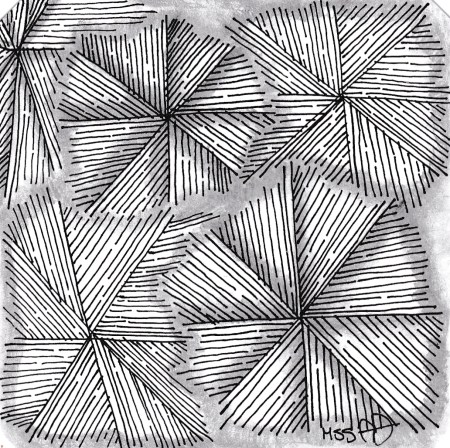
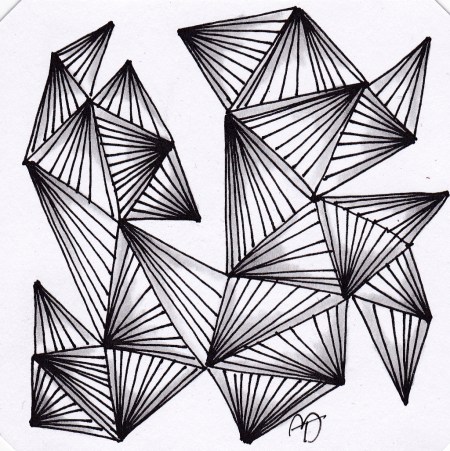
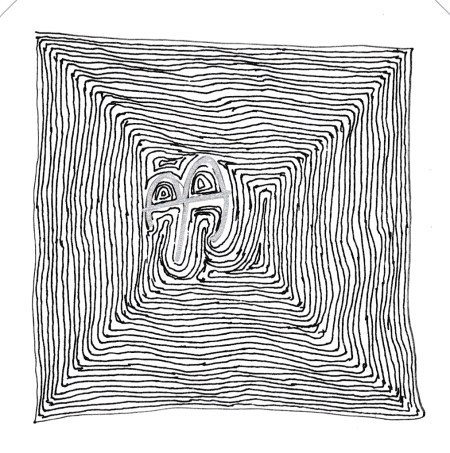
Zentangle: Tangle Patterns, Inspiration, and Deconstruction

This is not the original content I wrote to go with this post’s title. The first draft I wrote was a long rant in response to some very tense, unfriendly, and angry exchanges I keep encountering on some Zentangle-related websites and groups since I started using the meditative pattern drawing method. I decided not to post what I wrote because it doesn’t help anyone, least of all the people I see being dumped on, to write another angry post.

I started learning the Zentangle method because of the inherent meditative and mindful aspects of the process of drawing the various patterns. I’ve grown to enjoy getting lost in drawing lines and shapes. I spend a lot of time searching out more patterns online to expand my drawing skills and make the artwork I create in my art/gratitude journal more interesting. However, at times when I’m about to teach myself a new pattern I’ve found online, I notice negative exchanges written in some of the comments sections. It annoys me – actually, I get somewhat angry – because this thing, that is supposed to be enjoyable and relaxing, seems to be more about ownership and monetization than mindfulness.

I think some people forget that doodling has been around for a long time. Everyone does it. Although not everyone that doodles might take the time to name the patterns they draw. I know highlighting these points is going to make me unpopular to anyone who is devoted to the Zentangle method, but here’s the thing, slightly modifying something that already exists and giving it a new name doesn’t make it original or new. If that were the case, we would all be creative geniuses.
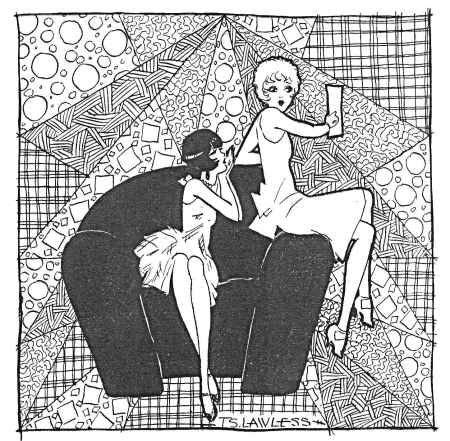
The Juggler - University of Notre Dame - May 1929

Cartoon from the commencement issue of The Juggler magazine of University of Notre Dame from May 1929


Furthermore, just because you’re inspired to deconstruct a complex pattern or image that was painstakingly created by an uncredited artisan in a woodwork carving, chiseled into a marble archway, painted on ceramic tiles, or stitched in fabric, that doesn’t make what you draw an original pattern. If you look around long enough you can usually find a pattern that existed for years, if not decades or centuries (in the case of ancient tribal and religious symbols) that looks like so-called “original” tangle patterns. At the end of the day, all art is derivative. Artists learn from imitating work produced by other artists, or trying to recreate things they see in the world around them, and they use it as a jumping off point to develop their personal style.


That being said, I have to stop letting myself get so bothered when I see some of the terrible things people write to each other in these spaces. As one Certified Zentangle Teacher (CZT) disappointingly stated in a comment I recently read online, for so many people Zentangle is “sadly just about making money”, which is bound to make some of those people more territorial and severe. For now, I will continue to use this drawing method as a creative meditative practice to divert focus away from my pain, but I think it wouldn’t hurt for some of the people getting bent out of shape about the use of patterns they “create” to remember that imitation is the purest form of flattery.


Arctic Monkeys – Brick By Brick
We Repeat What We Learn

Have you ever realized that the answer to a problem or confusing situation you were searching for was in front of you the whole time?

I had one of those epiphanies this afternoon after waking from a nap. For a long while, I’ve been trying to figure out the behaviour of one of my brothers. His actions in response to a situation in his life have left me scratching my head and wondering how it’s possible that he can be so cold and detached. I’ve been trying to understand how he can possibly be okay with the knowledge that another person might be suffering because of him. It hit me today that his behaviour was taught to him through the actions or lack of action taken by adults in our lives when we were children.

I’ve been telling myself that I don’t understand his behaviour because we had similar childhood experiences but I didn’t turn out the same as him. The problem with that statement is that I’m wrong. I did turn out the same. I learned the same behaviours he did. However, because I don’t act out against others, I’ve taken an almost self-righteous attitude about how he is living his life. Instead of hurting others, I choose to act out those same behaviours within some areas of my life, which is just as harmful. I choose to hurt myself – not physically but through certain privations – which doesn’t make my actions any less harmful. And it definitely doesn’t mean that I am better adjusted to life than my brother. The scale of my hypocrisy is enormous.

My brother may be an adult, but his actions are those of a small boy because emotionally – and quite possibly psychologically – he has not matured beyond the stage of a child hurt by so many people in his life. The only difference between us is that I can recognize, although not always, when I am triggered and reacting to a situation because of past traumas and I try to figure out how to break out of that space. My brother doesn’t know that he occupies these vastly different temporal spaces and because of this lack of awareness, he’s creating more pain for himself and others. Unfortunately, he has made it clear to me that he doesn’t want my help or that of anyone else who has offered. I only hope he figures some of this out before the hurt he causes becomes too deep to ever be repaired.


R.E.M. – Everybody Hurts


New Glasses And Improved Insight

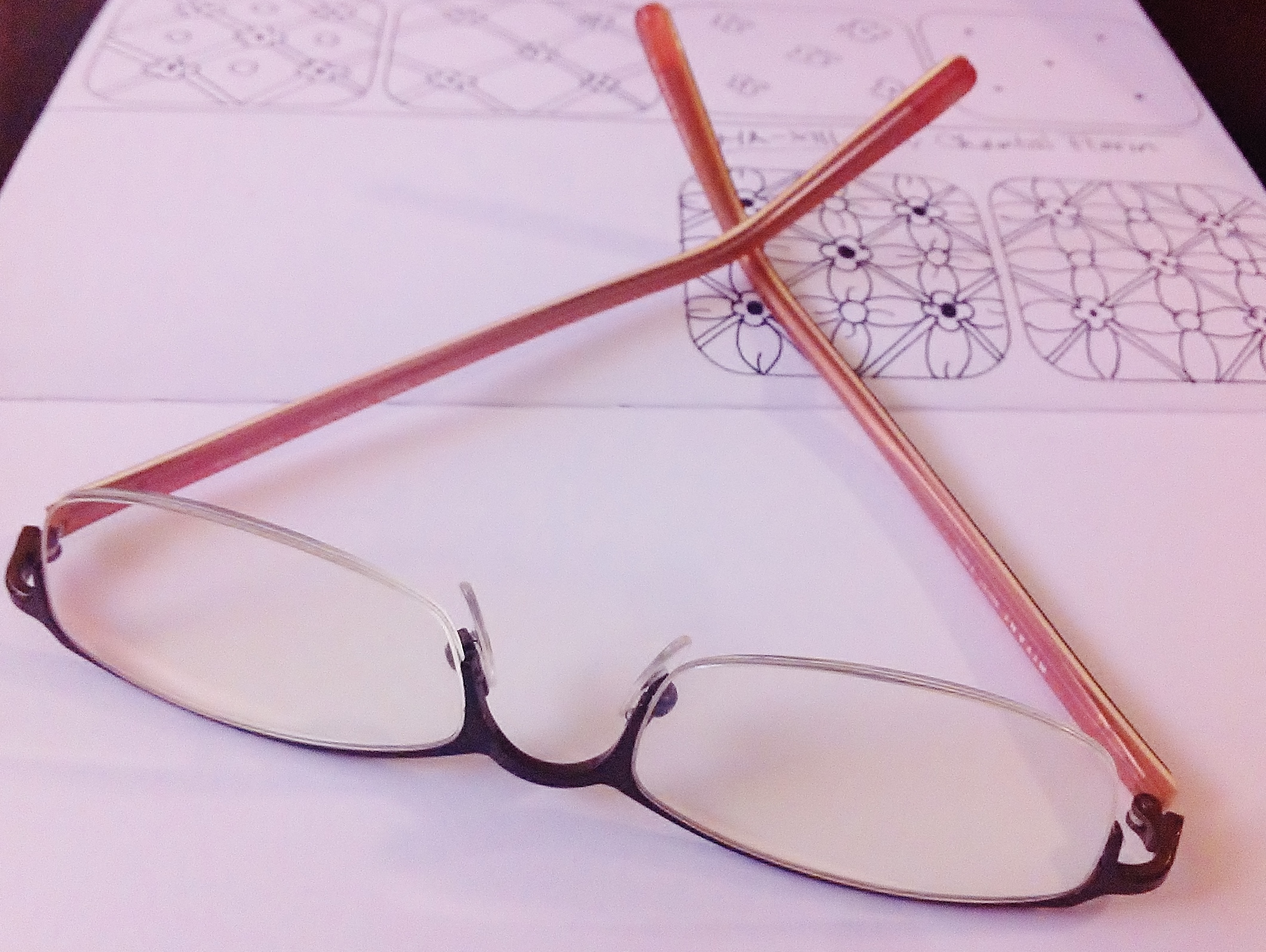
Literally seeing more clearly is a wonderful thing. I recently went to have my long overdue eye examination. I should have gone for my check-up around the time I became ill almost three years ago, but each time I scheduled an appointment I had to cancel it because my pain was too intense for me to push through it to travel to the appointment. I was forced to go now because the changes in my vision couldn’t be ignored any longer and my old glasses finally stopped helping me see things better. I started developing a pronounced vertical line between my eyebrows from squinting my eyes to see just about everything. It didn’t help that I had to hold things up close to my face for me to read or see details.

When I picked up my new glasses a few weeks ago, the improvement in my eyesight amazed me. Even in dim lighting, I can read small print from a significant distance away, which means it might be less difficult for me to get through reading a book now, instead of only reading articles online with a high level of zoom. Drawing and colouring aren’t as frustrating either because I’m having an easier time connecting lines with the fine points of the pens and pencils I’m using as I build my creative skills. I’m seeing details in things I had completely forgotten existed. Although, I’m not sure I need to see all my new grey hairs or every pore in my face. An added bonus is that the line between my eyebrows is fading because I no longer have to squint while holding things against the tip of my nose to figure out what’s in front of me.

New Glasses & Improved Insight

I also connected – however loosely – what I’ve decided to describe as a “metaphysical vision improvement” to getting new glasses because I’m seeing some things from my past more clearly. Having as much time on my hands, as I do these days, makes it difficult not to spend some of that time combing through past events and painful memories. Even though the moments are long gone and I know I can’t change them, it’s hard not to replay them. A few weeks ago, I spoke with a cousin about our past romantic entanglements and some of the lessons we’ve each learned from our respective relationships and breakups. After that conversation, I couldn’t stop thinking about one situation that years ago caused me a lot of unhappiness. I turned it over in my mind so many times that if it had been a living, breathing thing it would have developed a severe case of motion sickness.

I was fortunate enough to be able to reach out to someone who, after all these years, was able to give some helpful insight. What she told me confirmed that as much as I was hurt by what happened, it was the best thing for me. In that past relationship, I didn’t have the freedom to express my true self and I was forced to lie to people who love me to hold on to someone who could never fulfill my needs and made me doubt myself and feel insecure. The conversation we had helped me to let go of any lingering doubts and reminded me how easy it is to allow emotions and thoughts to suck us into a downward spiral where it’s almost impossible for us to see the truth sitting right in front of our noses.

Freeing up that emotional/psychological space and energy made room for something more enjoyable. The one thing that has been constant during the ups and downs of relationships and illness in my life is poetry, and each poem I write shows me truth I’m not always aware I know.


The Frame