The Toll of Opioid Pain Medications

Reading this article a few days ago, gave me pause: Opioid death toll in Canada nearly 4,000 last year, new data show.

I’ve been taking opioid-based (narcotic) pain medications since the first day of the hospitalization for my illness, almost five years ago. After my admission to the hospital emergency room, the first thing the ER doctor recommended to give me for my pain was Oxycodone. My pain was so intense that I could barely talk, but I refused it because I knew taking it would cause me to become incoherent and prevent me from clearly explaining what I was experiencing. The doctor tried to convince me to take it by telling me that I needed it to control the pain so she could examine me.

I knew I couldn’t tolerate even the gentlest touch without some kind of medication to dull the pain. However, I also knew the risks associated with this particular pain medication, which at that time, was already identified as a major culprit at the heart of the opioid epidemic. So taking it, even one time, was not something I wanted to do. The doctor deferred to my concerns and instead gave me a non-opioid medication by injection that kept my mind clear so I could have a lucid conversation about my medical history and current symptoms with her. It also gave me a chance to ask questions about my initial diagnosis and what actions she intended to take to confirm it.

After all the test results came back with a preliminary (and very wrongly assessed) diagnosis, the doctor again recommended that I take the Oxycodone. By that time, I was so exhausted and still feeling such incredible pain that I relented and agreed to take it. I asked her to prescribe the lowest possible dose that would still deliver some pain relief and she ordered it. Unfortunately, even though I was taking it at that low dose, it fogged my mind. It took a great effort to concentrate enough to talk, sit up in bed, or move in general. Everything felt like it was happening around me, in slow motion, and I felt a near total loss of control.

In the following days – in a semi-private room on the surgical ward of the hospital – the doctors continued to prescribe the same low dose of Oxycodone for me. After the third day, I had to demand that they stop giving it to me because of how unable I was to make sense of things unless everyone spoke very slowly and, more importantly, I started hallucinating. The hallucinations were so frightening that during one of them – despite the terrible pain – I got out of bed to search for someone who turned out to be a figment of my drug-distorted imagination. Thankfully, the doctor on-call listened to me and prescribed another opioid-based pain medication I was better able to tolerate; and Oxycodone is now listed on my medical records as a medication that I can NEVER take.

I know that it’s been reported that many of these opioid-related deaths are because of “recreational use” of certain opioids or after a patient has developed an addiction. Still, with the high doses of prescribed pain medications I take now, I’m at risk of developing an addiction or, heaven forbid, accidentally overdosing. Because of these risks, I’m very careful about taking my pain medications exactly as prescribed. I also make sure I pay close attention to any changes in the way my body reacts to these pain medications or whether any of the known, critical side effects suddenly appear: severe dizziness and/or fainting, trouble breathing, unusual drowsiness and/or difficulty waking up, and/or seizures.

Beyond these very real and frightening concerns, I must also think about the longer-term physiological effects of taking opioid-based pain medications. I’ve been taking them in one form or another since this all started, therefore, my liver and kidneys work, and have worked, overtime for nearly five years to process these drugs throughout my body. Because of this, my liver and kidneys get tested regularly to make sure they continue to work within normal levels and won’t add more complications to my already poor health.

There’s also the possibility that the longer I take these opioid-based pain medications that they could, one day, stop working without any warning. Worse still, I could develop a condition where instead of the medications managing my pain they cause me to feel more pain. This is because “taking opioids over a long period of time may in fact increase a patient’s sensitivity to pain (hyperalgesia). This happens because long-term use of opiate painkillers causes a decrease in your ability to tolerate pain and an increase in sensitivity to pain. In fact, people taking opioids long term may keep having pain, or may see their pain increase, long after the original cause of pain has healed.”

These are some of the thoughts and fears I live with every day. With every dose of the opioid-based pain medications, I take to cope with my pain. However, I recognize that although this is my reality, I feel blessed to be alive to have these thoughts and fears.

My heart breaks for anyone who has lost their life to this health crisis and those who have been left to mourn them.
 

The Pill Box

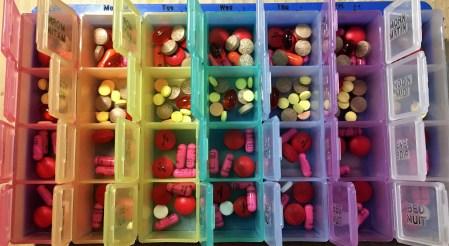
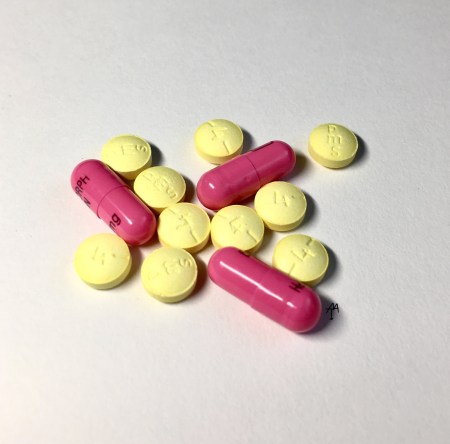
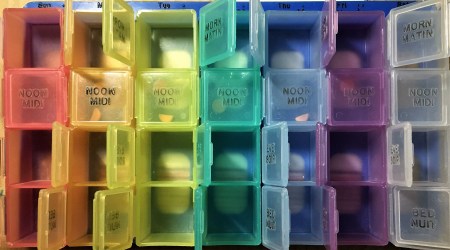
Every week, either late Saturday night or at early light Sunday morning, I go through the ritual of filling my pillbox with my medications. My pillbox has 28 compartments. Each gets filled with a varying number of medications in the form of pills or capsules. On average, I take a combination of about 32 pills and capsules each day. However, the 32 pills and capsules don’t account for all the medications I take daily because I have others that come in different forms i.e. liquids, inhalers, and – on the odd occasion when my gastrointestinal system protests against ingesting certain types of oral pharmaceuticals – suppositories. Early on in my illness, I was even prescribed a topical anesthetic for pain that came in patch-form, but it did little to reach the source of the pain deep in my pelvis.

The largest part of the pills and capsules that fill each pillbox compartment are medications I take to manage my pain. They aren’t all opioids/narcotics, but the majority of what’s in the compartments usually is. Unfortunately, not all these medications always do what they are prescribed to do. Therefore, over the last four years there have been many changes made to my medications. Changes in doses are usually an increase in strengths – as petite as I am I seem to need large doses to manage my pain –, but I’ve learned that dose increases doesn’t have to mean an increase in quantity. Some medications have also been swapped for others of equal strength when they have caused unexpected side effects or delivered no benefit at all after weeks and in some cases, months of hoping for some relief with them; and occasionally new medications get added to the mix in an effort to boost the benefits of what works.

The Pill Box – 1

The Pill Box – 2

Sometimes, the number of pills and capsules I take might fluctuate from day-to-day. That fluctuation depends on whether my doctor(s) writes prescriptions for medications with a minimum and maximum dose. Because my pain medications are largely opioids/narcotics, I try – not always successfully – to take the lower end of a prescribed dose when possible to manage my pain. My Pain Specialist prescribes my primary pain medication in two forms. The first is a long-acting opioid/narcotic prescribed to be taken multiple times each day that is intended to manage my pain for a scheduled period. The second is a breakthrough or ‘rescue’ dose of that same opioid/narcotic that I take in between the long-acting doses; especially in times when my pain levels are high, which is most of the time. I try to take that breakthrough medication on the lower end of the prescribed dose(s), when I’m having a good day, which is rare; or if I’m lucky enough to sleep through the night the overnight breakthrough dose gets skipped.

The main point of having a pillbox is to make sure I don’t miss scheduled medication doses because I take so many throughout the day. Unbelievably, I’m not always successful and might miss a dose of something from time to time, whether it’s because I get distracted or I’m fortunate enough to get some restful sleep. Nonetheless, the brightly coloured compartments of the pillbox that I fill with brightly coloured pills and capsules is my constant companion and may remain so as long as I need a reminder to take 32 pills and capsules – give or take a few – each day.

If you don’t have a pillbox, how do you remember to take your daily doses of multiple medications?


Sleep: The Unconscious Way to Cope With Pain

Have you ever had such intense pain, physical, or other, that all you could do to cope with it is sleep?

I’ve slept for the better part of the last 2 days. I had to attend a family event on Sunday afternoon. When I say “had to” I don’t mean forced to, I mean I would have felt horrible – worse than the pain I’ve had since – if I hadn’t attended because it was in honour of one of my favourite aunts who does whatever she can for everyone. However, between the drive to the home of my uncle who hosted, moving around to interact with all the family members and family friends; and then the drive home, my body had to go into near shutdown so I could cope with the resulting pain flare up.

By the time I arrived home around 11:00 PM on Sunday night, I knew I was in for a rough few days; not to mention my experience dictates that it takes at the very least two days for me to recover after going out to do anything. Upon arriving at my uncle’s house in the afternoon, my pain level was already climbing; and on the drive home, the soreness in my legs had already become unbearably intense. When my feet touched the ground as I got out of the car, it was definite that I would not escape the punishment for daring to enjoy life just a little bit while celebrating the life of someone I love. After shutting the door to my home behind me, I made a beeline for my bedroom to change into cozy pajamas then I went into the bathroom to perform the nightly rituals of brushing my teeth and putting my hair up so I don’t wake up with an equally painful tangled mess of hair to deal with.

I was in bed by midnight. It took some time to fall asleep because I was so uncomfortable with the pain building throughout my body. I vaguely remember waking a few times during the night, but I know I was too exhausted to awaken fully to take my overnight breakthrough dose of pain medications. I even slept late and missed taking my first large dose of pain medications on time at 6:00 AM. However, being late this one morning didn’t matter much because being asleep kept me unaware of the pain. The rest of Monday was spent in a groggy haze of pain medications and sleep, but I didn’t miss much because it poured rain most of the day and the grey sky outside was not at all appealing.

I woke up around 4:00 PM because my phone rang. It was my therapist calling me. I called him on Saturday shortly after coming out of my panic attack so he was responding to my message. I knew he wasn’t in the office during the weekend, but I felt that I had to talk to him as soon as it was possible to sort through why the panic attack might have happened. As usual, he helped me sort through the still lingering feelings and to realize how everything I’m coping with – including the current pain flare up – and all that I’ve lived through in my life are so deeply connected, it makes a panic attack a reasonable thing for me – or anyone dealing with so much – to experience. He also gave me some practical tips on how to cope if I have another episode: splash my face with cold water, put cold water/a wet cloth on the back of my neck, breathe into a paper bag, lay on the floor so I feel grounded, and connect visually with objects around me so I can know what’s real. I was grateful for that conversation and the clarity it brought.

I stayed awake for a few hours after that conversation. My friend R called for one of our weekly chats. Then I tried to make sense of the horrible news of the day and deciding what my stomach could tolerate so I could make a meal. I failed at both and fell back to sleep on my couch. I managed to wake up a few hours later to take my last large dose of pain medications and I might have stayed awake for about an hour or two. The next thing I became aware of was that for a second morning in a row my body opted to sleep as late as it could handle before waking to take my morning dose of pain and other medications. After doing that, I still had the need for two morning naps.

I also realize, sometimes I have to accept that it’s not always conscious methods that are best for coping with my pain.


The Beatles – Golden Slumbers/Carry That Weight/The End