The recent weeks of the ‘appropriation prize’ bullsh!t has and probably will stick with me for a long time to come. It’s saddening and hugely disappointing when you learn that people at the top of their field(s) who are widely respected don’t deserve to have anyone looking up to them. For people who are so influential (all of them white) to so casually out themselves as entitled, insensitive, racist pricks on social media, makes the world and this country feel like there have been few societal gains made by Aboriginal people, people of colour and other marginalized people, toward justice or equality.
I’ve lived my whole life knowing that people are treated different because of what they look like, where they come from and what they don’t have. But to bear witness to the unfolding of this event and its aftermath – an aftermath which may just be the beginning for some – has been painful. I wrote two posts about this issue, mainly the facts, without truly injecting myself into them and I feel like that wasn’t enough – or right. It wasn’t enough because I didn’t make it clear that the Aboriginal writers featured in the spring edition of the writers’ magazine were not alone in their hurt; and it wasn’t right because in cyberspace we can choose to be anonymous without revealing which side of an issue we choose to land on.
I am not Aboriginal, but as a person of colour, whose ancestors also had their lands, their bodies and minds colonized, I identified with the pain and anger Aboriginal writers and their communities felt. As someone who writes – although because of illness I do it now primarily for myself – the idea that anyone would find it acceptable, even in jest, to tell others to write about who or what they couldn’t possibly know beyond gross generalizations and dehumanizing stereotypes is maddening. For members of that elite, gate-keeping clique to become indignant and lash out at the ones hurt is irrational and sickening. It pains further that they tried to hide their racism behind supposed efforts to protect free speech – which I pointed out before, on this occasion of overt racism, became the beneficiary of protections when it was least threatened – from Aboriginal writers and their communities speaking out against the harm being perpetuated by the denial of the existence of appropriation.
As one who has been wounded, I know that to be always alert and ready to respond to an incident like this as an individual and/or a representative for your race/ethnicity/community is demanding. To have to restrain one’s self in the face of conflict to avoid perpetually being labelled angry or ignorant of the bigger picture is exhausting. To be repeatedly harmed and then told by the perpetrator no harm was done to you is abusive. To have the things that concern your life flippantly mocked and dismissed as ‘identity politics’ is a form of erasure conveniently applied when those with racial privilege and power have no interest in examining their wrongs, or seeing all of what makes you human.
Moreover, when people throw around the term ‘identity politics’ they seem to forget that in each person’s life it’s not realistic to separate politics from who you are because the personal is political, which simply relates to consciousness-raising, awareness of where you come from, and what makes you who you are in any moment. So instead of attempting to stir controversy with such a ridiculously inflammatory positioning of these words, they might actually think about doing something beneficial with the privilege, influence, and power they continue to stockpile. Perhaps, these privileged few could learn the true unpolished history of this country, which will show how impossible it is for any of them, or other white individuals, to write what they don’t know. It might also clarify, how inherently difficult it is for the Aboriginal writers they belittle, and other writers of colour, to produce beautiful work about what they know when our worlds are overrun by systemic violence, oppression, physical and emotional trauma, lost lives, wounded families, and sometimes fragile love(s).
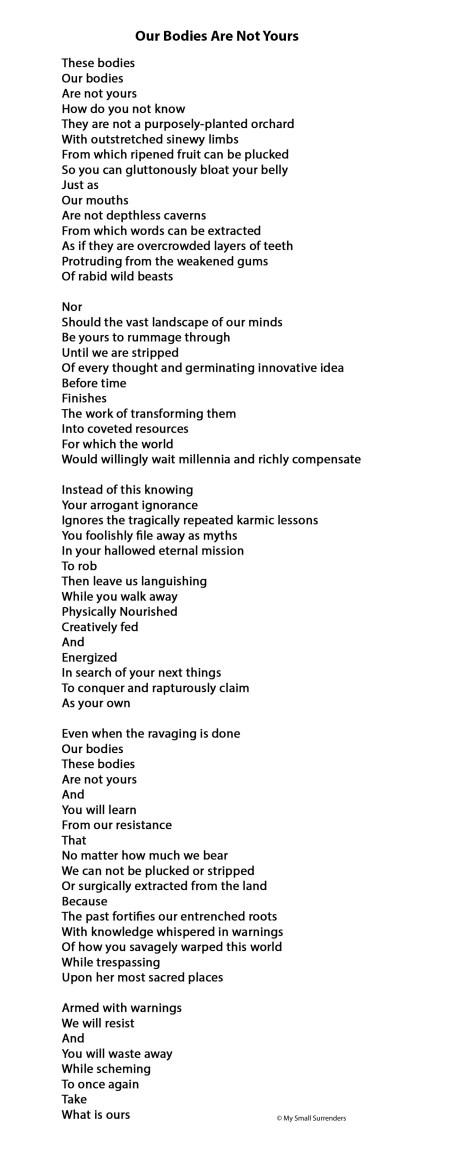
I’ll give them a place to start. After spending a few days in reflection, I turned to writing this post to purge the bullsh!t from recent weeks and only started feeling mildly better when poetry appeared. In all likelihood, were I to send any of this writing to any of the involved publishers, editors, or journalists, they would probably reject it without consideration because of the subject. Ironically, that knowing might be what prompted the editor to write that offending editorial; why in his words, the face of literature in this country is so white and middle-class…

 My Small Surrenders