The Appropriation Prize Through a Pain Clouded Lens

It’s hard being me right now. That’s not me feeling sorry for myself. I’m referring to living with a chronic illness that causes me constant pain. It makes it difficult for me to keep up with the social justice issues I once passionately followed and supported in my daily life; and it is harder still because I constantly doubt myself because pain affects my concentration, as do the pain medications I take to manage it.

It’s especially tough when I engage with people who may hold a privileged place in society because of their race, gender, sex, class and/or profession. If they say or do something that resonates negatively to my core, I question whether I heard or understood the words or actions correctly because my mind is sometimes so clouded by all the medications I take to manage my pain; and I question how or if I should respond.

I’m not American. However, since the arrival of the Trump Era and the relaxing of the niceties of political correctness – which served for so long as the thinnest shield between people of colour, LGBTQ communities, immigrants, the differently abled, and women, and the bombardment of overt racism, homophobia, sexism, and xenophobia; I’ve witnessed a shift. Even in my personal relationships. People now say what they think and feel without fearing repercussions.

Yesterday, I didn’t have to doubt, not even for a second, that members of the upper echelons within Canadian media have discarded all pretense that it matters if people know what they truly feel about marginalized and racialized people. In fact, a career journalist for the Toronto Star, went as far as pointing out in her Friday column that she loathes identity politics and racialized is “(an invented word)”, while applying her 20th century views to the state of modern-day journalism in reference to a black freelance writer’s activism.

My head wasn’t clouded at all yesterday. I had no doubt, when first I read an article in The Globe and Mail about the poorly received editorial in which the now former-editor of a writers’ magazine stated he did not believe in cultural appropriation and that there should be an ‘appropriation prize’. I had no doubt when I read the full editorial in the opening pages of the Spring edition of the writers’ magazine dedicated to Aboriginal writers, where the former-editor’s beliefs overshadowed content from the very writers whose stories are so often silenced.
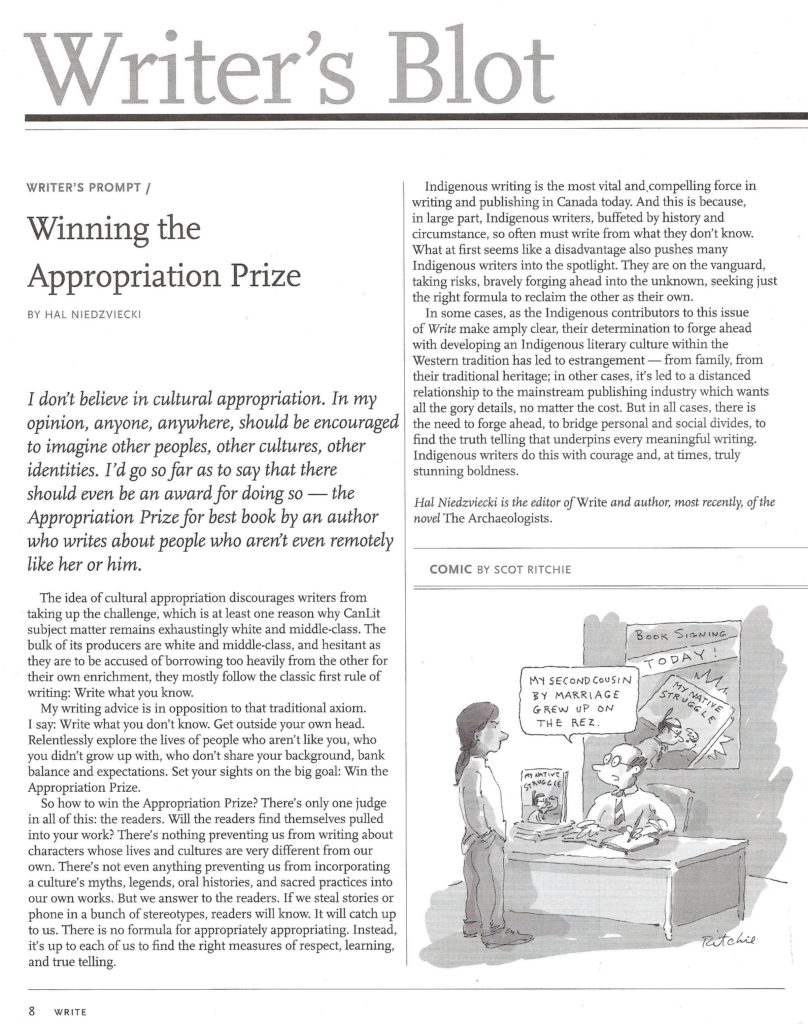
 

Write Magazine Spring 2017 – Hal Niedzviecki’s – Winning the Appropriation Prize


I still had no doubt when I later saw a list of white publishers, editors, and journalists facetiously jump forward to raise money to start a fictional ‘appropriation prize’ for the writer (assumedly a white one) who could best and most believably write about people, cultures, and races they know nothing about. That late night fundraising effort on Twitter was allegedly in response to protecting free speech – the beneficiary of protections in cases of overt racism always tend to be the thing that is least threatened. In the wake of fallout from the editorial written in the writers’ magazine, the editor resigned. This group of media power brokers voiced their outrage that a member of their clique was punished for something they too view as non-existent. They mocked the suggestion that the editorial harmed anyone. Harm which because of their privileged perches they could never see.
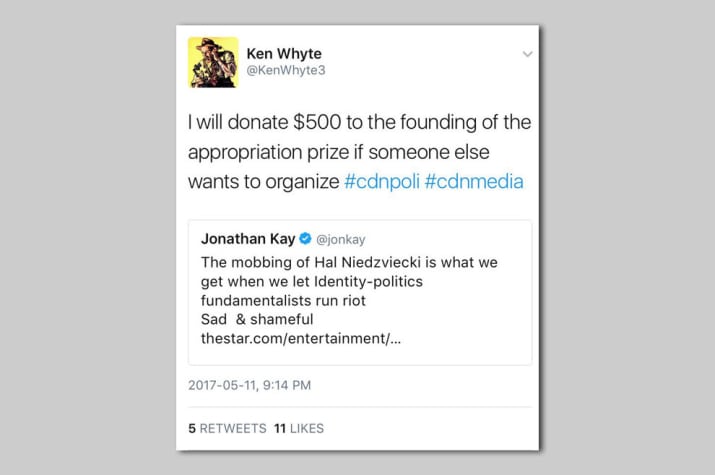
 

On Glibness And Diversity In Canadian Media – Buzzfeed – May 12 2017


Appropriation Fund – Contributors – Credit to Jake Mooney on Twitter – May 12 2017


I’ve chosen not to write the names of the people involved in this outrageous game of “this is who I really am” because I once held some of them in high esteem. I did, however, include the original offending editorial (above) and links throughout the post to informative articles I read yesterday, as well as additional links to more articles below.

As a Canadian, I’ve been hoping for the better part of a year that what is happening south of the border wouldn’t take hold here. The thing I forgot is that even when you think you have no weeds in a garden, it’s impossible to see what’s rooted below the surface of the dirt.


Editor quits amid outrage after call for ‘Appropriation Prize’ in writers’ magazine – The Star

Cultural appropriation prize fund was the unkindest cut of all: Paradkar – The Star

High-profile Canadian journalists pledge to raise money for ‘appropriation prize’ – The Star

Indigenous literature’s fearless aunties respond on cultural appropriation – Ricochet

André Alexis: The complex issues within cultural appropriation and art – The Globe and Mail

Christie Blatchford: Magazine editor the latest to be silenced for the sin of free speech – National Post

Editor Resigns Over an Article Defending ‘Cultural Appropriation’ – New York Times

In the end, cultural appropriation is about the cash: Walkom – The Star


Surgical Scar Struggles

I started writing this post in early September of last fall, after taking a long look at the 11-centimeter (just over four inches) surgical scar that starts at the bottom of my belly button and makes its way down my lower abdomen on to my pelvis. When I started writing it, I was feeling optimistic because it was starting to shrink and fade, but my mood shifted as I started to think about it being a lifelong reminder of what I continue to live through. I forgot that I had started writing it until recently when I read a post on Nursing Notions site titled ‘Not Yet Defeated’ about her experience with surgery and healing.

As I wrote last September, it hit me that my scar is more than a thick, raised, itchy, line in my skin that will never completely disappear. It is a constant reminder of so much. This vertical line is evidence of the most significant attempt to resolve the suspected cause of my chronic abdominal pain and the pain that grew from it and now radiates down my legs, out into my hips, and up my back. It is a reminder that a surgical team led by one of the most skilled surgeons in my city sliced through layers of my skin, fat and muscle that protected my abdominal organs to explore the space cradled by my pelvic bones to find the growth that shouldn’t have been there and remove it. My fading surgical scar will always remind me that although the surgery wasn’t as invasive as expected and the growth was cut out, it failed to get rid of my pain.

That may be the worst thing about having to look at my scar each time I undress or every time I touch it to scratch the itch: I remember the failure. The itch tells me the scar is healing, still shrinking, while my pain remains the same. Eighteen months after my surgery, regardless of how liberally I massage rich moisturizers into my skin, the itch won’t go away. Before the creation of my scar, I had already been through so much. Now, while it sits so prominently on my lower abdomen, I continue to live with the pain and more failed treatments. I thought that was more than enough. That was until I started planning a trip where I’ll have a chance to submerge my body in saltwater then allow myself to float to the surface towards warm rays of sunshine. Then, for a moment, I felt something unexpected…

Apart from my doctors, some family members, and a few close friends, I’ve taken comfort in not having to show my scar to anyone. The thought of having anyone stare at my scar is unsettling, and I’m not ready to have it become a conversation piece. When I pulled out my swimsuit bottoms recently I unexpectedly felt overwhelmed with self-consciousness. I’m no exhibitionist but I’ve always worn fairly conservative two-piece swimsuits because a one piece/maillot reminds me of high school gym classes. This means that to enjoy the water the way I’m looking forward to I need new swimwear because everything I own puts my once scar-free abdomen on display.

After anxiously searching online for hours, I finally found bottoms that cover my abdomen all the way up to my belly button completely hiding my scar. I know that in the grand scheme of all I’m living with this probably sounds vain and superficial, and it shouldn’t be a big deal. However, it’s a big deal to me because it’s another thing, more change, for me to adjust to. My life changed the day my pain started, it changed after each inconclusive test and invasive procedure to get to a diagnosis, it changed again with the first slice of the scalpel into my flesh and each stitch to close me up, and it continues to change with each failed treatment and every handful of pain medications I swallow daily.

My scar will always be with me as a symbol of what I have to live with because of my illness. My frustration is not knowing when or how deeply, coming into awareness of more changes will affect me in the future. However, I must believe I can find ways to live with it all: this time it’s in the form of spandex and nylon swimsuit bottoms. And I’ll do whatever I can to adjust to the next change when it arrives.

New Swimsuit Bottoms

Adrift

Sometimes I feel as if I’m floating through my life without any control or a meaningful destination or goal. I haven’t always felt this way, of course, but because I am housebound most days and time passes in the blink of an eye and I can’t point to what I’ve accomplished in recent months – years actually – it’s hard not to feel adrift. It’s difficult not to feel rudderless and without direction, as I pass from one painful hour to the next. Even when I do things to feel busy, to occupy all the passing hours, it’s hard not to compare this current life to the life I knew before; and, I wonder when I’ll stop the comparison and just accept things as they are and just be.

I know from experience floating in blue-green waters of oceans and seas, that there is nothing wrong with spending time, days even, letting my body float and drift. However, those days were numbered, planned, and chosen specifically for me to do nothing else. Those were days that I earned and payed for with hours upon hours of work. They were handfuls of isolated days within a year or more. When I could leave behind the demands on my time as I disconnected from the world and plunged into the peaceful sound of warm waves kissing beaches of powdery sand or sometimes pebbly shores of stones worn smooth by the never-ceasing waves.

It feels different, doing nothing now. As if, I have not earned this time. This time my body didn’t plan or ask for. This time that blurs one day into the next. Now, as I float over different waves, waves that are not peaceful, warm, or calm. Waves that batter my body, instead of keeping me buoyed under cloudless bright skies. I feel as though I need to do something every day to earn this time; and each day that passes without me producing or completing something makes me feel indebted to some thing in the universe that I can’t see, but I can feel hovering over me. A thing waiting for payment as my pain-filled body is carried farther adrift.

I know these feelings aren’t truthful. I know these thoughts surface because I still haven’t, after all this time, fully come to terms with the reality that doing nothing most days is okay because it’s all I can do. I know that if a friend or family member was living through this illness and having these thoughts and feelings, I would tell them they were being too hard on themselves. Yet, when the challenge is our own, it’s hard to show ourselves the same compassion we would extend to another. It’s easy to know the truth but it’s harder to accept it and live accordingly.

It amazes me how difficult it is to feel comfortable doing nothing, especially when we know it’s the best thing for our bodies. I don’t know when I will accept it. When I will truly believe there is nothing wrong with doing nothing because my body needs rest or it is racked with too much pain. However, in the meantime, I feel that imagining the sensation of my body floating on waves, free and weightless, may not be a bad image to hold on to when I think of myself adrift and without direction.

Adrift - Sand Swirl - November 2016