The Pill Box

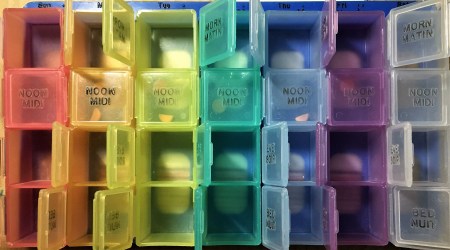
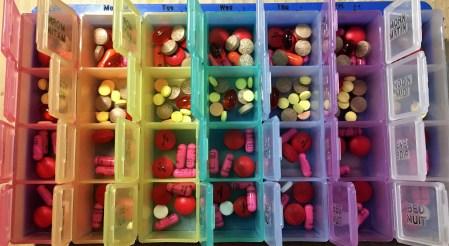
Every week, either late Saturday night or at early light Sunday morning, I go through the ritual of filling my pillbox with my medications. My pillbox has 28 compartments. Each gets filled with a varying number of medications in the form of pills or capsules. On average, I take a combination of about 32 pills and capsules each day. However, the 32 pills and capsules don’t account for all the medications I take daily because I have others that come in different forms i.e. liquids, inhalers, and – on the odd occasion when my gastrointestinal system protests against ingesting certain types of oral pharmaceuticals – suppositories. Early on in my illness, I was even prescribed a topical anesthetic for pain that came in patch-form, but it did little to reach the source of the pain deep in my pelvis.

The largest part of the pills and capsules that fill each pillbox compartment are medications I take to manage my pain. They aren’t all opioids/narcotics, but the majority of what’s in the compartments usually is. Unfortunately, not all these medications always do what they are prescribed to do. Therefore, over the last four years there have been many changes made to my medications. Changes in doses are usually an increase in strengths – as petite as I am I seem to need large doses to manage my pain –, but I’ve learned that dose increases doesn’t have to mean an increase in quantity. Some medications have also been swapped for others of equal strength when they have caused unexpected side effects or delivered no benefit at all after weeks and in some cases, months of hoping for some relief with them; and occasionally new medications get added to the mix in an effort to boost the benefits of what works.
The Pill Box – 1
The Pill Box – 2

Sometimes, the number of pills and capsules I take might fluctuate from day-to-day. That fluctuation depends on whether my doctor(s) writes prescriptions for medications with a minimum and maximum dose. Because my pain medications are largely opioids/narcotics, I try – not always successfully – to take the lower end of a prescribed dose when possible to manage my pain. My Pain Specialist prescribes my primary pain medication in two forms. The first is a long-acting opioid/narcotic prescribed to be taken multiple times each day that is intended to manage my pain for a scheduled period. The second is a breakthrough or ‘rescue’ dose of that same opioid/narcotic that I take in between the long-acting doses; especially in times when my pain levels are high, which is most of the time. I try to take that breakthrough medication on the lower end of the prescribed dose(s), when I’m having a good day, which is rare; or if I’m lucky enough to sleep through the night the overnight breakthrough dose gets skipped.

The main point of having a pillbox is to make sure I don’t miss scheduled medication doses because I take so many throughout the day. Unbelievably, I’m not always successful and might miss a dose of something from time to time, whether it’s because I get distracted or I’m fortunate enough to get some restful sleep. Nonetheless, the brightly coloured compartments of the pillbox that I fill with brightly coloured pills and capsules is my constant companion and may remain so as long as I need a reminder to take 32 pills and capsules – give or take a few – each day.

If you don’t have a pillbox, how do you remember to take your daily doses of multiple medications?

 

Horrible Boss Flashback

It never goes away, does it? The involuntary visceral constriction when someone reminds you of a terrible episode in your life. Did the person with whom you imagined yourself building a life break your heart or did you break theirs? Did someone you loved dearly suddenly permanently pass from your life? Did a trusted friend unforgivably betray you? Did you have employers who inappropriately inserted themselves into your personal life? I’ve experienced these situations, and more, that have sometimes made life more difficult than one wishes it to be. However, the incident of which I was recently reminded was the inappropriate treading into my life, which my last employer felt they had the right to do.

I ran into someone recently, whom I had the pleasure of working with on a project for a short time, not long before I became ill almost four years ago. Lucky for her, she did not have to bear the same degree of pain, humiliation, and strife I did to cut ties with our former horrible boss. Hearing the name of the company where we used to work made me cringe. Since the end the legal action I had to take against the company, I’ve done all I can to limit contact with anyone who worked there so I can maintain my peace of mind. Especially those former colleagues who blindly supported my former horrible boss without knowing the truth about what I was subjected to.

My former horrible boss tried to deny me access to my disability benefits when it became clear that I couldn’t return to work after my hospitalization at the onset of my illness. She demanded answers to embarrassingly inappropriate questions about my health. She later terminated the part of my extended health benefits that paid for the many expensive medications I take to function daily; and even worse, she terminated my employment without notifying me about a year into my illness in an attempt to strip me of my long-term disability benefits. On top of all that, she launched a campaign of misinformation within the company to explain my sudden then extended absence. The stress of trying to cope with all of this and my poor health and constant pain was, at times, too much to bear.

The person I ran into knew the crux of the situation because she had heard details from a mutual friend. She expressed her sympathies that someone, anyone, could have done any of what our former horrible boss did to me; especially because the early period of my illness was when my doctors had no conclusive answers about what was happening to my body and I was truly fearful for my life. Instead of being able to direct my focus on my health alone, I was forced to cope with the added stress of an employer who felt they could insert themselves into the most intimate parts of my life. When I refused to share what was happening to me, in part because I truly didn’t know, but mainly because it’s against the law for an employer to ask. It set in motion the series of events I listed above – and much more I try never to think of – that I still sometimes can’t believe. The right to protect my health and personal information caused a protracted legal case that thankfully vindicated me and ended my former horrible boss’s persistently violent prying into my life.

Even though all of that happened, the best thing about this flashback, about any flashback, is that it’s no longer part of one’s current reality. It may be difficult to be transported back to a particular moment when something devastating happened, however, that living moment is gone. Better still, I know I have the protection of the law and the emotional and psychological tools to bolster me if ever the smallest thoughts of that situation resurface in my life, and if any do, I don’t have to stay with them or delve beyond the surface of those memories unless I choose to do so. In this case, where anything involving my former horrible boss is concerned, I choose not to delve deeper than necessary to describe how she attempted to intimidate and deprive me of what I needed to care for myself. I choose not to allow who she was, and probably still is, affect me beyond a momentary tremor in my subconscious because I survived and beat her attempts to harm me during a time when I had to dig deep just to keep living.


The Difficulty Of Being Loved

FACT: When we are loved, it’s not always easy to accept it and take in the full meaning of it.

The difficulty of it lies in trusting the realness of receiving something immeasurable without any expectation of having to give a single thing in return. It’s especially difficult when we have lived lives where we survived abuses and/or significant traumas where love and tenderness were withheld to increase suffering. How can a person trust a reality where things are given without a price or obligation attached, when one’s whole existence screams that it isn’t possible to have that, to be worthy of that, or deserving of another human being who regards your being with tenderness and care?

I’m a witness to this struggle now. I’m seeing this unfold in the life of one of my friends and the mental health toll is enormous. My friend’s partner is in the midst of a major health battle and seems incapable of accepting, or acknowledging, how deeply they are loved and cared for by so many people. This person could be told every hour on the hour that they are loved and they still might never believe it. The exhaustive effort invested in repeated attempts to show love in tangible ways with the gifting of things, through deliberate actions, physical emotional comforts, and just being there are all dismissed as insufficient or outright meaningless; which makes the giver, in return, feel unloved.

Being on the receiving end of this dismissal may be a deeper pain than never being loved. Watching someone I love live through something like this makes me feel helpless. There isn’t enough I can do or say to make this situation better. I can be supportive. I can tell my friend kind words or make suggestions about how to cope. However, I know my actions and words only salve the pain during the moments when we interact. When those moments end, my friend is the one who returns to living this difficult reality. A reality that – if I’m reading things correctly – is not going to end well, no matter how much I hope for an alternate result.

As this situation unfolds, it’s getting harder for me to understand why people make living the lives we have so much harder than they must be. Why do we treat each other so harshly? And why, when we are most in need of it, do we reject the kindness and love of those closest to us?


Bonnie Raitt – I Can’t Make You Love Me