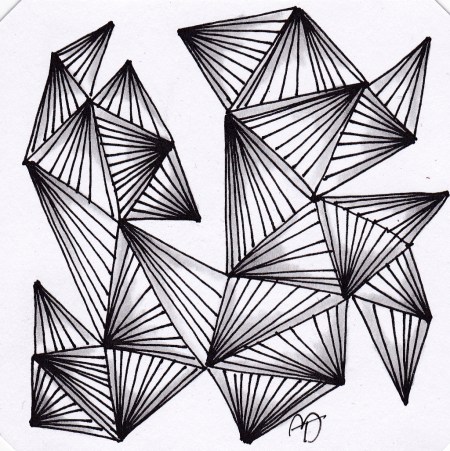
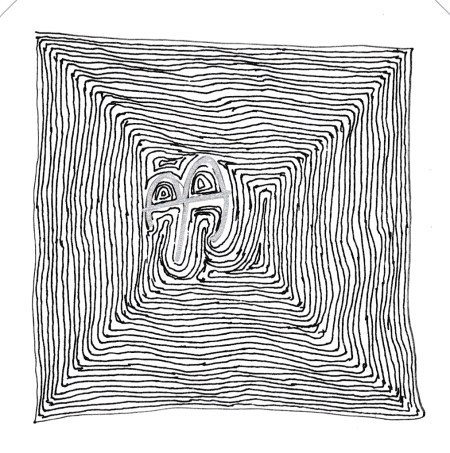
Gratitude and Creativity: Meditative Line Drawing

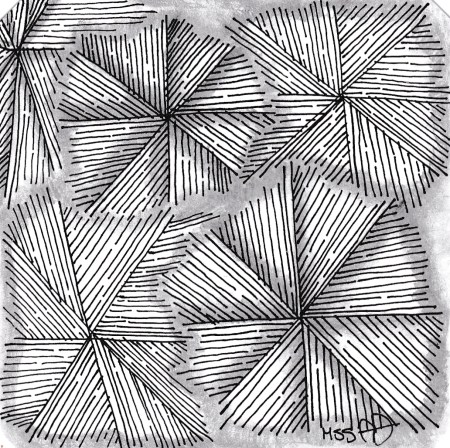
It’s not a heart, but in the spirit of the day it is red. ❤️

If you’re feeling lonely today or healing a broken heart, maybe tracing the lines in this line drawing can distract you from that heaviness for a moment.

Wait. Before you, literally, give me the finger and move on to another site: I’m not being glib. These lines do have a deeper meaning and I hope they will help others as they have helped me.

Drawing like this, without thinking or planning, is part of the creative practice I’ve been developing for myself since shortly after becoming ill. I use it to move my focus away from my chronic pain when it becomes too intense or it prevents me from sleeping. It doesn’t stop the pain. However, similar to meditation where focussing on the breath can ease anxiety, reduce stress, or help to relax our bodies so sleep comes more easily, meditative line drawing can help loosen the tension felt in the body – even for a short while.

Meditative line drawing (and doodling) shift my energy, so not every thought and emotion I have is directed toward my pain. This aspect of my creative practice has become one of the more frequently used methods for me to mentally cope with this illness; especially because I don’t always feel well enough to do significant amounts of creative activity like detailed drawing, painting or even writing, which all require a larger investment of time and energy.

Drawing lines is an activity that uses very little energy and causes even less stress or anxiety because it doesn’t have to be planned and it can be done anywhere at any time. All that’s needed is a pen or pencil and paper. Although, truth be told, I now own enough art supplies to open a store. Still, the simplicity of this practice when weighed against the benefits makes me grateful I discovered meditative drawing and doodling, within the larger concept of keeping an art journal when I did. Being creative gives me something other than pain to think about and manage.

Try drawing lines of your own, without thinking about where your pen or pencil will go for a few minutes. You might be surprised that doing this unclutters your mind – even if it’s just a bit to begin with – and it could be the start of your own creative practice too.

 

Gratitude and Creativity: Unsteady Vertigo Lines

So many things in my life have changed in recent years with the arrival of my pain. One of the big things is my limited transportation options. I don’t drive or travel by public transportation anywhere anymore. I don’t drive because I’m not comfortable gauging how foggy my pain medications will make my mind or how much they dull my reflexes and the time it takes to respond to sudden, unpredictable movements. I don’t take buses or the subway mainly because I have a tough time climbing stairs and I can’t stand for very long before my pain increases. Not to mention the painful, unexplained reaction my body has to what I assume are the vibrations from any vehicle I travel in for longer than ten minutes. I also have frequent bouts of lightheadedness, dizziness, and nausea, which does not bode well for traveling alone or operating a two-ton vehicle.

Sometimes my dizziness becomes full-blown vertigo, which is “the sudden sensation that you’re spinning or that the inside of your head is spinning.” It comes with no warnings. The best method of coping with it is sitting down, or lying down when just sitting upright makes everything spin. I had one episode that stretched over an entire week. It was impossible for me to do much beyond lying on my couch or sleeping. The constant feeling of the room spinning around nauseated me. At one point, I sat on my bathroom floor next to the toilet bowl for about an hour, so I could avoid falling over if the need to vomit did arise. Luckily, I haven’t had an episode as severe as that in the last couple of months.

Although there is no cure for vertigo, there are treatments to manage it. If it doesn’t go away on its own or if the frequency of the episodes increases, I may have to undergo a procedure called canalith repositioning, which involves “several simple and slow maneuvers for positioning your head” to move particles from your inner ear to another area where they are more easily absorbed. This procedure is taught by a doctor, audiologist, or physical therapist and “is usually effective after one or two treatments.” However, if canalith repositioning doesn’t work there is a surgical option that boasts a 90% success rate. I’ll keep my fingers crossed that things don’t get any worse and that the worst part of my vertigo remains the need to hug my toilet bowl periodically.

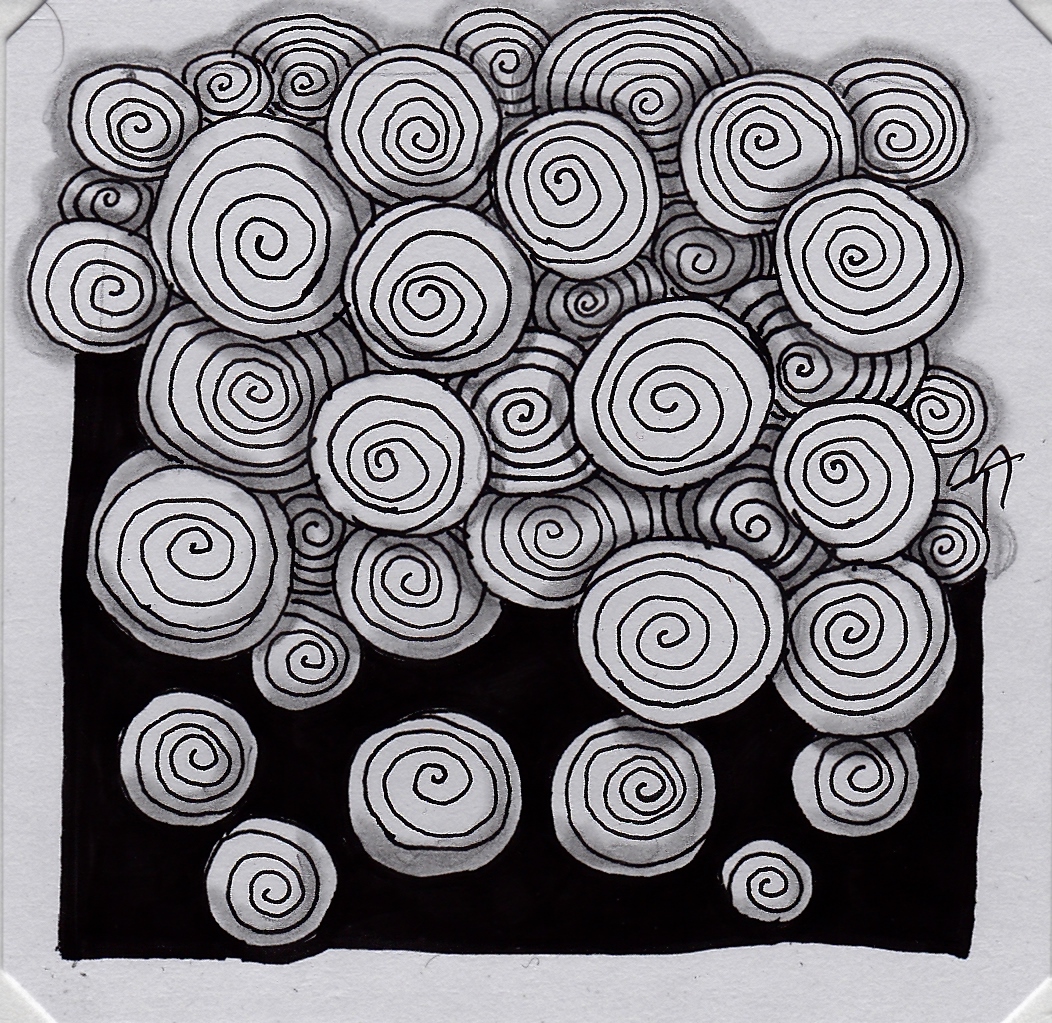
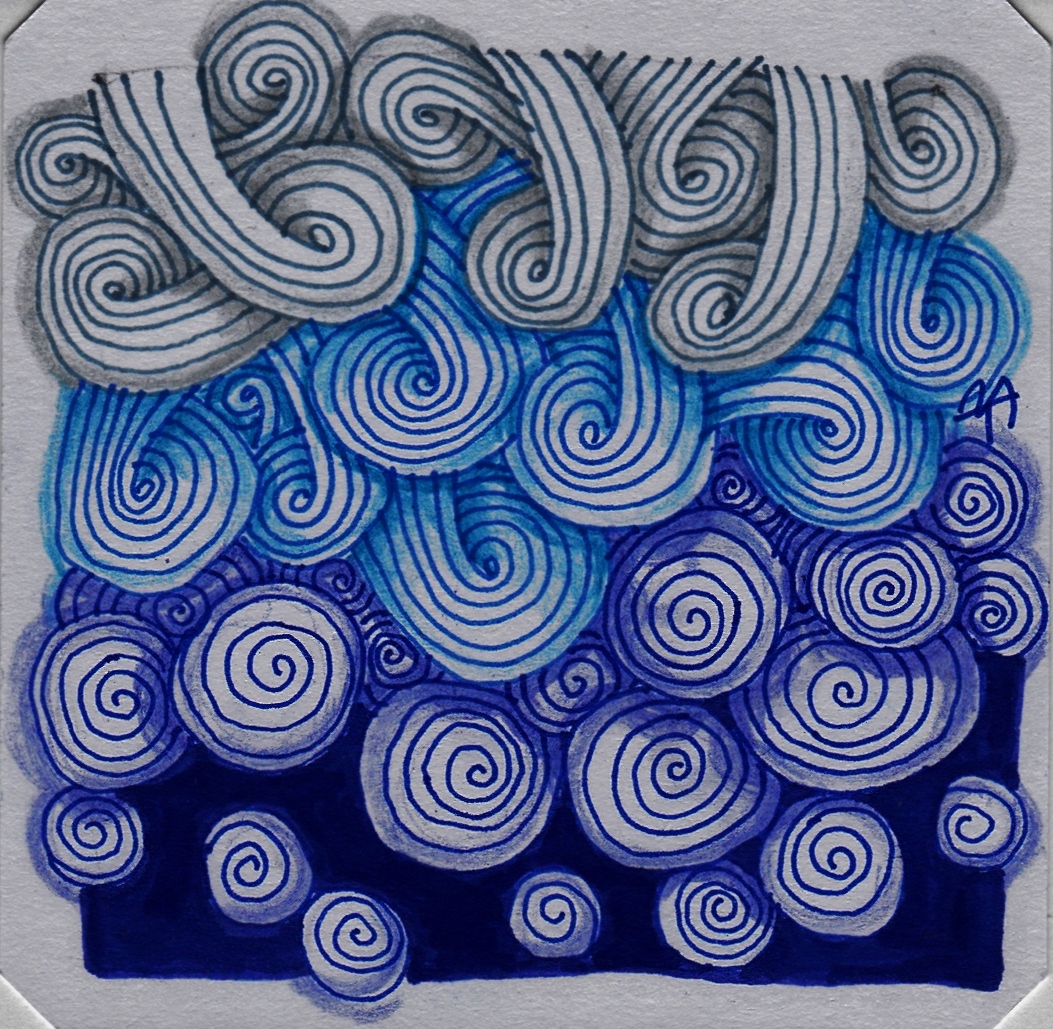
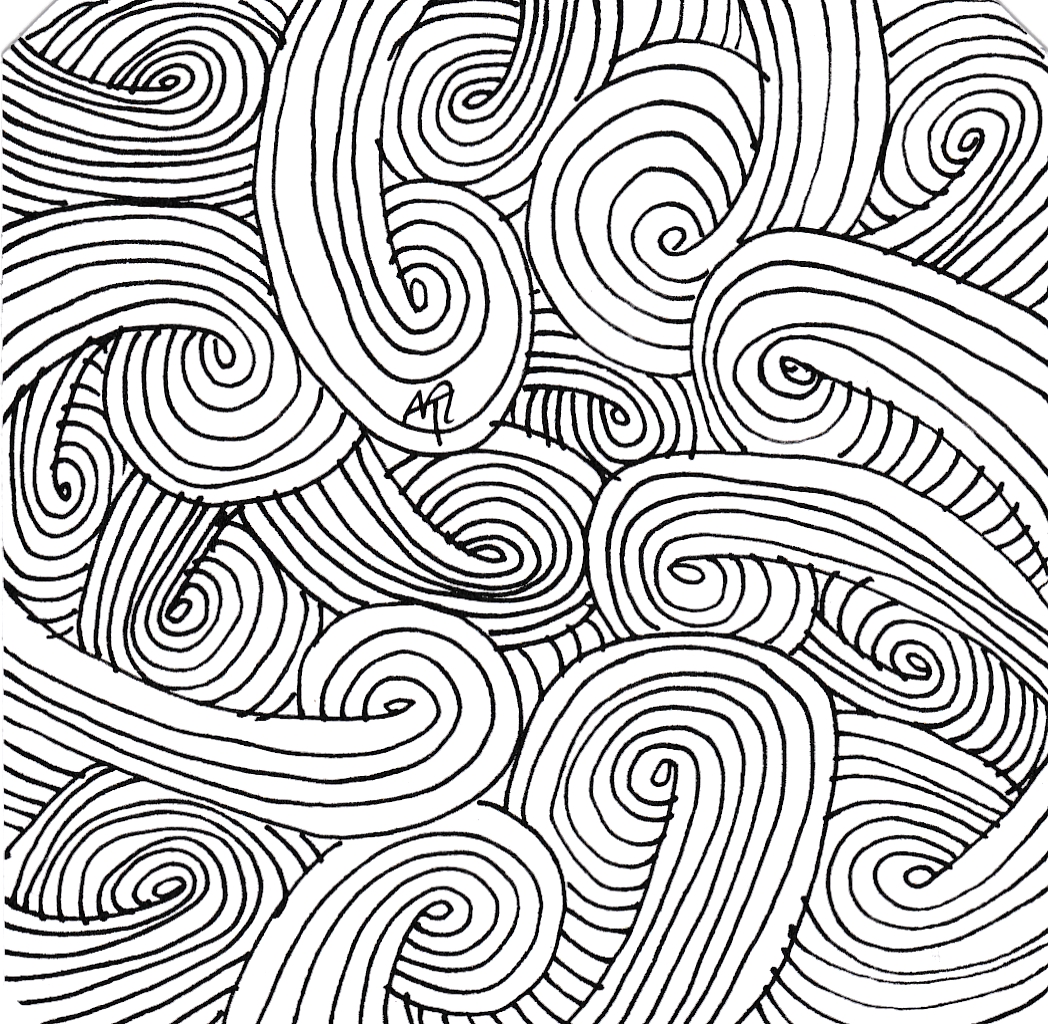
Even with this periodic dizziness, I’m still trying to focus on creativity. I think my body’s unsteadiness has given rise to my current obsession with patterns with curled and circular lines. I’ve given a lot of attention to a tangle pattern called ‘sand swirl’. I noticed while drawing it how my lines wobble, giving each swirl a shaky, non-uniform appearance when I want smooth, curved lines. I’ve drawn it repeatedly, by itself and with other patterns, even in coloured ink, trying to practice the wobbles out of it. But alas, no matter how deeply I concentrate, the wobbles aren’t going anywhere. In fact, they show up in other patterns I draw that have curled, circular or swirled lines. I can’t seem to will my hand to hold my pen to create the steady, smooth curves I want to draw.

Surprisingly, while trying to eliminate the unsteady, wobbly lines, I created some things I really enjoy looking at. I’m starting to think these unsteady, wobbly lines may be part of my artistic signature. Instead of trying to eliminate them, I’ll just embrace them and let my shaky hands lead me to create more swirling line art to become lost within.


Tiffany Lovering Tangle Tutorial – Sand Swirl


Zentangle: Tangle Patterns, Inspiration, and Deconstruction

This is not the original content I wrote to go with this post’s title. The first draft I wrote was a long rant in response to some very tense, unfriendly, and angry exchanges I keep encountering on some Zentangle-related websites and groups since I started using the meditative pattern drawing method. I decided not to post what I wrote because it doesn’t help anyone, least of all the people I see being dumped on, to write another angry post.

I started learning the Zentangle method because of the inherent meditative and mindful aspects of the process of drawing the various patterns. I’ve grown to enjoy getting lost in drawing lines and shapes. I spend a lot of time searching out more patterns online to expand my drawing skills and make the artwork I create in my art/gratitude journal more interesting. However, at times when I’m about to teach myself a new pattern I’ve found online, I notice negative exchanges written in some of the comments sections. It annoys me – actually, I get somewhat angry – because this thing, that is supposed to be enjoyable and relaxing, seems to be more about ownership and monetization than mindfulness.

I think some people forget that doodling has been around for a long time. Everyone does it. Although not everyone that doodles might take the time to name the patterns they draw. I know highlighting these points is going to make me unpopular to anyone who is devoted to the Zentangle method, but here’s the thing, slightly modifying something that already exists and giving it a new name doesn’t make it original or new. If that were the case, we would all be creative geniuses.

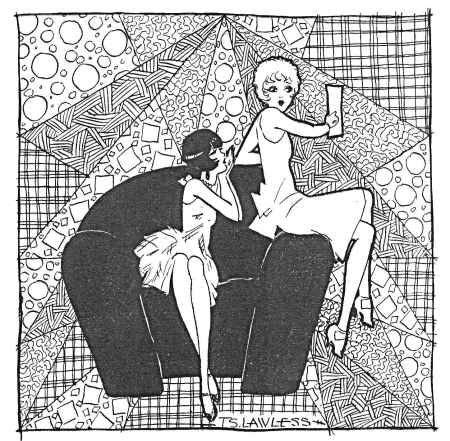
The Juggler - University of Notre Dame - May 1929

Cartoon from the commencement issue of The Juggler magazine of University of Notre Dame from May 1929


Furthermore, just because you’re inspired to deconstruct a complex pattern or image that was painstakingly created by an uncredited artisan in a woodwork carving, chiseled into a marble archway, painted on ceramic tiles, or stitched in fabric, that doesn’t make what you draw an original pattern. If you look around long enough you can usually find a pattern that existed for years, if not decades or centuries (in the case of ancient tribal and religious symbols) that looks like so-called “original” tangle patterns. At the end of the day, all art is derivative. Artists learn from imitating work produced by other artists, or trying to recreate things they see in the world around them, and they use it as a jumping off point to develop their personal style.


That being said, I have to stop letting myself get so bothered when I see some of the terrible things people write to each other in these spaces. As one Certified Zentangle Teacher (CZT) disappointingly stated in a comment I recently read online, for so many people Zentangle is “sadly just about making money”, which is bound to make some of those people more territorial and severe. For now, I will continue to use this drawing method as a creative meditative practice to divert focus away from my pain, but I think it wouldn’t hurt for some of the people getting bent out of shape about the use of patterns they “create” to remember that imitation is the purest form of flattery.


Arctic Monkeys – Brick By Brick