Drawing to Cope with Trauma

I usually draw and doodle because of the meditative qualities these activities offer that help to lessen my connection with the physical pain I feel every minute of every day.

In recent weeks, I’ve realized that I’m drawing and doodling to escape thinking. There is so much happening in the world around us now and thinking about all of it— or any of it—can be overwhelming. The need to disconnect from streams of information and news for longer periods is becoming greater with each passing day.


Unfortunately, the ability to disconnect is also a luxury that most of us may not have because the information that’s being shared is important to our overall health and safety. We need to know and understand the latest developments with respect to the current Coronavirus pandemic (Link to Mayo Clinic) in order to safeguard our health and the health of everyone around us, especially those who are most vulnerable. Nevertheless, tuning in to hear all of this information daily is becoming dizzying, and at times confusing, but it’s also always frightening.

It’s frightening because the virus at the root of this pandemic keeps presenting new symptoms—or no symptoms at all—once it infects us. It also continues to challenge current medical knowledge about how it’s killing us because of the varied ways it attacks our immune systems. Still, as much as all of this information is overwhelming and continually changing, it’s absolutely necessary for us to engage with it.

It’s also becoming difficult to consume news about the needless and senseless deaths of people within and around our communities in brutal and barbaric situations. Exposure to live-streamed images and graphic reports of murders of people of colour is taking a toll on my mental health. The way I’m feeling makes me certain that everyone being exposed to these same images and reports is also being deeply and negatively affected, even if we all don’t acknowledge it.

The combination of this daily bombardment of necessary but frightening information and unfiltered, brutal news is traumatic.

Trauma that we experience directly, or even vicarious trauma (also called compassion fatigue) from witnessing horrible things that happen to other people, take a toll on each of us in common yet sometimes surprising ways.

When we experience trauma, direct or indirect, we may feel some or all of the things listed below:

  • Isolating yourself
  • Loss of pleasure in life
  • Difficulty concentrating
  • Insomnia
  • Physical and mental fatigue
  • Bottling up your emotions
  • Increased nightmares
  • Feelings of hopelessness or powerlessness
  • Overeating
  • Excessive use of drugs or alcohol
  • Poor self-care

Sadly, we are now living in a time of extreme uncertainty. A time where we are already emotionally and psychologically vulnerable, on top of which, too much information and endless streams of violent images are continuously bombarding our already frazzled senses. Then, as if these factors weren’t enough, we must consider that during this already difficult time most of us are also isolated from the supports of our friends and families that we typically rely on for comfort.

This isolation imposed by Public Health Authorities in response to the current pandemic, means each of us is responsible, more than ever, to find ways to ground and soothe ourselves, so that we can effectively cope and continue to fulfill our basic daily needs.

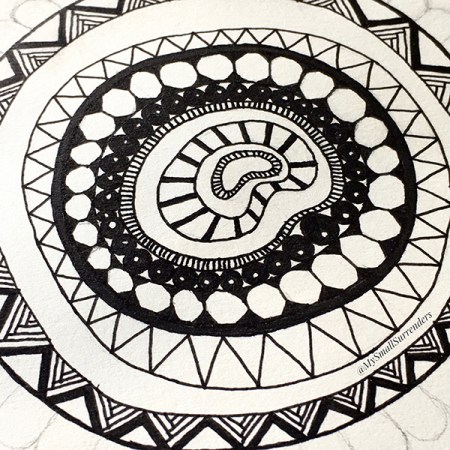
Good or bad, before the start of this pandemic, I already had years of experience living in socially isolated conditions to learn how to cope with traumatic experiences by myself; and to figure out which activities help me cope best with difficult circumstances. In these times, leaning on my creativity, even if what I create isn’t considered beautiful or interesting to others, is what helps to emotionally ground me and soothe the anxiety that may surface.


Just drawing lines is a meditative exercise that helps calm my senses by allowing me to disengage from the things that cause me anxiety and aggravate my chronic pain. Even if it’s just for a short time.

For each of us the healthy, positive coping tools that might bring us comfort may be different. However, finding them and using them to help us through this and other difficult times, will be what prevents us from becoming so overwhelmed that we can’t get out of bed in the morning.


* * *


Note: To learn more about trauma and vicarious trauma and some tools that may help with coping, please visit the links I included in this post.

I am not affiliated in any way with the organizations whose links I share in this post.
 

Jumbled Lines From Jumbled Thoughts

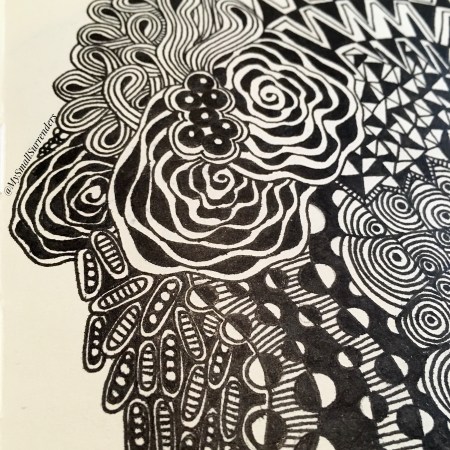
The lines I draw in my sketchbook aren’t always neat and tidy, and they don’t always get filled with bright colours…


Jumbled Line Drawings – Close Up


Sometimes I draw lines and shapes simply because I need to unload the clutter I feel in my head.

When I do that, what shows up on the page is usually an accurate reflection of the jumbled thoughts I’m trying to clear out.


Jumbled Line Drawings – Full Page


I wonder how many of you use your sketchbooks in this way. 🤔


Surviving Social Isolation with a Chronic Illness

I’ve been uncertain about writing this post for weeks.

However, I’ve been swayed by each conversation I have with friends and family. I’ve been swayed the more I read and watch stories about people having cabin fever. I was swayed the more I heard about people becoming anxious because governments around the world started enforcing strict social distancing and social isolation (Link to Mayo Clinic) rules roughly six weeks ago to combat the risks associated with infections and deaths from the Coronavirus (COVID-19) pandemic.

The more convinced I became the more I felt the need to write about this. I needed to write this because very little has changed in my life, since governments started enforcing social distancing and social isolation rules in the past six weeks.

For the majority of the past seven years, I’ve spent my time housebound and alone because of chronic pain caused by a chronic illness. At the beginning of it all, I thought I might lose my mind because until that point my life had been a very active one.

I was a workaholic, which meant I invested a lot of time and energy into work that I loved. After an injury forced me to give up running, I used to walk for hours throughout the city regardless of the weather, instead of riding public transit, taking taxis, or driving. In the summers, I rode my bicycle through the streets and, whenever I could, I traveled to other countries. I spent most of my weekends with friends or family for get-togethers, going out to eat, going out to dance, watching movies, or just shooting the breeze about the week that had passed over drinks.

It felt as if I was never home. The exceptions were for showering and changing my clothes or grabbing a bite to eat before going out again; or sleeping at night to rest before going to work in the morning.

Then my illness and its accompanying debilitating pain arrived and EVERYTHING changed.

The onset of my illness caused me unbearable pain that has never stopped. Some days, the pain makes it nearly impossible for me to move around within the walls of my home; and it wiped out my ability to go out to live an active life the way I’d been used to.

In fact, my life came to a complete standstill. I could no longer work. Going out was reduced to scheduled medical appointments or treatments, and no end of emergency visits to the hospital because the most basic activities, like walking, still cause me to have mind-numbing pain flare-ups.

This change in my health that changed my life meant that if I wanted to see my family and friends, they had to come to me. It became too painful and exhausting for me to go out, or to go through the motions of getting ready to go out. If I visited them, I had to plan to stay for days so I could rest my body after the painful trip there and before the painful return trip home. At times, this has felt like more of an imposition than a fun time together.

The incessant pain and unpredictable pain flare-ups mean my life has become one long tentative plan dotted with repeated cancellations. Over time, because of my poor health I have seen fewer and fewer friends, many of whom have left my life along the way because they’ve been unable or unwilling to accommodate the things I need to do to care of myself. Consequently, I’ve spent most of the past seven years alone in pain-fuelled isolation.

Early on, it became clear with each passing day that I needed ways to fill the seemingly endless hours of my days. Since being physically active or engaging in activities that made it necessary to frequently leave my home were out of the question, I had to find things I could do that required little physical exertion, yet stimulated my mind and that I could do comfortably at home. What I finally settled on was to start a creative practice—my own version of art therapy—involving writing and making art (mostly drawing). I also increased my efforts to maintain connections with the people in my life that I care about and who made it clear they reciprocate that care.


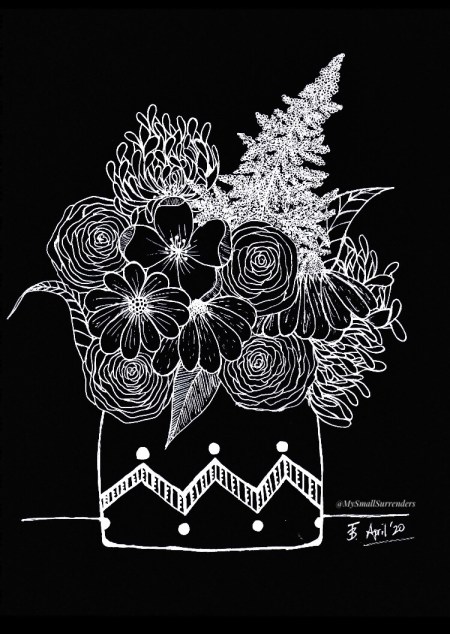
I͟m͟a͟g͟i͟n͟a͟r͟y͟ ͟F͟l͟o͟r͟a͟l͟ ͟B͟o͟u͟q͟u͟e͟t͟ ͟o͟n͟ ͟B͟l͟k͟ ͟P͟a͟p͟e͟r͟ ͟-͟ ͟A͟p͟r͟i͟l͟ ͟’2͟0͟


I write this not to belittle any person’s feelings of isolation and/or boredom. I write it as confirmation that since I’ve survived nearly seven years of social isolation forced on me by a chronic illness and chronic pain, then everyone forced into social isolation in recent weeks can survive too. From my experience, the biggest part of surviving this social distancing and social isolation, because of the risks associated with this viral pandemic, is focussing on self-care, primarily our individual mental health and emotional well-being, and working to maintain (or build) connections with our friends and families.

My hope in writing this is that people understand that every one of us is resilient. Whether it’s six weeks of social distancing to contain the spread of COVID-19 and reduce deaths caused by it; or seven years of social isolation from being housebound by an illness, we can cope with significantly more than we believe we can.