This doodle in no way represents how I feel about children. I love children. However, when they cry, it is noisy.
I clearly do not have great technique when attempting to blend coloured markers and pens, but I see that as a challenge to myself to practice and get better. With this doodle, I did learn that Sharpies, which are alcohol-based ink pens, blend better than the water-based ink markers I chose to colour the face of my crying baby. That being said, this doodle turned out better than I thought it would.
I decided to participate in InkTober this year. Jake Parker created InkTober in 2009 “as a challenge to improve [his] inking skills and develop positive drawing habits. It has since grown into a worldwide endeavor with thousands of artists taking on the challenge every year.”
According to Jake, anyone can do InkTober, just pick up a pen and start drawing. I’ll be using the challenge to hopefully improve my drawing skills and as a daily mindfulness practice. I find that when I focus my attention on drawing something it distracts me from my pain. I’m so committed to this challenge, I started an Instagram account so I can have my posts counted as part of the InkTober community.
The rules for InkTober are simple
Make a drawing in ink (you can do a pencil under-drawing if you want).
Post it online
Hashtag it with #inktober and #inktober2016
Repeat
Note: you can do it daily, or go the half-marathon route and post every other day, or just do the 5K and post once a week. What ever you decide, just be consistent with it. InkTober is about growing and improving and forming positive habits, so the more you’re consistent the better.
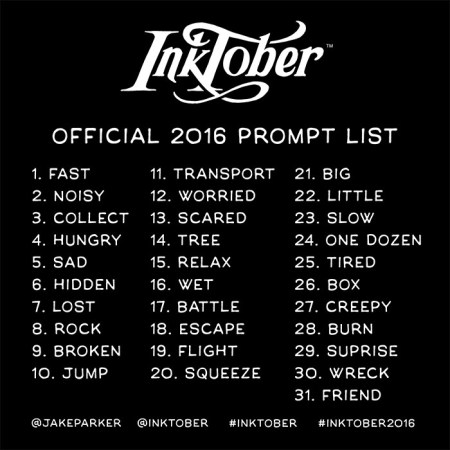
This is the official Prompt List for this year’s challenge
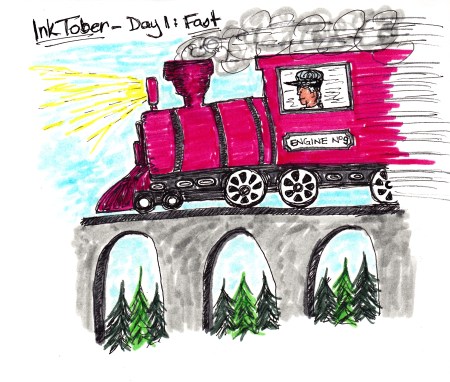
I spent all day trying to think of what I could possibly draw to represent the first prompt: FAST. Well, here’s my first drawing for the challenge. I can only hope that I get better as the month progresses…
So many things in my life have changed in recent years with the arrival of my pain. One of the big things is my limited transportation options. I don’t drive or travel by public transportation anywhere anymore. I don’t drive because I’m not comfortable gauging how foggy my pain medications will make my mind or how much they dull my reflexes and the time it takes to respond to sudden, unpredictable movements. I don’t take buses or the subway mainly because I have a tough time climbing stairs and I can’t stand for very long before my pain increases. Not to mention the painful, unexplained reaction my body has to what I assume are the vibrations from any vehicle I travel in for longer than ten minutes. I also have frequent bouts of lightheadedness, dizziness, and nausea, which does not bode well for traveling alone or operating a two-ton vehicle.
Sometimes my dizziness becomes full-blown vertigo, which is “the sudden sensation that you’re spinning or that the inside of your head is spinning.” It comes with no warnings. The best method of coping with it is sitting down, or lying down when just sitting upright makes everything spin. I had one episode that stretched over an entire week. It was impossible for me to do much beyond lying on my couch or sleeping. The constant feeling of the room spinning around nauseated me. At one point, I sat on my bathroom floor next to the toilet bowl for about an hour, so I could avoid falling over if the need to vomit did arise. Luckily, I haven’t had an episode as severe as that in the last couple of months.
Although there is no cure for vertigo, there are treatments to manage it. If it doesn’t go away on its own or if the frequency of the episodes increases, I may have to undergo a procedure called canalith repositioning, which involves “several simple and slow maneuvers for positioning your head” to move particles from your inner ear to another area where they are more easily absorbed. This procedure is taught by a doctor, audiologist, or physical therapist and “is usually effective after one or two treatments.” However, if canalith repositioning doesn’t work there is a surgical option that boasts a 90% success rate. I’ll keep my fingers crossed that things don’t get any worse and that the worst part of my vertigo remains the need to hug my toilet bowl periodically.
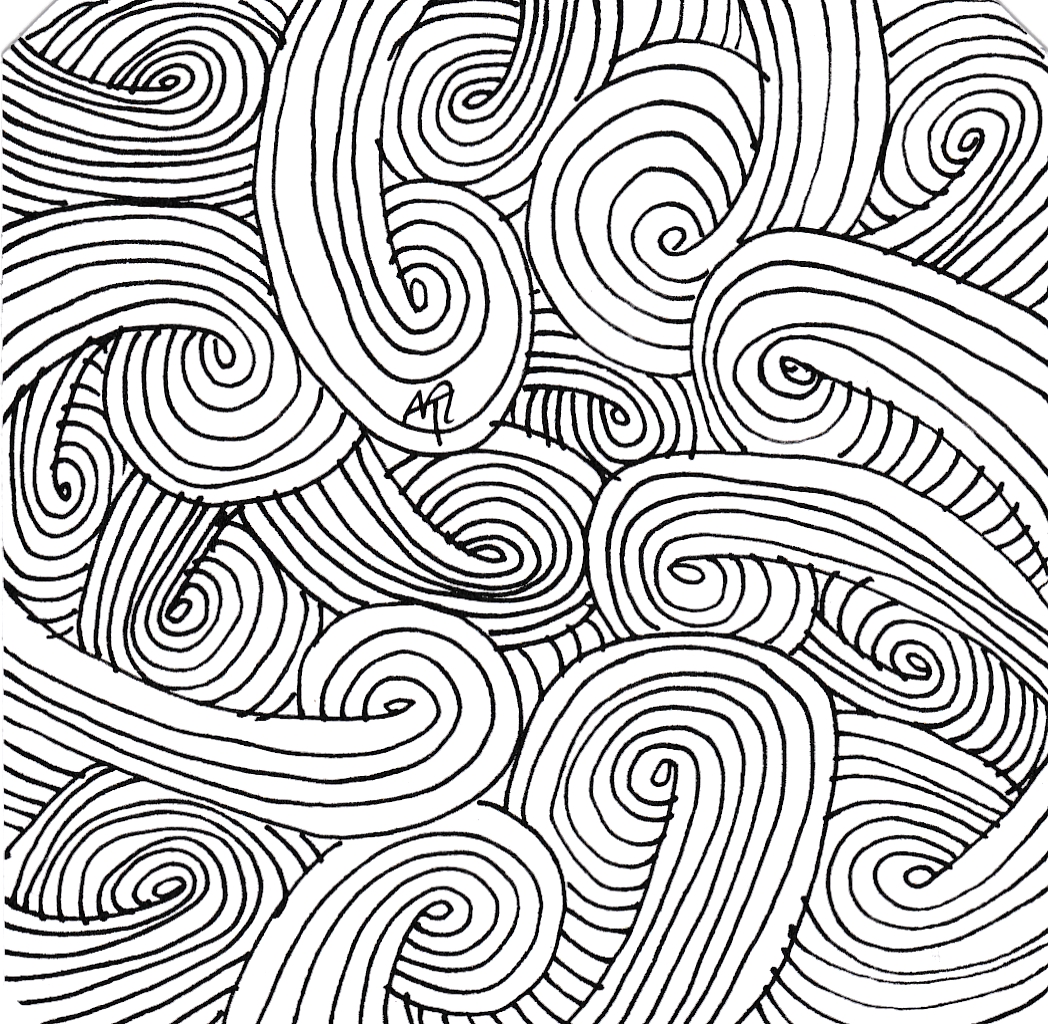
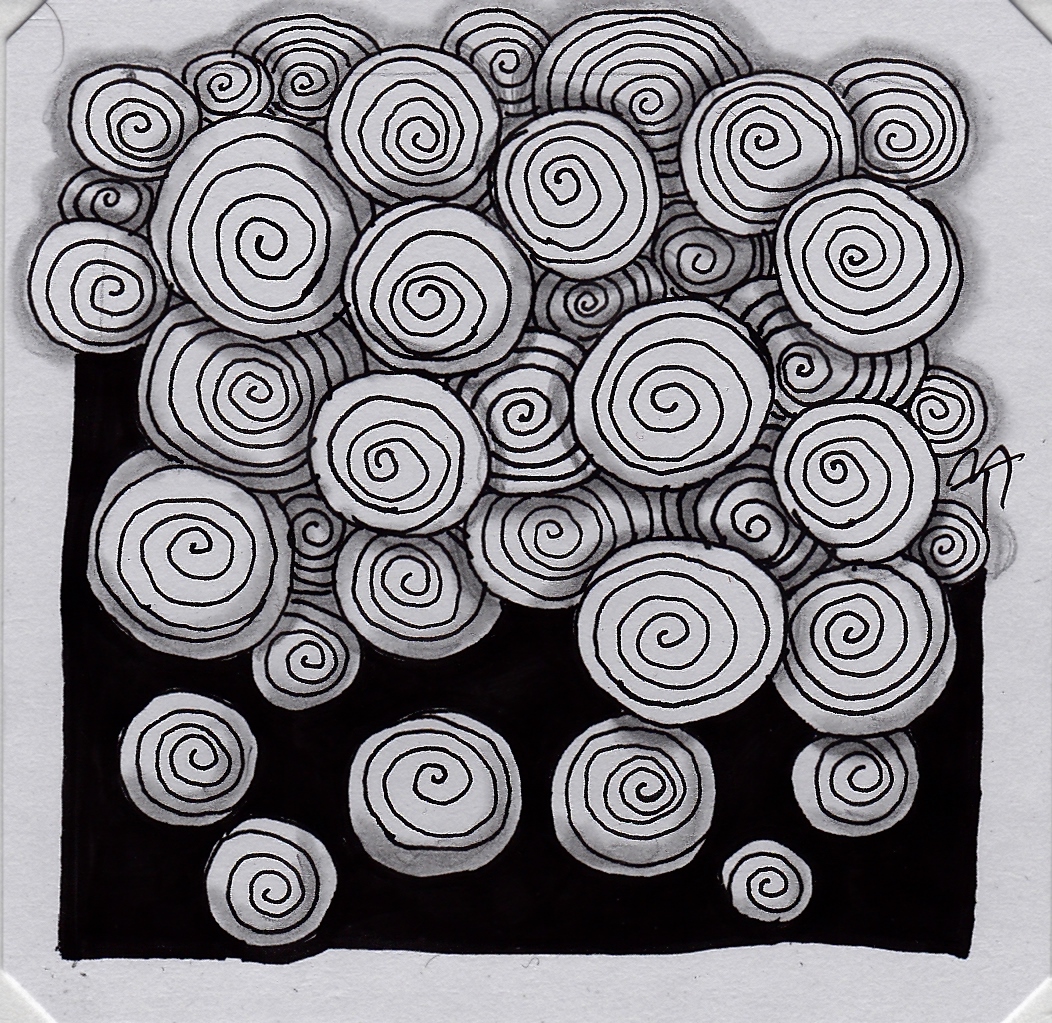
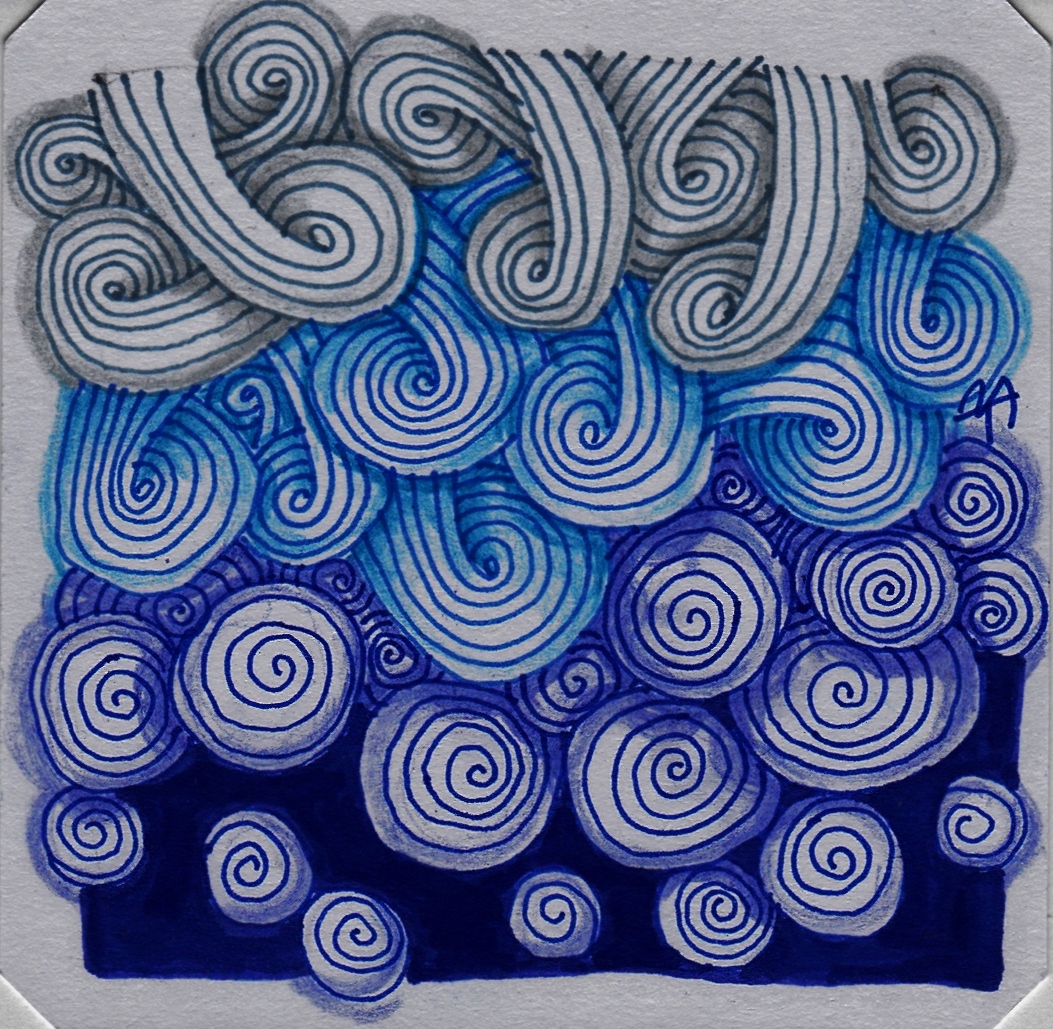
Even with this periodic dizziness, I’m still trying to focus on creativity. I think my body’s unsteadiness has given rise to my current obsession with patterns with curled and circular lines. I’ve given a lot of attention to a tangle pattern called ‘sand swirl’. I noticed while drawing it how my lines wobble, giving each swirl a shaky, non-uniform appearance when I want smooth, curved lines. I’ve drawn it repeatedly, by itself and with other patterns, even in coloured ink, trying to practice the wobbles out of it. But alas, no matter how deeply I concentrate, the wobbles aren’t going anywhere. In fact, they show up in other patterns I draw that have curled, circular or swirled lines. I can’t seem to will my hand to hold my pen to create the steady, smooth curves I want to draw.
Tile 23 – Sand Swirl Shaded
Tile 24 – Sand Swirl Full Tile
Tile 26 – Crimson Sand Swirl – Added Shade
Tile 29 Shaded – Circles On Water
Tile 30 Shaded – Sand Swirl-Circles On Water in Blues
Surprisingly, while trying to eliminate the unsteady, wobbly lines, I created some things I really enjoy looking at. I’m starting to think these unsteady, wobbly lines may be part of my artistic signature. Instead of trying to eliminate them, I’ll just embrace them and let my shaky hands lead me to create more swirling line art to become lost within.




 My Small Surrenders