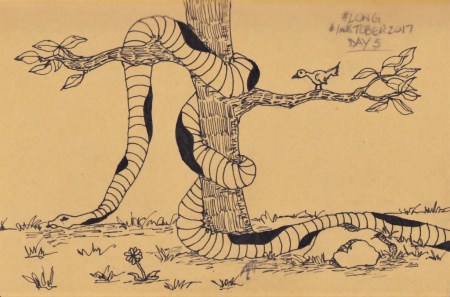
InkTober 2017: Day 5 – Long

Snakes scare the crap out of me. Even looking at photos of them makes the hairs on my skin stand on end. So I question why my mind conjured up an image of a snake to illustrate the word ‘long’, which is today’s InkTober prompt. I’m not sure why they scare me so much, considering most snakes are harmless. Maybe it’s because as far back as I can remember, in movies, even in documentaries and television series, it’s usually the most deadly snakes shown. Typically, there are scenes wherein after being bitten by a snake (rattlesnake, cobra, black mamba, copperhead, or water moccasin) there’s always alarm and frenzied activity to search for an anti-venom to save a person’s life. So why wouldn’t I have this irrational fear?

In my lifetime, I’ve only seen snakes up close a few times – not counting those in zoo enclosures. The two incidents that stand out most in my mind were thankfully uneventful, but I still remember my over the top reactions. The first time was years ago, while vacationing in Miami and spending time in South Beach, which was not someplace I would have expected to run into a snake. We were walking along the main street and came upon a street performer whose entire act was having an albino python wrap itself around his neck, shoulders and upper body. When I first saw it I didn’t think it was real because the colour looked unnatural as it was almost a pale neon green-yellow.

The snake’s handler and I assume owner, talked to people as they walked along the sidewalk trying to convince them to take the snake from him and allow it to slither across their shoulders. There was a fee for that, which to me seemed insane to pay to have something cold and scaly move across one’s skin. He also charged a fee if passersby wanted to take a picture with him and that huge neon snake. When I finally realized it was real, I wanted to run to the other side of the street to get as far away from it as possible. I don’t remember anyone I was with taking a photo with or touching the snake but the image of its long scaly body hanging from its owner’s shoulders is burned vividly on my brain.

My next encounter with a snake was in a parking lot. I was out running errands one day and when I got out of my car and walked toward the building where I’d gone to pick up something, I saw a small group of people transfixed by an object on the paved ground. As I got closer, the long thin object moved and a few of the people became hysterical. When I saw it was a snake I stopped walking and froze on the spot where I stood. I could not move as I watched it slither around. I’m not sure how long I stood there contemplating what to do: should I get back in my car and drive away or should I wait for the snake to slither away so I could finish what I had come to do?

It turned out that I didn’t have to decide. A security guard had called animal control or some other organization – apparently the snake had been there for quite some time before I arrived –, and they showed up not long after my body and brain failed me. The animal control person pulled out a hooked pole and guided the snake into some sort of bag or net. He claimed whatever breed of snake it was it was harmless and based on its size was a baby, and not an abnormally long grass snake as someone in the crowd had speculated. Whichever it was, I was happy to see it scooped up and taken away so I could get on with my day.

So poisonous or not, long or short snakes scare me to the point of making me want to run away or become instantly paralyzed by fear. But it seems that drawing them doesn’t have much of an effect on me.
 

iRest: Learning to Do Nothing

In the fall of 2014, my therapist introduced me to a, new to me, meditative practice called Yoga Nidra, which translated from Sanskrit to English means ‘yogic sleep’ or ‘sleep with awareness’. This yoga practice is said to be “an immensely powerful meditation technique, and one of the easiest yoga practices to develop and maintain.” To teach me the Yoga Nidra practice he used materials developed for the iRest Yoga Nidra Meditation program. iRest “is currently being utilized in VA hospitals, military bases, hospitals and clinics, hospice, homeless shelters, community programs, and schools. Research has shown that iRest effectively reduces PTSD, depression, anxiety, insomnia, chronic pain, and chemical dependency while increasing health, resiliency, and well-being.”

The few times we worked on the practice during therapy sessions, I felt sensations in my body that I couldn’t articulate. To be honest, the unfamiliar sensations I felt in my body freaked me out, which might be why when I used the recorded guided meditations at home on my own; I had great difficulty working through the exercises. Ironically, it was also hard for me to relax and even harder to find a comfortable position so I could focus. I told myself, and my therapist, it was too hard for me to practice alone, and I made myself believe that. After a short time trying the practice, I gave it up.

A few months ago, my therapist told me about a six-week iRest group program held at a local hospital that still had space available and he asked if I might be interested in taking it. I was a bit hesitant because it obviously meant weekly travel that would undoubtedly increase my pain, even though it was just a short cab ride from my home, but I agreed to have him send a referral on my behalf all the same. The program started at the beginning of November, and I wasn’t at all surprised that my health issues met the requirements for me to take part. I was skeptical at first because of how I had felt when first introduced to the practice but I was open to learning more about it in a structured group setting.

The first class of the program introduced us to a meditation similar in some ways to a body scan in mindfulness meditation with the striking difference that your awareness isn’t focussed on your breath and body. With iRest, you focus your awareness on sensations in your body, your body’s energy, and all energy around you. As the program progressed, the class materials, discussions, and meditations became more intense. Through the iRest meditations, the reading materials, and group discussions I was better able to understand my struggles with certain issues. Interestingly, a discussion about fear made the most significant impact on me. We discussed how paralyzing it could be, especially when we don’t understand the origin of our fears.

Over the course the program, we learned to identify what is called sankalpa or personal intentions for each meditation in the practice. I focussed on the issues that seem to consume so much of my time and energy. Thankfully, there was content in the classes I connected with that I felt related directly to my issues: trying to accept my illness and that because of it, I now do nothing. I came to understand that acceptance is not about resigning myself to or giving up on an issue, nor should it be a struggle because acceptance should come without effort. What I’ve been doing is fighting against what exists, which creates mental and emotional pain and intensifies the physical pain in my body. This added pain, mental and emotional, is triggered each time I compare what exists now with my former, pre-illness life. It’s triggered whenever I project my anxiety and fears and attach unproven meaning(s) to the actions of anyone with whom I interact.

The solution to end the extra pain is to do the other thing I fight against: nothing. In doing nothing we connect with the purest form of being. Doing nothing allows us to disentangle our existence from the identities we create because of the work we do and to fit into our various social environments. This uncovering, or unmasking, is necessary to understand ourselves. I recognize now, that my illness is an opportunity to strip away the many masks I wore because I needed to fit in to the world around me, including within my family. For the first time, in my life; I don’t have to justify my existence. I can just be myself, which in this moment means not working and definitely not beating myself up while I do nothing, which is so necessary for me to heal.

Because I couldn’t understand this before, my instincts led me to fight against losing what I’ve known my whole life: constant busyness and doing. Even though, always being busy and doing things is not the whole of who I am, nor is it the complete picture of any other human being. Continuous activity actually prevents us from connecting with our true selves and attending to our needs. Through the iRest program and the self-inquiry it required, I know that what I was really struggling with since the arrival of my illness was my fear. Definite fear about having an illness that still defies complete diagnosis and treatment, but also fear of not being able to point to an identity grounded in constantly doing to show the world or myself who I am.

Of course, there’s a lot more to the iRest program than the small snapshot I’m recounting, but after those six weeks I feel less conflicted than when we started out. More importantly, I feel gratitude about what I learned from iRest, and ultimately about myself, this time around. Unlike the first attempt, two years ago, when I let my fear get in the way of experiencing something new, I also see the value in developing a solo practice. My intention is to continue with the meditations from the program and my self-inquiry. I am practicing to gain as much benefit as I can so the fears I’ve been holding and struggling with – and the many fears I’m certain have yet to emerge from my subconscious – will no longer overwhelm my being and existence, even if my illness remains with me indefinitely.

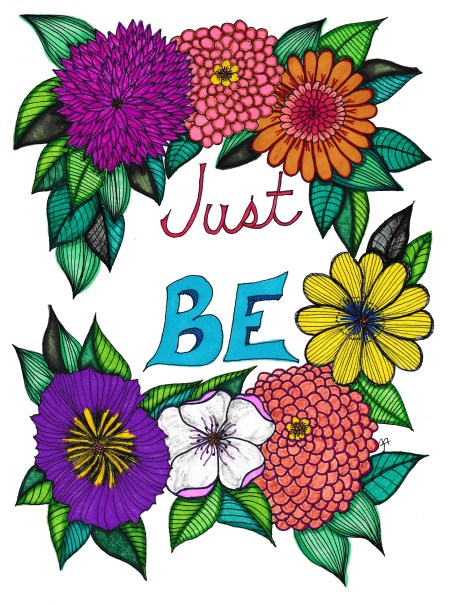
Just Be


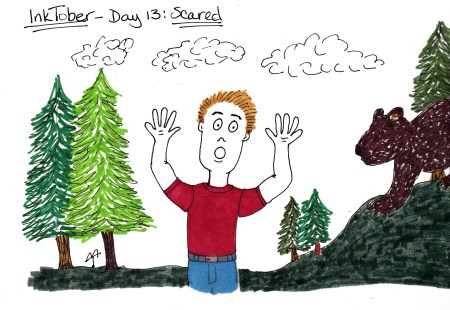
InkTober: Day 13 – Scared

Whether we’re willing to admit it or not, all of us get scared. It doesn’t take a free-roaming wild animal to start our adrenaline racing through our bodies. Some of us have inexplicable phobias about things ranging from the tiniest specks to the highest of heights, or things that, sometimes, no one else can see. Whatever our fear, being scared is a part of being human and sometimes it’s the emotion that reminds us that we are alive.

InkTober - Day 13 - Scared