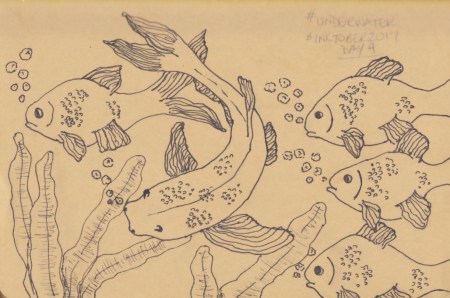
I’m not the strongest swimmer. But I love swimming in open waters, preferably saltwater. Earlier this year I had the opportunity to swim in saltwater in an idyllic tropical setting. My Pain Specialists gave me the all-clear to travel with the hope that a different environment without the stresses and reminders of my daily life might be therapeutic. My family and friends hoped for the same, but also wanted me to have fun and get back to enjoying life the way I used to.
Unfortunately, contrary to the hopes of my doctors, family, and friends whom, I believe, all hoped that any time spent in tropical climes could have magical effects on my health; I didn’t have many improvements. In fact, the repeated force of large slapping waves pounding against my body as I walked out into the surf made my skin, lower abdomen, and lower limbs hurt. To avoid this I had to wade far enough out until the water covered my body up to my chin and I could tread water. But, being me, that wasn’t enough to satisfy the longing I’d had to play in open water.
My eagerness to plunge my body below the surface to escape the waves and lose myself in underwater play was not well thought out. As I cut through the water with my arms then arched my back and kicked my legs to propel my body forward and deeper below the surface my back and legs gave me a sharp warning. Swimming, even in the buoyancy of saltwater, can cause me more pain. Moreover, the hard kicking I had to do to bring myself back to the water’s surface and closer to the sandy shore forced me to use more energy within seconds than I used to get to the beach.
After learning this lesson, the time I spent in the water was more laidback. I floated on top of the water allowing the energy of the waves to move my body. When I used my own kinetic energy, I did slow backstrokes or treaded water so my head could bob above water. Then I spent hours sitting on the warm sand laughing and talking to my friend F with whom I had traveled. Although I would have liked to do more underwater exploring, I don’t have a single regret about that trip. If I did, it would be that it wasn’t longer.
I survived my first acupuncture treatment. I know that sounds dramatic, but I did have to sign a consent form and waive my right to sue the hospital and all staff if I had any negative reactions before my pain specialist started the treatment. Besides, once I outline what happened, that I characterize the outcome as survival might not sound far-fetched. After I signed the consent form, my pain specialist and the assisting nurse outlined all the possible known negative reactions I could experience during and after the treatment. The intention was to place ten acupuncture needles in my lower back close to my tailbone radiating outward to my hips, and more needles in other areas of my body. Because I can no longer lie comfortably on my stomach, we had to figure out the best position for me to lie down on the table to prevent me from moving during the treatment. The best position turned out to be lying on my left side with my right leg bent at the knee and supported by a pillow. I had another pillow placed under my head and both arms stretched in front of me – reading that back it sounds more complicated than it was. In anticipation of the bright lights of the treatment room, I brought a sleep mask with me that I put on to create a more relaxing mood.
With me lying steadily in place on the table, my pain specialist moved my clothes aside to get access to the bare skin of my lower back. She spoke to me as she started to insert the needles asking if they were causing too much pain as she placed them. Unfortunately, even though she didn’t insert them too deeply, the pain of each needle she put under the skin close to my tailbone was unbearable. After she inserted the fifth needle in the flesh close to my right hip, she decided not to put anymore into my back. I’m glad she stopped because I’m not sure I could have handled the pain of five more needles. My pain specialist placed the sixth and seventh needles on the backs of each of my hands in the soft pad between my thumbs and index fingers. The nurse set a timer for ten minutes, and then it was lights out.
During the first ten minutes, as I was lying on the table in the semi-darkness, I could feel an intense, tingling sensation radiating from each needle in my back and hands. It was uncomfortable and not at all like past soothing acupuncture treatments. When the timer went off the nurse came back to the treatment room to adjust, or as she said “twizzle” each needle. She set the timer for another ten minutes and left me alone in the dimmed room once more. The discomfort from the needles continued to grow. The familiar feeling I get at the beginning of a pain flare up started building in my legs, but there was still time left on the timer. While I waited for the time to run out, I hoped that the removal of the needles would ease the discomfort.
At the end of the twenty-minute treatment, my pain specialist returned to remove the needles. She delicately plucked each fine, silver sliver of metal from under my skin, and the nurse used cotton pads to dab blood away from some of the insertion points. My pain specialist told me to sit up slowly. As I sat up, a wave of nausea hit my stomach. I wanted to vomit. I sat still for a moment then tried to stand up. I felt dizzy. I had to sit back on the table. The nurse and my pain specialist were very concerned and made me lie back down for about 30 minutes. When I finally felt steady enough to stand up, the nurse said she could tell that I felt better because the colour had returned to my face. However, there was still concern that I might need more medical attention. She told me that if the nausea and dizziness continued or worsened that I should go to the emergency room.
As the day progressed, the nausea and dizziness started to fade slowly, but the pain flare up that followed was as unbelievable as it was unexpected. For the first week following that treatment, I had soreness in the areas where my doctor placed the needles; tingling in my hands and the soles of my feet; that tingling turned into fiery pain from the soles of both my feet all the way up to my pelvis and lower back, and I felt exhausted. I couldn’t sit comfortably and standing or moving around made the pain worse. I tried massaging the arches of my feet, my ankles and thighs but the added friction made the burning pain worse. Even my hands tingled, although I only had a single needle placed in each one. By the time I went back to the pain clinic for the second treatment a week later, I was so sore and stiff that my pain specialist decided against more acupuncture and had to increase the doses of my pain medications to help me cope with the pain. She also expressed surprise that I returned for another treatment and told me she hadn’t expected me to make it to the appointment because of the shape I was in after the first session, and how much pain I was still in while meeting with her. Even though I was still in so much pain, it never occurred to me to cancel the treatment.
It’s been a month since I had that acupuncture treatment and my pain is just getting back to a level where I can cope, even with the higher doses of pain medications. Because I had positive experiences with acupuncture in the past, this outcome came as a real shock to me. I knew that it was possible to feel some nausea and dizziness afterwards, but I wasn’t prepared for the intensity of what I experienced. Since going through this I found AcuTake, an online publication that provides information about acupuncture. According to an article on the site, “7 Acupuncture Side Effects That Are Normal”, one of the potential side effects is “worse symptoms” or what “is sometimes referred to as a healing crisis” because acupuncture “awakens your self-healing capabilities” and “can cause not only an exacerbation of current symptoms but also the recurrence of previous ailments that had been dormant.” The article further states, “The good news about this side effect is that it’s a sign that things are moving. In the case of acupuncture, this means that the primary objective is being met. That is, you are starting to transition on multiple levels from stuck to unstuck.”
I don’t know how true it is that I have to feel worse before I get better, but I have a follow-up appointment scheduled with my pain specialist in about two weeks and we’ll definitely have a conversation about whether the agony that comes with acupuncture will benefit me in the long run.
I was never what one might call a yoga devotee. Although, I remember the very first yoga class I went to about 15 years ago with a friend from work and how well I slept when I regularly went to classes. I also remember how strong and flexible my body felt. Because of these memories, I’ve attempted to do some yoga since becoming ill to ease the stiffness and soreness all over my body, and improve my sleep. Unfortunately, most of the poses I tried made me feel more pain instead of soothing it. The only pose that helped at all to calm my severe pelvic pain from time to time was child’s pose, which doesn’t require much movement at all.
As part of my decision to be a more active participant in my healing, I’ve decided to try practicing yoga again. I did a bit of research and found the website Yoga Journal. The site doesn’t only provide instructional videos for “doing” yoga; it also includes educational information about the history and benefits, and can help you find the type of yoga and specific poses to practice depending on what you believe your body needs.
Today was the first day I attempted to do a complete yoga sequence: the sun salutation or Surya Namaskar in Sanskrit. I was able to complete three rounds of the basic variation – minus the jumps to transition between poses and deep stretching –, which doesn’t sound like a lot, but considering what happened the last time I tried, it’s a huge improvement. I used to work through the series of poses that make up a sun salutation without much thought. I can’t do that now.
I’m relearning how to move my body, after almost three years of being sedentary because of pain. I have to be mindful of each movement I make, how fast I make it, and whether it makes me have an intense pain flare up. I also have to remind myself to breathe because while I focus on moving my body I hold my breath, which makes me tense and could cause me to injure myself. I’m hoping that a slow, steady yoga practice will rebuild my strength and increase my healing, even if it means making each movement cautiously and enduring a little extra pain to start.

 My Small Surrenders