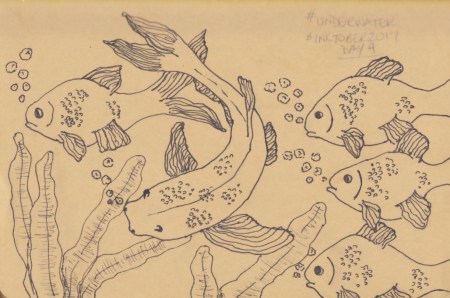
InkTober 2017: Day 4 – Underwater

I’m not the strongest swimmer. But I love swimming in open waters, preferably saltwater. Earlier this year I had the opportunity to swim in saltwater in an idyllic tropical setting. My Pain Specialists gave me the all-clear to travel with the hope that a different environment without the stresses and reminders of my daily life might be therapeutic. My family and friends hoped for the same, but also wanted me to have fun and get back to enjoying life the way I used to.

Unfortunately, contrary to the hopes of my doctors, family, and friends whom, I believe, all hoped that any time spent in tropical climes could have magical effects on my health; I didn’t have many improvements. In fact, the repeated force of large slapping waves pounding against my body as I walked out into the surf made my skin, lower abdomen, and lower limbs hurt. To avoid this I had to wade far enough out until the water covered my body up to my chin and I could tread water. But, being me, that wasn’t enough to satisfy the longing I’d had to play in open water.

My eagerness to plunge my body below the surface to escape the waves and lose myself in underwater play was not well thought out. As I cut through the water with my arms then arched my back and kicked my legs to propel my body forward and deeper below the surface my back and legs gave me a sharp warning. Swimming, even in the buoyancy of saltwater, can cause me more pain. Moreover, the hard kicking I had to do to bring myself back to the water’s surface and closer to the sandy shore forced me to use more energy within seconds than I used to get to the beach.

After learning this lesson, the time I spent in the water was more laidback. I floated on top of the water allowing the energy of the waves to move my body. When I used my own kinetic energy, I did slow backstrokes or treaded water so my head could bob above water. Then I spent hours sitting on the warm sand laughing and talking to my friend F with whom I had traveled. Although I would have liked to do more underwater exploring, I don’t have a single regret about that trip. If I did, it would be that it wasn’t longer.
 

InkTober 2017: Day 3 – Poison

The word ‘poison’ conjured up so many images – most of them literary. There was, of course, Juliet. According to Shakespeare, she pretended to end her life with poison because she couldn’t see any other way to be with Romeo whom she fell in love and married after knowing him for only a few days. Then she really had to end her life after, unbeknownst to him, her grieving new husband found her temporarily lifeless body and ended his own life because he couldn’t live without her. Definitely a tragic tale and probably Shakespeare’s best known. However, I prefer a more ancient tale of doomed young love that involves a slightly more complicated love story that ends in a similar fashion found within the pages of ‘Tristan and Iseult’. A medieval tale that became popular in the 12th century.

My mind then jumped to modern fairy tales where beautiful young girls tend to get poisoned just because they are young and beautiful. I immediately thought of the two immortalized by Walt Disney and idolized by little girls everywhere: ‘Snow White’ and ‘Sleeping Beauty’. Snow White became an orphan. However, instead of loving her, her stepmother envied her for her beauty, goodness, and youth. That envy grew into hatred, which… you know where this story goes. Then in Sleeping Beauty’s case, she was poisoned because her parents made a faux pas and left a rather important (and powerful) person off the guest list for her christening. Rather than letting it go, that slighted guest allowed her anger to consume her, so she cast a spell that of course involved poison and voilà: the beautiful, very much-loved, young girl was put in a coma.

I apologize for my glibness.

These stories are all beautiful and at the same time sad, but they tell us something about the human psyche too. As long ago as medieval times – and probably before humans had written languages – we’ve been obsessed with love, violence, and death. ‘Romeo and Juliet’ and ‘Tristan and Iseult’ are passionate love stories where violent incidents bring the main characters together and then end with their tragic deaths – albeit by their own hands.

Similarly, violence is inherent to fairy tales where we see children, men, and women repeatedly threatened by all manner of actions that can, and often do, result in their deaths. Even more interesting is that fairy tales are styled the way they are because they were written originally for adults, which makes sense when thinking about what kind of story would keep adults entertained.

I had no idea this is where my thoughts would take me when I started thinking about this post. Nonetheless, writing about this makes me wonder, whether telling these stories to children and young adults – I was introduced to ‘Romeo and Juliet’ in ninth grade – doesn’t somehow poison their thinking and normalize violence with very little effort.

This is probably the kind of thing I should think about while savouring a good glass of wine…


InkTober 2017: Day 2 – Divided

Divided: that’s a loaded word for me. For a long while, I’ve been feeling that my life is divided. It got that way four years ago, on the day my illness showed up. I didn’t know it then but, since the first moments, it divided time into before and after illness. I’ve tried not to think of my life that way, at least not from a negative perspective, because I know that my life is greater than these two dimensions. However, the truth is, I have to acknowledge that my life is not the same.

It may never be what it was before the day two extra-strength Tylenols weren’t enough to soothe the pain as it grew in my lower abdomen. It may never be the same as it was before I lost control of my trembling body. Trembling that became uncontrollable shaking because the pain was so overwhelming. My life may never be the same as it was before the ambulance ride that took an eternity to get me to the hospital emergency room. Before the months of multiple doctors’ misdiagnoses or the reluctant surgeon’s year of waffling about whether she could or would ever try to help me by doing the surgery she trained to do. Nor may it become the same, as after illness, since finally having surgery didn’t result in the end of any of my pain.

The interesting thing is that the space I occupy now is nowhere near after illness. It can’t possibly be when there are moments when all I can think about is freeing my body of pain and when that pain-free time will become permanent. My current existence is probably better characterized as ‘since illness’, which is an altogether different division. So far, each pain treatment I’ve undergone has delivered negligible short-lived relief or completely failed; and if the ongoing pain treatments are any indication, I may never achieve an after illness state.

Yet, I must continue living without losing hope, or my sanity. I have to keep myself grounded to avoid causing myself unnecessary grief because, as I’ve been taught: suffering is wanting something other than what exists in the present moment. Therefore, looking back at what was in my past (before illness) or what’s in store for my future (after illness) is unhelpful.

My life didn’t stop because of my illness. Although I fully accept that it changed, there’s no need to divide it into pieces and compartmentalize events into good and bad. I will, however, continue to live in the present, mindful of focussing on each moment as it comes.

The image I’ve chosen today to illustrate the word divided is a pie. We divide whole pies into slices to feed others and ourselves. If a thing must be divided I prefer to look at the possible positive outcomes from its division.