Mammogram: An Ounce of Prevention

When living with a chronic illness, it’s easy to lose sight of the many things that are normally done to maintain overall good health or to make sure there aren’t any new health issues. Recently, for the first time in ages, I did something preventive instead of focussing only on treating existing illness(es). I had a mammogram. My GP (general practitioner/family doctor) ordered it at the beginning of the new year. Because, in her words, I was “overdue” to have one done.

I know she was right. Nevertheless, I still wasn’t eager to have all feeling squashed out of my breasts. The last time I had a mammogram seemed like centuries ago, but I can still remember the pressure of the hard plastic trays that flatten a woman’s breasts so a detailed image of her breast tissue is clearly captured. It hurt. Because of that memory, I wasn’t looking forward to experiencing that extreme discomfort again.

I was able to get the mammogram appointment scheduled at the same Breast Clinic as the previous one. The Breast Clinic is in the same hospital as the Pain Clinic where I’m treated, which isn’t too far from my home, so I walked to my appointment. I’ve been walking to my appointments as much as possible in recent months, even though it takes days – and sometimes as much as a week or longer – to recover because it’s a chance to get some fresh air and much-needed exercise. Although it was quite cold outside, walking there in the crisp winter air was a chance to steel my nerves as I anticipated the added pain to come.

After registering at the Breast Clinic’s reception desk, I didn’t wait long to hear my name called. Along with another patient, I received instructions to undress in an area with small, curtained cubicles and to put on blue hospital gowns, making sure they opened in the front. Because it was freezing cold outside, I had dressed in multiple layers of warm clothes, so it took ages for me to undress, which being in a small confined space didn’t help. Of course, I also had a hard time tying the hospital gown closed. It wasn’t that I couldn’t tie the belt. It was that the oversized gown kept falling open. I finally gave up and walked into the sitting area clutching the collar closed.

As soon as I entered the sitting area, the Mammography Technician came to get me. She was cheerful in a way that put me on edge. I suppose that when you do work – no matter how well-intentioned – that causes another person to feel pain, being overly cheerful is one way to attempt to make them feel at ease while making yourself feel better. I followed her cheerfulness down the hall to the examination room where she told me to stand in front of the Mammography machine.

She fiddled with some dials on the control panel then walked over to position my body for the first scan. I was so anxious about the imminent flattening of my breasts that I started to sweat. That made me self-conscious because the hospital gown had to be pulled off my shoulders so the Mammography Technician could grab hold of each of my now sweaty breasts to place them, one at a time, on the shelf of the Mammography machine. After which she would lower the plastic tray above each breast until it squashed it; and while being squashed, enough x-rays to capture good images would shoot through each breast. Just thinking about this made me sweat more. Thankfully, the Mammography Technician didn’t seem to notice my sweat.

Even so, I fully expected my breasts to pop out from between the shelf and tray before an image could be captured. But no… regardless of how slippery my skin or the size of my breasts the Mammography Technician’s training was not going to fail her. She pinched and squeezed until every bit of each breast was first flattened vertically like too many books forced on a too small shelf; then horizontally like a sandwich in a Panini press. Then, just as I was bracing myself for more discomfort, it was over.

My memory, it seemed, had exaggerated the length of time I had previously spent having my flesh contorted. Although, I suspect, it might have more to do with the skill of the Mammography Technician. She didn’t spend a lot of time repositioning me (my body or my breasts) to settle me in the right angles to capture the necessary images. All it took was fours scans – each breast from two different positions – for her to get it right. In hindsight, maybe that’s why she’s so cheerful: she gets each patient in and out of the Mammography machine so fast they have nothing to complain about. At least I had nothing to complain about; she even let me take pictures of the Mammography machine so I wouldn’t have to look for stock photos online.

I left the exam room and I got dressed in the many layers of clothing I’d put on to keep me warm on my walk to and from the hospital, faster than I had undressed. As I took the elevator to the main floor and walked out into the frigid gray afternoon, I had a smile on my face because the thing that I – and millions of women all over the world – dreaded doing that afternoon, turned out not to be so bad. Thanks to that Mammography Technician, I left the Breast Clinic in a better mood than when I went in. And because of this positive experience, I’ll be reminding all the women I care about to go have mammograms.

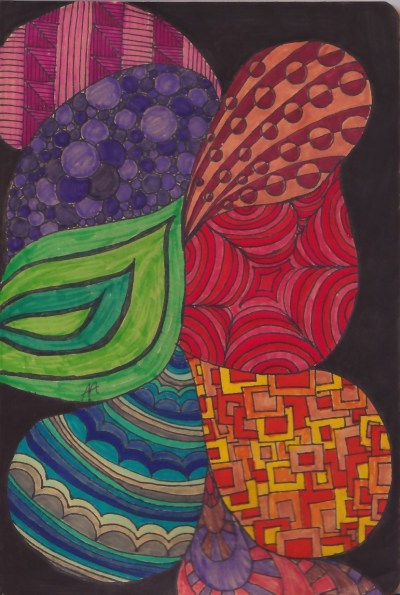
Even better, that positive experience was the inspiration to create something colourful that I’ve titled: Decorated Drops.
 

Eating Healthy, Simply When You Have Hypoglycemia

I’ve learned that eating healthy doesn’t have to be a huge production. These days, it takes a lot out of me to make a meal from scratch. I used to enjoy doing that for myself and for friends, when I had the time, before my illness arrived. There are friends, and some family members, that I’m still beholden to because at some point, beyond the last five years, I promised to make them dinner, which for whatever reasons never came to fruition. Maybe I’ll invite everyone over for a potluck dinner and try to convince them that I’ve paid my debt(s)… Continue reading

Falling Away

I’ve had a terrible time in recent weeks: extremely erratic sleep, high pain levels, low mood, swollen legs and feet, and tears. As terrible as it’s been, I’m always conscious, and working at accepting, that when one has to save their energy to cope with intense pain every day, other things in life sometimes need to fall away.

I’ll use a recent situation to illustrate my point: The sink in my bathroom was replaced. What started out as a small leak became a major undertaking when the exact location of the leak couldn’t be isolated. I noticed the leak months ago. It caused a constant slow drip of water into the cabinet under the bathroom sink. I had to remove all the toiletries and other bits and pieces stored in the cabinet because the drip became strong enough to splatter and get things wet. To prevent water damage I also placed a small container on the spot where I saw the drip landing and pooling on the bottom of the cabinet.

Shortly after I placed the first call to the resident maintenance manager, he came to inspect the leak. After his inspection, he assured me that it was a minor issue he could probably resolve within an hour. He returned the next day with all his plumbing gear and a replacement part for something on the sink’s main pipe. Can you tell I know nothing about plumbing from that statement?

As promised, within an hour he stood up from under the sink and declared the leak fixed. Unfortunately, the next day when I opened the cabinet doors and knelt on the floor in front of the empty cabinet ready to replace the shelf paper and refill it with my things I noticed that an area of the shelf was wet. I was not happy about it.

I placed another call to the maintenance manager. He found it unbelievable that his work had not resulted in a permanent fix of the leak. He returned to my home and fiddled under the sink a few minutes longer than he had the first time. This time he said the issue was not a pipe at all. It was the sink itself, which due to age and erosion had sprung a leak on its bottom. This time, to complete the repair, the sink had to go and a new one installed in its place. When this would happen or how long it would take was up in the air. The maintenance manager first had to check his inventory to see if he had a spare sink that would fit then schedule a time to do the work.

As I said before, that was months ago. While I waited, I moved all the things that once filled the cabinet under my bathroom sink to the hallway outside my bathroom. All those things sat in uneven rows I had to walk past many times every day for months: bottles of shampoo and conditioner, jars of hair gel, bottles of lotions, soaps, hair clips, makeup, and more. I passed it all in the hallway every day and tried to pretend it wasn’t there driving the neat freak inside me crazy. I didn’t fuss or make a complaint about the length of time it was taking to fix what started out as a small leak. Instead, I waited patiently for the maintenance manager to buy a new sink and complete the repair.

This story about the repair and eventual replacement of my sink is akin to what my life has become. Since my misdiagnosis nearly five years ago, I’ve had to allow many things to fall away and become less rigid about who I am and what I find acceptable. I no longer fuss or complain about my circumstances, nor do I push my doctors to do something to make me better NOW; as I did with the doctors at the beginning of all of this. Doctors whom I did not trust, with good reason, since I soon learned they misdiagnosed my illness. Much like waiting for the arrival of a new sink, there isn’t much I can do to hurry things – namely the changes in my health that I desire. Even though treatments continue to be unsuccessful, I believe my current doctors are looking for answers and doing everything they can for me.

I now bear the inconvenience of delayed deliveries, the disappointment of canceled plans, and last-minute rescheduled appointments or treatments as if they were displaced bottles of shampoo and lotions because I understand that sometimes $h!t just happens and I have to roll with it. Still, the most significant thing that has fallen away is any unreal expectation(s) that the first attempt with newly prescribed medication(s) or treatment(s) may instantly cure and make all that ails me better because sometimes the fall from the height of unrealistic expectations hurts more than the pain itself.

Besides, the intensity and wide arc of the moods and emotions (anxiety, anger, agitation, sadness, and more…) don’t serve me well either. In fact, they worsen my pain. Therefore, allowing them and so many other things to fall away is necessary to cope better with my illness. Furthermore, I’m finding that the more I relax about things, the less likely I am to have a pain flare up, which is a small comfort when a body always has pain.