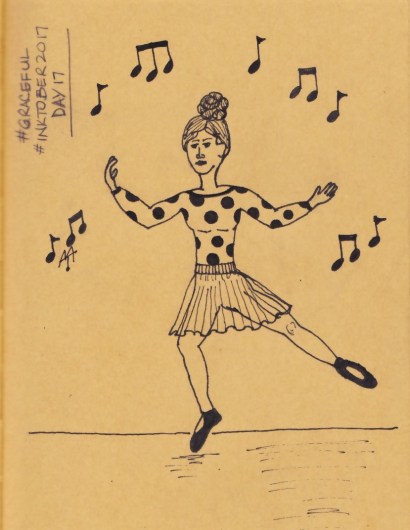
InkTober 2017: Day 17 – Graceful

Women are expected to be graceful – Always. But that’s not a practical thing when you’re a human being, unless you’re a dancer; and even then you may stumble or make a misstep in a choreographed routine from time to time. Maybe that’s why I was a tomboy when I was younger until the end of my teen years. I must have had some internal guidance telling me that it was impossible to live up to the pretty ribbons my mother perpetually tied in my hair and the patterned dresses she zipped and buttoned me into that made it impossible for me to move as freely as I desired.

Being a girl became more challenging as I hit puberty. When my body started to change, in some ways it made playing the sports, which were mostly designated for boys, harder to play. Later, life still became more physically restrictive as I was told how to stand, what to wear, how to paint my face and style my hair, and sometimes how to speak, all in the service of putting my femininity on full display. Yet none of that made me feel graceful. Not the curves my body developed, not the clothes I wore, nor the mannerisms I adopted.

The only times I felt graceful was when I was doing something physical. Doing things that my now deceased grandmother never tired of reminding me were meant for boys: running outdoors, kicking a soccer ball, throwing a football in a perfect spiral, competing in gymnastics, skiing across open terrain or down hills, riding my bicycle, or even my least strong activity, swimming. Doing those things made me feel I had full autonomy over my body to test my strength, and push my physical limits. Unfortunately, my body no longer affords me the ability to do these things as I wish to.

So how does one exercise the gracefulness their body literally prevents them from being? In my case – and I suppose it might be the same for others living with a chronic illness – being graceful has become about how I face the daily challenges and large adversities that loom within all the unknowns to come. One can be the demanding “bull in the china shop” trying to force action from or answers out of doctors, who although they haven’t cured you yet, go above and beyond to figure out what is happening in and to the body they’ve chosen not to give up on and to which they continue to deliver care.

I can also work to preserve what was once plentiful in my physical movement, through mindful interactions within relationships with friends and family. The primary way I see doing this for myself is through acceptance. Accepting that the strength and agility I may be losing from within my body because of continuous pain is being replaced by something stronger, the love and care from those who remain close to me.
 

InkTober 2017: Day 16 – Fat

I have allergies. Thankfully, they are not the severe kinds that make people have to walk around with an EpiPen® (epinephrine injection). Some of my allergies are seasonal and haven’t required much attention by way of taking antihistamines or other remedies for many years. Others are along the lines of sensitivities to foods (e.g. dairy) and the environmental kinds that one can’t escape, such as dust and mold. I also have a couple of odd ones that don’t merit discussion because they are so out in left field. However, there is one allergy that fits perfectly with the image that popped into my mind for the Day 16 prompt: Fat.

I’m allergic to cats. The hairier and the more they shed the worse I react to them. I may sneeze, cough, become itchy from the top of my head down the length of my body, and I have, on occasion, gotten red very-raised hives on different parts of my skin. All of these symptoms can arise without direct contact with a cat. Luckily, taking antihistamines – usually ahead of visiting the home of people who have cats – is helpful with coping. Luckier still, although I’m asthmatic, I can’t recall ever experiencing severe issues with my breathing because of my proximity to cats.

The incredible thing about being allergic to cats is that they ALWAYS seem to know who is. It’s as if they have an internal radar that helps them to hone in on people who are allergic to them. In my case, I’ve had a broad range of experiences that confirm this theory. First, there’s what comes across as a simple friendly behaviour cats engage in to say hello to the new person in the room: purring and rubbing themselves against, around, and through your legs with their entire bodies starting with the tip of their whiskers to the end of their tails. I’ve been told this is just their way of letting you know you’re liked, but I suspect it’s a way of collecting intelligence then marking you for further action(s).

Those further actions may include but may not be limited to sniffing parts of your body, usually exposed parts like feet and hands. There are the frequent strolls-by that involve more, sometimes extended, contact between their bodies and the bodies of the allergy-inflicted. The main goal of this and other contacts being maximizing the transfer of their allergy aggravating hair and dander. However, for me the ultimate action that cats take against the allergy-inflicted is the “I’m-going-to-make-your-body-my-bed-by-stomping-all-over-you-until-you’re-as-soft-as-I-can-make-you” dance.

What this entails is a cat, either stealthy or in one pouncing motion, finding its way to your lap. The most memorable of these stompings came under the feet of a rather large, hairy, old, fat, orange cat. This cat landed on my lap then unceremoniously raised its hind end and tail and started moving in a tight circle on my lap. Each turn caused more hair to fall off its body to my clothes, yet all I could do was sit there until it found the exact position in which it wished to plant itself to take a nap. The length of that nap seemed eternal and I can still picture that fat mound of orange hair rising and falling as it breathed in and out.

When the cat had slept satisfactorily, it slowly stretched its body then lowered itself to the floor and walked away without the slightest hint of a thank you or an apology for lowering my allergic defenses. This action and others like it is why I believe that cats can sense when someone is allergic to them, and no one can ever convince me otherwise.


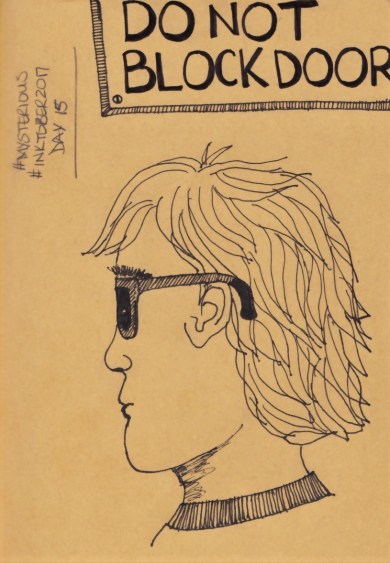
InkTober 2017: Day 15 – Mysterious

One of my favourite things to do when I was a teenager was ride the subway in my city from one end to the next, for hours, while writing. I would sit on a seat that gave me a wide vantage point to watch people as they entered and exited the subway car in which I rode. Watching people’s movements inspired my poetry and prose writing. Trying to see beyond the clothes and blank expressions, they wore, made my mind work to create personas or circumstances I felt suited each man, woman, or child as they moved briefly toward me then permanently away from me out the train’s sliding doors.

On one occasion, I wrote a short poem about a man whose presence caught my attention. He was tall and he stood in the doorway of the train’s car with one shoulder leaning against the Plexiglas-enclosed entryway. However, I couldn’t read too deeply into him because he wore sunglasses, which prevented me from seeing his eyes and made him more mysterious than he probably was. Not being able to see a person’s eyes always makes it difficult for me to read them and in this case, his sunglasses made it impossible.

As the man continued standing in the doorway, I was unable to hide my interest in him. Although I couldn’t see his eyes I knew he was looking at me. As he stood there, I wrote about him and I wondered if he knew he was my subject. I got my answer when the train arrived at his stop. Before he left the train, he looked directly at me and smiled. I was so taken aback by that sudden unexpected connection that I smiled back. I smiled back not knowing for certain why he smiled at me.

As silly as it may sound: to this day, thinking about that experience unnerves me. Why did that man, whose eyes couldn’t be seen, smile at a teen-aged girl while they rode on the same train?