
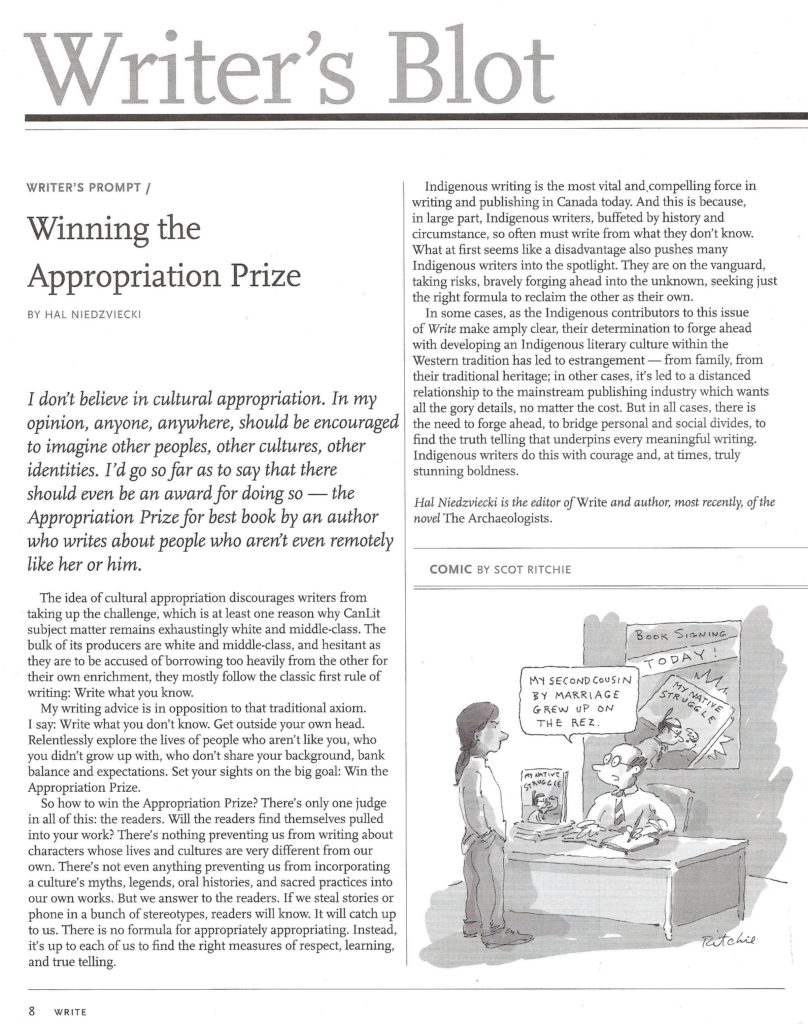
I’ve been engrossed by a shameful display of white (mostly male) privilege exhibited on social media and in widely circulated articles, by a group of powerful Canadian publishers, editors, and journalists in recent days. The words they have used (written and verbal) have caused pain to which they are oblivious. Even as some of them apologized, it was clear they did not understand why so many people are angered and hurt. Some of them, while holding firm or further digging in, continue to defend what they see as an attack on free speech.
This morning, in an interview on CBC Radio, Indigenous critic Jesse Wente, eloquently re-positioned the spotlight where it belongs. He brought back to the fore, the issue of the Aboriginal writers, including Alicia Elliott, who were personally harmed and whose works were overshadowed by the flippant editorial that stated cultural appropriation does not exist and encouraged other writers to write about people and lives they do not know. His emotional and frank statements raise the question of why, in 2017, these discussions are still so necessary.
Jesse Wente – CBC Metro Morning
You can also watch the interview and read the written transcript here on the CBC website.
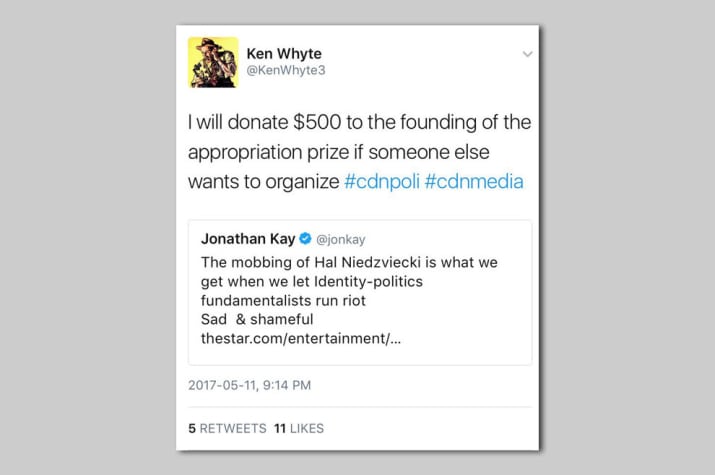
As often happens in controversial cases involving race, Mr. Wente was also called upon on Saturday, by CBC News, to engage in debate about Aboriginal cultural appropriation with the editor/journalist whose offensive tweet was the catalyst for the call to donate to an appropriation prize. In that interview, it was remarkable to watch as Mr. Wente’s words fell on the ears of a person who is so disconnected from the barriers racism and other social justice issues can sometimes impose. From his position of power, which is propped up through multiple societal constructs, said editor/journalist was both condescending and immovable.
Appropriation vs. artistic freedom – CBC News Interview
That editor/journalist has since resigned from his role as editor-in-chief at a Canadian literary magazine. As part of his reason for resigning he noted, “The Walrus Foundation is moving in a direction that is different from what I was hoping. My dream was always to create a Canadian version of Atlantic magazine, which offers intelligent well-researched viewpoints and articles on all sorts of issues, including controversial topics,” he said. “The cultural appropriation issue would be only one small example of that.”
For further insight into this issue more articles are listed below.
The cultural appropriation debate isn’t about free speech — it’s about context – Alicia Elliott – CBC Arts –
The unbearable whiteness of being (oblivious to privilege) – Ricochet
A Note from the Publisher and Executive Director – The Walrus
‘I invoked cultural appropriation in the context of literature and writing only’: Hal Niedzviecki – CBC The Current
Jonathan Kay resigns as editor of The Walrus amid cultural appropriation controversy – The Globe and Mail
Walrus editor Jonathan Kay quits amid free speech uproar: ‘I have been censoring myself more and more’ – National Post
It may be harmless appropriation to you. But it’s our preservation – The Globe and Mail
Cultural appropriation and the privilege of creative assumption – The Globe and Mail
Cultural appropriation: Why can’t we debate it? – The Globe and Mail
Debate over cultural appropriation a centuries-old battle for Indigenous groups – The Globe and Mail


 My Small Surrenders