Surgical Scar Struggles

I started writing this post in early September of last fall, after taking a long look at the 11-centimeter (just over four inches) surgical scar that starts at the bottom of my belly button and makes its way down my lower abdomen on to my pelvis. When I started writing it, I was feeling optimistic because it was starting to shrink and fade, but my mood shifted as I started to think about it being a lifelong reminder of what I continue to live through. I forgot that I had started writing it until recently when I read a post on Nursing Notions site titled ‘Not Yet Defeated’ about her experience with surgery and healing.

As I wrote last September, it hit me that my scar is more than a thick, raised, itchy, line in my skin that will never completely disappear. It is a constant reminder of so much. This vertical line is evidence of the most significant attempt to resolve the suspected cause of my chronic abdominal pain and the pain that grew from it and now radiates down my legs, out into my hips, and up my back. It is a reminder that a surgical team led by one of the most skilled surgeons in my city sliced through layers of my skin, fat and muscle that protected my abdominal organs to explore the space cradled by my pelvic bones to find the growth that shouldn’t have been there and remove it. My fading surgical scar will always remind me that although the surgery wasn’t as invasive as expected and the growth was cut out, it failed to get rid of my pain.

That may be the worst thing about having to look at my scar each time I undress or every time I touch it to scratch the itch: I remember the failure. The itch tells me the scar is healing, still shrinking, while my pain remains the same. Eighteen months after my surgery, regardless of how liberally I massage rich moisturizers into my skin, the itch won’t go away. Before the creation of my scar, I had already been through so much. Now, while it sits so prominently on my lower abdomen, I continue to live with the pain and more failed treatments. I thought that was more than enough. That was until I started planning a trip where I’ll have a chance to submerge my body in saltwater then allow myself to float to the surface towards warm rays of sunshine. Then, for a moment, I felt something unexpected…

Apart from my doctors, some family members, and a few close friends, I’ve taken comfort in not having to show my scar to anyone. The thought of having anyone stare at my scar is unsettling, and I’m not ready to have it become a conversation piece. When I pulled out my swimsuit bottoms recently I unexpectedly felt overwhelmed with self-consciousness. I’m no exhibitionist but I’ve always worn fairly conservative two-piece swimsuits because a one piece/maillot reminds me of high school gym classes. This means that to enjoy the water the way I’m looking forward to I need new swimwear because everything I own puts my once scar-free abdomen on display.

After anxiously searching online for hours, I finally found bottoms that cover my abdomen all the way up to my belly button completely hiding my scar. I know that in the grand scheme of all I’m living with this probably sounds vain and superficial, and it shouldn’t be a big deal. However, it’s a big deal to me because it’s another thing, more change, for me to adjust to. My life changed the day my pain started, it changed after each inconclusive test and invasive procedure to get to a diagnosis, it changed again with the first slice of the scalpel into my flesh and each stitch to close me up, and it continues to change with each failed treatment and every handful of pain medications I swallow daily.

My scar will always be with me as a symbol of what I have to live with because of my illness. My frustration is not knowing when or how deeply, coming into awareness of more changes will affect me in the future. However, I must believe I can find ways to live with it all: this time it’s in the form of spandex and nylon swimsuit bottoms. And I’ll do whatever I can to adjust to the next change when it arrives.

New Swimsuit Bottoms

iRest: Groundless Ground

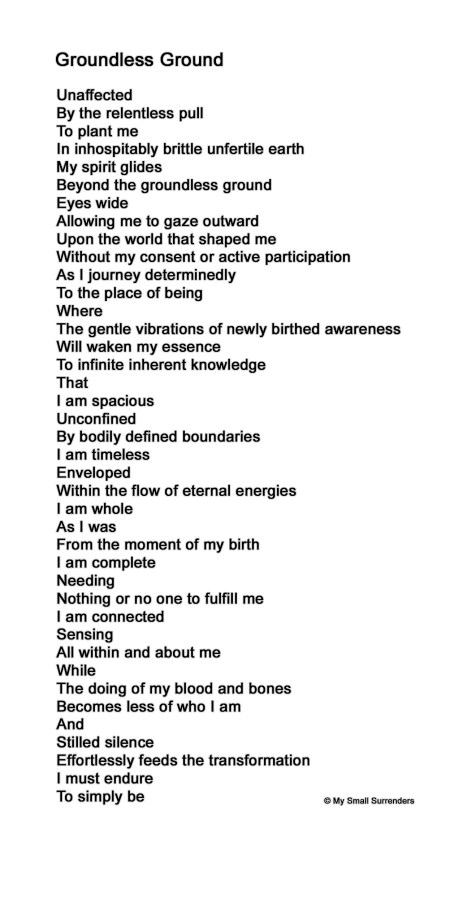
During the iRest program I participated in last November, I spoke with the doctor who facilitates the program about a memory from my childhood that surfaced. I quite vividly remembered a day when I was walking home from school – I’m guessing I was in eighth grade – when I suddenly felt a sensation that might be characterized as an out-of-body experience. I felt as if I wasn’t physically connected to the ground beneath me. I didn’t feel completely connected to my body either, but I could sense and see everything around me it was as if I was simply witnessing what was happening through my eyes. I felt that at any moment, I might float away but, because gravity was doing its job, I wouldn’t go flying off the planet.

I know it sounds strange and I can’t remember having that experience at any other time in my life: the awareness of not actually walking down the street in my body. The iRest program was probably the first time I thought I wouldn’t be considered odd if I shared it, mainly because we talked about the abstract concept of a person’s essence and being, rather than the soul. When I described this memory to the doctor, she told me there is a name for what I experienced. It relates in psychological terms to our consciousness and metaphysically to our essence or being. The experience is known as the ‘groundless ground’, which may even be likened to the ‘witness state’ in meditation. It was a great relief to have a frame of reference for the memory of an experience that felt so strange.

As we discussed it further, the doctor explained more about the metaphysical concepts of ‘essence’ and ‘being’ and asked me to spend some time thinking of what about me, my being, has been consistent throughout my life. Of course, the one thing that surfaced was writing, more specifically writing poetry. Writing poetry may be the one thing in my life that is never forced or analytical and has been part of me for more than half my life. It may be the only thing about myself I never question nor do I wonder why or where it comes from; and of course acquiring this new insight inspired me to write poetry.

Groundless Ground

iRest: Learning to Do Nothing

In the fall of 2014, my therapist introduced me to a, new to me, meditative practice called Yoga Nidra, which translated from Sanskrit to English means ‘yogic sleep’ or ‘sleep with awareness’. This yoga practice is said to be “an immensely powerful meditation technique, and one of the easiest yoga practices to develop and maintain.” To teach me the Yoga Nidra practice he used materials developed for the iRest Yoga Nidra Meditation program. iRest “is currently being utilized in VA hospitals, military bases, hospitals and clinics, hospice, homeless shelters, community programs, and schools. Research has shown that iRest effectively reduces PTSD, depression, anxiety, insomnia, chronic pain, and chemical dependency while increasing health, resiliency, and well-being.”

The few times we worked on the practice during therapy sessions, I felt sensations in my body that I couldn’t articulate. To be honest, the unfamiliar sensations I felt in my body freaked me out, which might be why when I used the recorded guided meditations at home on my own; I had great difficulty working through the exercises. Ironically, it was also hard for me to relax and even harder to find a comfortable position so I could focus. I told myself, and my therapist, it was too hard for me to practice alone, and I made myself believe that. After a short time trying the practice, I gave it up.

A few months ago, my therapist told me about a six-week iRest group program held at a local hospital that still had space available and he asked if I might be interested in taking it. I was a bit hesitant because it obviously meant weekly travel that would undoubtedly increase my pain, even though it was just a short cab ride from my home, but I agreed to have him send a referral on my behalf all the same. The program started at the beginning of November, and I wasn’t at all surprised that my health issues met the requirements for me to take part. I was skeptical at first because of how I had felt when first introduced to the practice but I was open to learning more about it in a structured group setting.

The first class of the program introduced us to a meditation similar in some ways to a body scan in mindfulness meditation with the striking difference that your awareness isn’t focussed on your breath and body. With iRest, you focus your awareness on sensations in your body, your body’s energy, and all energy around you. As the program progressed, the class materials, discussions, and meditations became more intense. Through the iRest meditations, the reading materials, and group discussions I was better able to understand my struggles with certain issues. Interestingly, a discussion about fear made the most significant impact on me. We discussed how paralyzing it could be, especially when we don’t understand the origin of our fears.

Over the course the program, we learned to identify what is called sankalpa or personal intentions for each meditation in the practice. I focussed on the issues that seem to consume so much of my time and energy. Thankfully, there was content in the classes I connected with that I felt related directly to my issues: trying to accept my illness and that because of it, I now do nothing. I came to understand that acceptance is not about resigning myself to or giving up on an issue, nor should it be a struggle because acceptance should come without effort. What I’ve been doing is fighting against what exists, which creates mental and emotional pain and intensifies the physical pain in my body. This added pain, mental and emotional, is triggered each time I compare what exists now with my former, pre-illness life. It’s triggered whenever I project my anxiety and fears and attach unproven meaning(s) to the actions of anyone with whom I interact.

The solution to end the extra pain is to do the other thing I fight against: nothing. In doing nothing we connect with the purest form of being. Doing nothing allows us to disentangle our existence from the identities we create because of the work we do and to fit into our various social environments. This uncovering, or unmasking, is necessary to understand ourselves. I recognize now, that my illness is an opportunity to strip away the many masks I wore because I needed to fit in to the world around me, including within my family. For the first time, in my life; I don’t have to justify my existence. I can just be myself, which in this moment means not working and definitely not beating myself up while I do nothing, which is so necessary for me to heal.

Because I couldn’t understand this before, my instincts led me to fight against losing what I’ve known my whole life: constant busyness and doing. Even though, always being busy and doing things is not the whole of who I am, nor is it the complete picture of any other human being. Continuous activity actually prevents us from connecting with our true selves and attending to our needs. Through the iRest program and the self-inquiry it required, I know that what I was really struggling with since the arrival of my illness was my fear. Definite fear about having an illness that still defies complete diagnosis and treatment, but also fear of not being able to point to an identity grounded in constantly doing to show the world or myself who I am.

Of course, there’s a lot more to the iRest program than the small snapshot I’m recounting, but after those six weeks I feel less conflicted than when we started out. More importantly, I feel gratitude about what I learned from iRest, and ultimately about myself, this time around. Unlike the first attempt, two years ago, when I let my fear get in the way of experiencing something new, I also see the value in developing a solo practice. My intention is to continue with the meditations from the program and my self-inquiry. I am practicing to gain as much benefit as I can so the fears I’ve been holding and struggling with – and the many fears I’m certain have yet to emerge from my subconscious – will no longer overwhelm my being and existence, even if my illness remains with me indefinitely.

Just Be