The Toll of Opioid Pain Medications

Reading this article a few days ago, gave me pause: Opioid death toll in Canada nearly 4,000 last year, new data show.

I’ve been taking opioid-based (narcotic) pain medications since the first day of the hospitalization for my illness, almost five years ago. After my admission to the hospital emergency room, the first thing the ER doctor recommended to give me for my pain was Oxycodone. My pain was so intense that I could barely talk, but I refused it because I knew taking it would cause me to become incoherent and prevent me from clearly explaining what I was experiencing. The doctor tried to convince me to take it by telling me that I needed it to control the pain so she could examine me.

I knew I couldn’t tolerate even the gentlest touch without some kind of medication to dull the pain. However, I also knew the risks associated with this particular pain medication, which at that time, was already identified as a major culprit at the heart of the opioid epidemic. So taking it, even one time, was not something I wanted to do. The doctor deferred to my concerns and instead gave me a non-opioid medication by injection that kept my mind clear so I could have a lucid conversation about my medical history and current symptoms with her. It also gave me a chance to ask questions about my initial diagnosis and what actions she intended to take to confirm it.

After all the test results came back with a preliminary (and very wrongly assessed) diagnosis, the doctor again recommended that I take the Oxycodone. By that time, I was so exhausted and still feeling such incredible pain that I relented and agreed to take it. I asked her to prescribe the lowest possible dose that would still deliver some pain relief and she ordered it. Unfortunately, even though I was taking it at that low dose, it fogged my mind. It took a great effort to concentrate enough to talk, sit up in bed, or move in general. Everything felt like it was happening around me, in slow motion, and I felt a near total loss of control.

In the following days – in a semi-private room on the surgical ward of the hospital – the doctors continued to prescribe the same low dose of Oxycodone for me. After the third day, I had to demand that they stop giving it to me because of how unable I was to make sense of things unless everyone spoke very slowly and, more importantly, I started hallucinating. The hallucinations were so frightening that during one of them – despite the terrible pain – I got out of bed to search for someone who turned out to be a figment of my drug-distorted imagination. Thankfully, the doctor on-call listened to me and prescribed another opioid-based pain medication I was better able to tolerate; and Oxycodone is now listed on my medical records as a medication that I can NEVER take.

I know that it’s been reported that many of these opioid-related deaths are because of “recreational use” of certain opioids or after a patient has developed an addiction. Still, with the high doses of prescribed pain medications I take now, I’m at risk of developing an addiction or, heaven forbid, accidentally overdosing. Because of these risks, I’m very careful about taking my pain medications exactly as prescribed. I also make sure I pay close attention to any changes in the way my body reacts to these pain medications or whether any of the known, critical side effects suddenly appear: severe dizziness and/or fainting, trouble breathing, unusual drowsiness and/or difficulty waking up, and/or seizures.

Beyond these very real and frightening concerns, I must also think about the longer-term physiological effects of taking opioid-based pain medications. I’ve been taking them in one form or another since this all started, therefore, my liver and kidneys work, and have worked, overtime for nearly five years to process these drugs throughout my body. Because of this, my liver and kidneys get tested regularly to make sure they continue to work within normal levels and won’t add more complications to my already poor health.

There’s also the possibility that the longer I take these opioid-based pain medications that they could, one day, stop working without any warning. Worse still, I could develop a condition where instead of the medications managing my pain they cause me to feel more pain. This is because “taking opioids over a long period of time may in fact increase a patient’s sensitivity to pain (hyperalgesia). This happens because long-term use of opiate painkillers causes a decrease in your ability to tolerate pain and an increase in sensitivity to pain. In fact, people taking opioids long term may keep having pain, or may see their pain increase, long after the original cause of pain has healed.”

These are some of the thoughts and fears I live with every day. With every dose of the opioid-based pain medications, I take to cope with my pain. However, I recognize that although this is my reality, I feel blessed to be alive to have these thoughts and fears.

My heart breaks for anyone who has lost their life to this health crisis and those who have been left to mourn them.
 

The Pill Box

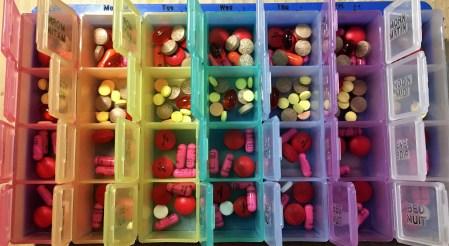
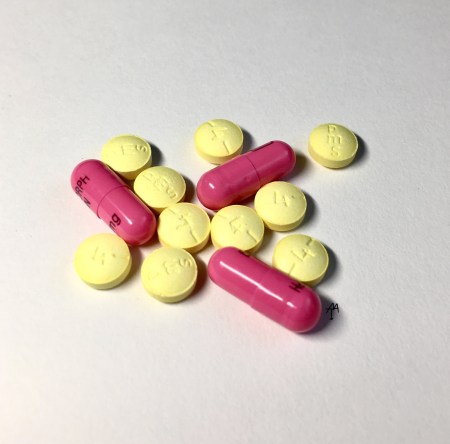
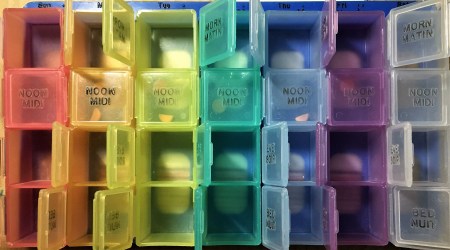
Every week, either late Saturday night or at early light Sunday morning, I go through the ritual of filling my pillbox with my medications. My pillbox has 28 compartments. Each gets filled with a varying number of medications in the form of pills or capsules. On average, I take a combination of about 32 pills and capsules each day. However, the 32 pills and capsules don’t account for all the medications I take daily because I have others that come in different forms i.e. liquids, inhalers, and – on the odd occasion when my gastrointestinal system protests against ingesting certain types of oral pharmaceuticals – suppositories. Early on in my illness, I was even prescribed a topical anesthetic for pain that came in patch-form, but it did little to reach the source of the pain deep in my pelvis.

The largest part of the pills and capsules that fill each pillbox compartment are medications I take to manage my pain. They aren’t all opioids/narcotics, but the majority of what’s in the compartments usually is. Unfortunately, not all these medications always do what they are prescribed to do. Therefore, over the last four years there have been many changes made to my medications. Changes in doses are usually an increase in strengths – as petite as I am I seem to need large doses to manage my pain –, but I’ve learned that dose increases doesn’t have to mean an increase in quantity. Some medications have also been swapped for others of equal strength when they have caused unexpected side effects or delivered no benefit at all after weeks and in some cases, months of hoping for some relief with them; and occasionally new medications get added to the mix in an effort to boost the benefits of what works.

The Pill Box – 1

The Pill Box – 2

Sometimes, the number of pills and capsules I take might fluctuate from day-to-day. That fluctuation depends on whether my doctor(s) writes prescriptions for medications with a minimum and maximum dose. Because my pain medications are largely opioids/narcotics, I try – not always successfully – to take the lower end of a prescribed dose when possible to manage my pain. My Pain Specialist prescribes my primary pain medication in two forms. The first is a long-acting opioid/narcotic prescribed to be taken multiple times each day that is intended to manage my pain for a scheduled period. The second is a breakthrough or ‘rescue’ dose of that same opioid/narcotic that I take in between the long-acting doses; especially in times when my pain levels are high, which is most of the time. I try to take that breakthrough medication on the lower end of the prescribed dose(s), when I’m having a good day, which is rare; or if I’m lucky enough to sleep through the night the overnight breakthrough dose gets skipped.

The main point of having a pillbox is to make sure I don’t miss scheduled medication doses because I take so many throughout the day. Unbelievably, I’m not always successful and might miss a dose of something from time to time, whether it’s because I get distracted or I’m fortunate enough to get some restful sleep. Nonetheless, the brightly coloured compartments of the pillbox that I fill with brightly coloured pills and capsules is my constant companion and may remain so as long as I need a reminder to take 32 pills and capsules – give or take a few – each day.

If you don’t have a pillbox, how do you remember to take your daily doses of multiple medications?


Opioid Induced Constipation & The Undignified Big Pharma Response

Last Sunday, like millions of other people, I watched Superbowl 50. As usual, there were some great commercials throughout the game. However, I can’t forget one commercial from the 2nd quarter. Not because it was funny and creative like most of them were, but because of the targeted medical condition: opioid induced constipation (OIC). The reason I can’t forget it was how embarrassed I felt as my friend with whom I watched the game laughed at the inappropriate humour the pharmaceutical company used to promote its product. For those of you who don’t suffer from chronic pain or have never had the need to take opioid (narcotic) pain medications for pain relief, I assure you this condition is a real thing. The Australian Pain Society states, One of the most common adverse effects of chronic opioid therapy is constipation. Up to 95% of patients prescribed an opioid report constipation as a side effect, which can occur soon after taking the first dose.”

Opioid induced constipation is also known as opiate bowel dysfunction (OBD); and according to the American College of Gastroenterology “constipation may be debilitating among those who require chronic analgesia [pain relief]. OIC/OBD affected an average of 41% of patients taking an oral opioid for up to 8 weeks.”   The reason for this is that “opioids cause constipation by binding to specific receptors in the gastrointestinal tract and central nervous system, resulting in reduced bowel motility through direct and indirect (anticholinergic) mechanisms.”  In short, the opioid pain medications delay or block messages throughout the body that tell you when you need to empty your bowels.

I understand that a commercial’s purpose is to grab its audience’s attention in a short time. However, the tone of this commercial failed to convey the seriousness of this condition, while using lowbrow humour to flog the product. Practical Pain Management, a publication founded and written by pain experts, notes that although opioids have been in use for centuries; it’s only in recent decades that this kind of medication has received any significant attention and investigation. Sadly, we are only beginning to understand and identify the many side effects of opioids. Constipation, nausea, emesis, pruritus, respiratory depression, and somnolence are well known. However, not so well known are effects on immune function, urinary retention, endocrinopathies, gastroesophageal reflux (GERD), gastroparesis, sleep apnea, cardiovascular system, osteoporosis, emotions, dentition, and renal function.”

This lack of knowledge about opioids begs the question, how many people know that if a patient that has OIC/OBD does not receive the proper medical treatment it “may cause rectal pain and bleeding, abdominal pain and distension, urinary incontinence, faecal impaction, rectal tearing, and, in very severe cases, bowel obstruction and colonic perforation?”  How aware are people that OIC/OBD can reduce a person’s quality of life as much as the chronic pain doctors prescribe the opioid medications to treat? The Australian Pain Society also notes that, Some patients would rather endure chronic pain than suffer from the severe constipation that can arise with long-term opioid therapy. One study found that approximately one-third of patients missed, decreased or stopped using opioids in order to make it easier to have a bowel motion; the majority (86%) of these patients experienced increased pain as a result, which reduced their quality of life. Reducing the opioid dose is not considered useful, as analgesia [pain relief] may be compromised and constipation may not resolve.”

I know that 30 seconds isn’t a long time and not all the points I raise most likely could have been touched on in that amount of time. However, I do know that the pharmaceutical company could have approached this issue in a more dignified way. When the commercial ended – and my friend’s laughter died down –, I did educate him about the seriousness of OIC/OBD, and how I’m affected by this condition because of the large doses of opioid pain medications I have to take to manage my pain. I hope that others who might have been in the same situation during the game were able to have similar conversations. If not, here’s a link to a therapeutic brief from an Australian Pain Society study that gives information about OIC in plain language in a downloadable PDF file: Opioid-induced constipation– a preventable problem


Bob Dylan – Dignity