Never Doubt Your Lived Experiences

Being ill with all these glorious old and all the wonderful new symptoms is teaching me a lot about the people in my life and myself. However, I think the singular most important thing is that I should never allow another person – not even a doctor – to make me doubt my lived experiences. What I’m living through cannot be completely understood by another person, so why should I allow another person to question my experiences. Why should someone else get to tell me how much pain I should be feeling, why I shouldn’t take so much pain or other medications, or believe they have the right to question why my surgery didn’t deliver the results they expected. Why am I allowing their questioning about my health to make me doubt the value of my lived experiences?

I’ve caught myself allowing some of these doubts to creep in before. This morning a close friend reminded me why I shouldn’t allow that to happen. I spoke to him yesterday about the swelling in my legs and feet then sent him a photo so he could see the extent of it. He called me this morning to tell me how shocked he was by the photo. His exact words were, “When someone tells you their feet are swollen you try to imagine it, but when I saw the photo of your feet I gasped.” He was shocked at how “unrecognizable” my feet are. He said he couldn’t imagine how I must feel or what I’m going through while trying to cope with this on top of everything else.

His expression of empathy toward me was the jolt I needed to remind me that I should never doubt myself. Because of doubting myself, I was delaying going to see my family doctor to get my legs and feet checked because I told myself the swelling isn’t a big deal – the swiftness with which my doctor responded to my email yesterday clearly says I’m wrong. I downplayed this symptom because I was allowing the voices from other people telling me I should be better by now to cloud the reality I’m living with. I’m not better yet. My surgery did not eliminate my pain. I’m taking a significant amount of pain medications because they make it possible for my body to move so I can do basic daily tasks. My legs and feet are swollen beyond recognition and the swelling is adding to the difficulty I already have with walking.

What I’m experiencing is real. What I read that is written by others with health issues, general life issues, or just things from their lives they want to share, are real experiences. No one ever has the right to make another person doubt their lived experiences – their reality – and I have to remind myself of this more often.


Adele – Chasing Pavements
Struggling With Acceptance

I’m struggling with acceptance: acceptance of my own circumstances. Currently, I have no control over what my life looks like from day-to-day because my pain is so unpredictable. This past week I suffered through multiple days with feet and legs so swollen they hurt and made it hard to walk. I didn’t get much sleep either, and as I write this, I’m in the midst of a pain flare for which I’ve had to take the highest doses possible of my pain medications for a few days. If I don’t get some relief with this amount of pain medications, I have to go to the emergency room to get help.

What I’ve outlined is only some of what I can’t accept on days like this. Over the last little while, I can’t accept that after more than two years of countless tests, so many invasive procedures, and a rather risky surgery, I have no pain relief. I can’t accept relying on handfuls of pain medications to allow my body to function, while they cloud my thinking. I can’t accept that the only time I don’t feel pain, is when I’m asleep; and the irony that sleep is a state that is so difficult for me to reach because of my pain. Nor can I accept that the sleep I so desperately need sometimes never comes or, when it does come, is interrupted by my pain. This cycle makes me feel like a helpless hamster performing on a spinning wheel for a treat that never comes.

As much as I’m having difficulty accepting my pain, I’m having even more difficulty accepting the compassion and generosity of the people in my life. The people who are trying to help me cope with the pain and all the adjustments I have to make in my life. I know this doesn’t’ make sense, but it’s hard to go from living an independent life with what seemed like endless years of adventurous activity ahead of me to being someone who can barely get out of bed some days. I know I have trouble accepting their compassion and generosity toward me because I’ve always had trouble showering myself with these things. Although, I have no difficulty expressing and abundantly giving these things to others – and I never have, not even now that I’m ill.

I’m starting to question whether this lack of acceptance and being hard on myself, and having expectations that others don’t have of me – not even my doctors – are harming my health. My therapist has an exercise he asks me to do where I am to imagine that I have a close friend or a twin living with my challenges and feeling as I do. I have to give them support and tell them what I think about how hard they are on themselves. The result is always the same: I’m able to see how ridiculous it is that I can feel compassion and empathy for someone else, but unable to feel them toward myself and unable to be gentle when attending to my needs. When we finish this exercise, I promise to work harder at being gentle with myself because I know it’s the right thing and best thing to do for myself. I do try. Really, I do, but it’s hard. It gets harder each day that I don’t know what to expect from my body.

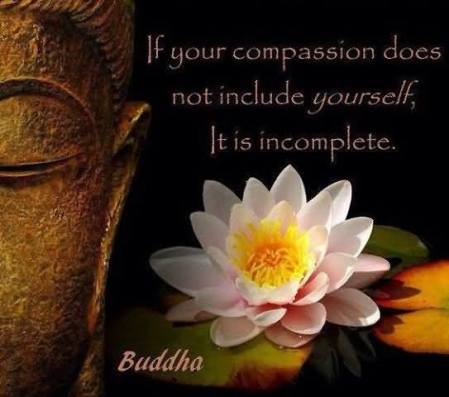
I’m afraid that my struggle with acceptance is doomed to continue as long as my pain continues and will need my attention for a long time to come. Whenever I feel this way, I remember this quote, “If your compassion does not include yourself, it is incomplete.”

If Your Compassion - Buddha

I believe this is true, so I know the right thing to do for myself, to break my struggle with acceptance of my pain and my changed life is to treat myself with more compassion, just as I would with someone I care about.


Pain Clinic #7: Trying Alternative Pain Treatments

I had my third appointment at the pain clinic since having surgery in August. Each appointment I have makes me aware of how fortunate I am to have access to such an incredible resource. My pain may not be gone, but I have specialists working to support me and trying to find the root cause – and hopefully the cure – of my pain. My primary doctor at the pain clinic is a wonderfully compassionate woman who is open to exploring as many alternative treatments as possible to treat my pain.

During this appointment, we reviewed my pain medications. I’m still taking a considerably higher dose of the opioid pain medications than I was before surgery, but I’ve been trying to decrease the doses over the past few months. I’m keeping a daily log detailing how much I take throughout each day. My pain specialist encouraged me to continue keeping this log because it’s helping to identify trends in my pain. I can pinpoint when I have a pain flare up and what activities may cause it, and whether I need to increase the doses of my pain medications. To support these trends she wrote me prescriptions for each of my pain medications with quantities large enough for me to increase or decrease my doses as my pain dictates.

Acupuncture was the next thing we discussed. My pain specialist is a trained acupuncturist. By all accounts, she’s highly skilled. Knowing that as a medical doctor – she’s an anesthesiologist – she has a holistic approach to treating pain makes me feel encouraged. One of my next appointments with her will be in the treatment centre of the pain clinic – where I had my nerve block  – for acupuncture. Her hope is that acupuncture treatments will help to reduce my pain and my need for such high doses of pain medications. My hope is that the treatments will deliver those results, and much more.

We also talked about the Mindfulness-Based Chronic Pain Management (MBCPMTM) program offered at the same hospital as the pain clinic. The program teaches patients “how to manage their chronic pain and illness through Mindfulness and meditation practice, and better lifestyle skills.” It’s based on the Mindfulness-Based Stress Reduction Program (MBSR) originated by Jon Kabat-Zinn. My pain specialist is referring me to the program to give me another option for managing my pain. The idea for me to try this program originated with my therapist because our therapy sessions include mindfulness practices. My pain specialist believes this program will be a beneficial addition to the practices I’m already including in my life to cope with my pain. I believe, whatever the outcomes, I have an incredible support system that keeps working to find solutions to get me pain-free.


Third Eye Blind – Semi-Charmed Life