Can Pain Kill You?

Can pain kill you? According to the responses from my Google search, yes, it can.
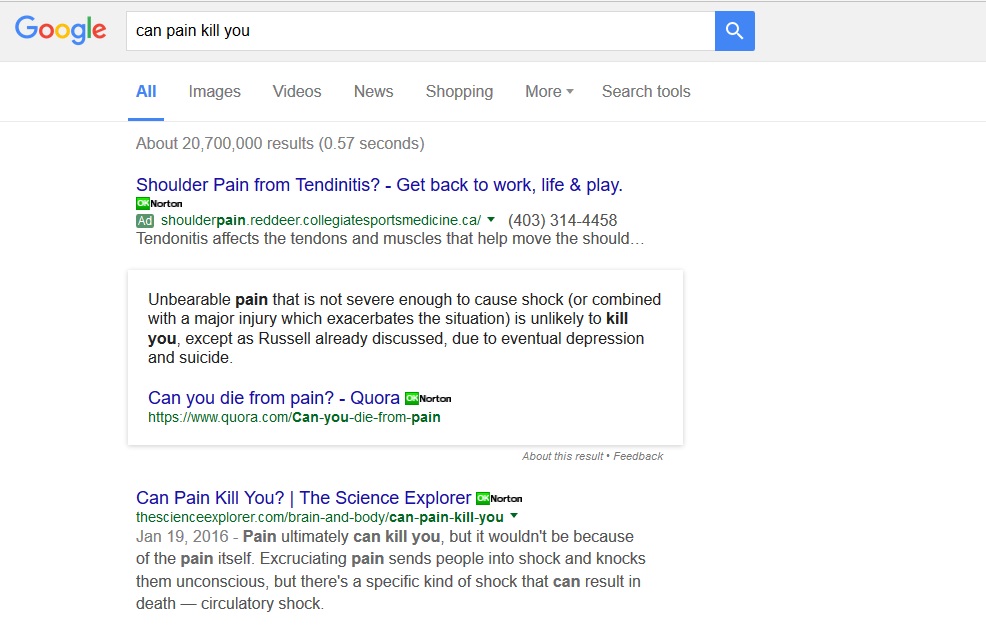
Can Pain Kill You

Some days, like today, I feel like my pain might kill me. I know that might sound over-the-top, but if you’ve never experienced debilitating pain, there’s no other way for me to describe it. When I used to get frequent blinding migraines or my monthly menstrual cramps made it impossible for me to get out of bed, I always took comfort in knowing that those pains would eventually end. Now, with this pain, there is never any relief. There is no day on the calendar or time frame after taking medication that I can look forward to because they mean there will be an end to the pain threatening to split my skull open or implode my reproductive organs. The pain radiating from deep in the right side of my pelvis, out towards both hips, down both legs, and up my back has no schedule or half-life to which I can look forward in anticipation of relief.

Some days, like today, the pain is so unbearable; walking, standing, or even sitting still, hurt so badly I don’t know what to do with myself. I don’t know what to do with this anxious energy racing through me that probably adds to the frenetic activity within my nervous system and amps up the pain. I don’t know how to make myself comfortable when I sit because no surface can ever be soft enough against my aching tender skin. While just the thought of trying to rub and massage the hurting parts of myself makes me cringe and nauseated to the point of wanting to vomit.

If the pain, like the type of pain I feel, can kill a person by pushing them to suicide, I can understand why. I’m not, by any means, contemplating ending my life, but I’m uncertain about how long – it’s been three years already – I can live like this not knowing when or if I will get any pain relief. How long can I continue to accept being characterized as a “mystery patient” by my doctors who can’t pinpoint why my body is still reacting, to a growth that is no longer in my pelvis, before it becomes too much to bear? A psychological episode most likely will not be what brings my life to its end. It could very well be the stress of constant pain on my body that makes my blood pressure boil over, causing a stroke, or my blood could become poisoned by the copious amount of opioid pain medications I take, leading my organs to start to fail. Que sera sera…

I know none of this is helpful or optimistic, but this is where my pain sends my mind on days like today when I hurt so badly I don’t know what to do with myself.


Bittersweet: Living With Chronic Pain And Hypoglycemia

I’m hypoglycemic. Hypoglycemia is “a condition characterized by an abnormally low level of blood sugar (glucose),” in your body. Blood sugar/glucose is your body’s main energy source, and low levels can cause some big problems. Think extreme sugar crashes that cause you to get “the shakes” and cold sweats, and in extreme cases pass out. This is not a good thing when you’re a chronic pain sufferer. Being in pain all the time makes it hard to follow a regular schedule for meals because intense pain makes it difficult to move, which means preparing something to eat isn’t always easy. The high doses of pain medication don’t help either. If my appetite isn’t dampened by unbearable pain, I often don’t eat because I’m too groggy to focus or stay awake, or I can’t remember the last time I ate something.

I was diagnosed as hypoglycemic about two decades ago. The doctors, who diagnosed me, were never able to give a specific cause for this condition in my body. I saw multiple endocrinologists who are doctors that specialize in diagnosing diseases related to the glands and treating “people who suffer from hormonal imbalances, typically from glands in the endocrine system.” For an endocrinologist, “the overall goal of treatment is to restore the normal balance of hormones found in a patient’s body.” In my case, not only was my blood sugar dangerously low, but my insulin levels were ridiculously high too. This was significant because insulin is the hormone in the body that keeps your blood sugar level from becoming too high (hyperglycemia) or dropping too low (hypoglycemia). Insulin does this by allowing “your body to use sugar (glucose) from carbohydrates in the food that you eat for energy or to store glucose for future use.”

Unfortunately, I didn’t know that this process hadn’t worked properly in my body for a long time. What I thought was just exhaustion from overwork was actually my body getting close to shutting down. Following my diagnosis, I underwent a barrage of tests to figure out the best treatment(s) for me. Each endocrinologist I met with had different theories about why these imbalances existed in my body. More surprisingly, each one had a vastly different treatment approach he wanted to use to restore my blood sugar/glucose and insulin to normal levels. The most extreme was an endocrinologist who wanted me to undergo surgery so he could manually massage my pancreas on the off chance I might have a microscopic pancreatic tumor. I opted not to do that because the CT scans I had before seeing him showed no sign that any such tumor or other growth(s) existed.

Bittersweet - Blood Glucose Monitor

What finally helped me to re-establish normal blood sugar/glucose and insulin levels wasn’t surgery or medications. It was changing the way I eat. I did not go on a diet. However, I had to eliminate some foods (processed carbohydrates with added sugars) and add more of others (high protein), and I had to eat more often throughout the day – what some people refer to as grazing. I also had to start using a blood glucose monitor to check my blood sugar levels daily. It took a long time to get used to these changes, but I felt a definite improvement in my health and had fewer and fewer low blood sugar episodes, which was a relief because passing out is never fun.

Over the years, whenever I’ve strayed from my proven formula of a specific balance in my meals and eating frequently throughout each day, I feel a change within my body. I start to feel sluggish, weakened, and off balance and I have had episodes of fainting without much warning. I’ve been feeling some of those symptoms more and more over the last three years. Sadly, a few weeks ago I had to start monitoring my blood sugar levels on a daily basis again. It hasn’t reached dangerously low levels, but it’s been low enough on a few occasions that I have to be vigilant about eating more and more often. As I stated before, eating as I should, because of my pain, is not easy now but my experience with hypoglycemia reminds me that the alternative is a lot worse.


The Archies – Sugar, Sugar


When Hoofbeats Mean Zebras

For some time I’ve been having a recurring dream – actually, it’s now a live waking vision – that I make an appointment to see the doctor who started me on my journey into chronic pain. She no longer works at the hospital where I was first treated for, and ignored when I described, my severe pelvic pain so I would need to do some detective work to track her down. Why would I want to exert any effort to see her you might be wondering? Well, when someone irreversibly changes your life for the worst you get an overwhelming desire to confront them to see the look on their face when you recount for them the hours, days, and months of endless pain you now live with because of their avoidable mistakes.

I believe I deserve an opportunity to tell her how disappointing it was – and continues to be for me – that a female physician was so dismissive of me when I described my pelvic pain symptoms. During my hospitalization, I tried, unsuccessfully, to share my medical history, and family health history, with her on the off chance there might be a relevant connection to something from my past or genetic ancestry. I want her to understand that just because a patient presents some symptoms for a particular illness that they could still very well have something else, and that the old saying of when you hear hoofbeats, think of horses not zebras isn’t always the right medical diagnostic rule to follow.

The results from the first abdominal scans I had were unusual and shocked the Emergency Room doctors, but a lack of expertise meant I had to receive treatment elsewhere. However, once they admitted me to the second hospital the attending doctors seemed to be on a mission to contain my illness to a textbook diagnosis that was more common, predictable, and manageable, which over time proved to be wrong. The diagnosis wasn’t right, yet this doctor continued to work from her flawed viewpoint, while my health deteriorated with each passing day. Oddly, even with my physical decline and increasing pain, she was certain I wouldn’t need to rest for longer than a week after my release from the hospital before returning to work. I want her to know how wrong she was about that too because it’s been almost three years and I’m not any closer to going back to work and no one can see if or when that might be possible for me.

I also I want her to know how wrong she was for under-prescribing pain medication for my pain management and telling me that if I had a pain flare up outside her hospital clinic hours to go the Emergency Room where I could receive additional support. The Emergency Room staff and doctors at that hospital were not supportive. At best, during each of my pain-filled late night visits they thought I was there seeking more opioid-based painkillers and did the bare minimum to treat my pain. Once they read my hospital clinic chart, they didn’t order any more tests or investigate alternative diagnoses; they simply hooked me up to an IV to boost the effects of the painkillers. They then wrote more prescriptions for the same dose of those ineffective pain medications; and told me to go back to the hospital clinic to see the same doctor who was failing to manage my pain because she didn’t believe what she had incorrectly diagnosed could cause so much pain. Poor pain management forced my nervous system into overdrive to respond to the onslaught of pain messages from my body. Now, even with the higher doses of pain medications I take, my nervous system can’t do enough to calm my body or ease the pain.

Because of all of this, in my recurring vision , I am angry. However, the doctor is unrepentant and she falls back on the cliché that medicine isn’t an exact science. I imagine standing in front of her, while trying to ignore my intense pain; bewildered that she refuses to accept any responsibility for the errors that brought such significant changes to my life. Thankfully, my anger is broken by a moment of clarity when I realize that there is nothing for me to gain from such a meeting. Nor do I believe that someone who carries herself through the world with an air of superiority would gain from it. As this vision fades, I see the next person in a line of this doctor’s past patients waiting to tell her similar things, but I know she won’t hear them either. I walk away thankful that I found doctors who are willing to listen to me and understand that sometimes when you hear hoofbeats they are zebras.


Joni Mitchell – Both Sides, Now