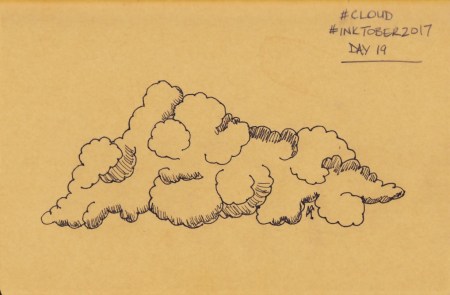
InkTober 2017: Day 19 – Cloud

As a child, did you play the game where everyone would lay on their backs in the grass and look for shapes, usually animals, in the thick fluffy white clouds as they floated by? I loved that game. I also loved trying to see the things that others saw, although I wasn’t always successful. However, what I loved more was the slight dizzy feeling I would get as the clouds and their blue backdrop of sky moved above us because it made me feel as if I was moving too.

Sometimes I would lie on the grass for what felt like hours. Then when I finally stood up, I would feel unsteady. I always needed a moment to steady myself on the solid ground before I could start running around again with my friends.

I wonder if I’m the only one who felt that sensation?


InkTober 2017: Day 18 – Filthy

I was raised in a family where swearing, especially among children, was unacceptable – even taboo. Because of this, for most of my life I’ve considered swearing a filthy habit or something done by those who have a limited vocabulary and inability to express their thoughts without relying on profanity. I’m not so sure I believe that so strongly now. In recent years, as my illness has refused to subside, my opinion has softened. Maybe it’s partially because my pain medications have somewhat lowered my inhibitions or it might be that when I’m in extreme pain my mind doesn’t always function clearly.

Whatever the reason, swearing has become part of a shorthand for me to express my anger, frustration, and pain. However, I’m still a bit reserved about when I use obscenities. I won’t swear in front of my parents or elder members of my extended family, probably because somewhere deep inside me I still fear some sort of punishment for using what I was raised to believe is “bad language.” I don’t swear when speaking to the doctors whose support and efforts to get me healthy have been steadfast. And I definitely don’t use curse words in the presence of children.

So when, if not in front of all those I’ve listed, do I spurt coarse four-letter – and occasionally longer-lettered – words? I use curse words when I’m talking to friends and family (like my brother) with whom being myself, all of myself, is never questioned. I blurt them out when, frustrated, I fumble through explaining to my therapist how I’m coping with all aspects of my illness. I can also string curses together, better than a sailor does, when I’m on my own and hopelessly trying to do something that never posed any difficultly when I was healthy.

Although I may not swear in every conversation or every instance of frustration, I must admit that I don’t view doing so as filthy as I once did. It has earned a place in my linguistic arsenal as a tool that helps me get to the point of what I need to communicate faster than trying to search for the appropriate words when I need that energy to focus on what ails me.


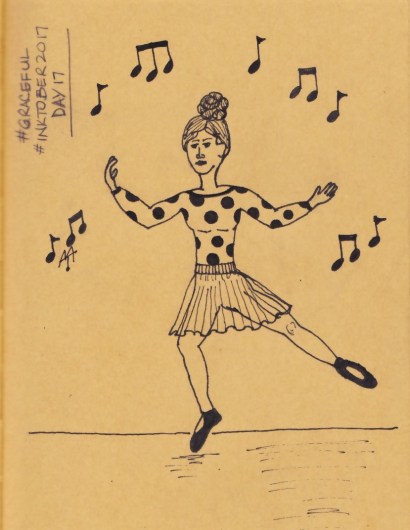
InkTober 2017: Day 17 – Graceful

Women are expected to be graceful – Always. But that’s not a practical thing when you’re a human being, unless you’re a dancer; and even then you may stumble or make a misstep in a choreographed routine from time to time. Maybe that’s why I was a tomboy when I was younger until the end of my teen years. I must have had some internal guidance telling me that it was impossible to live up to the pretty ribbons my mother perpetually tied in my hair and the patterned dresses she zipped and buttoned me into that made it impossible for me to move as freely as I desired.

Being a girl became more challenging as I hit puberty. When my body started to change, in some ways it made playing the sports, which were mostly designated for boys, harder to play. Later, life still became more physically restrictive as I was told how to stand, what to wear, how to paint my face and style my hair, and sometimes how to speak, all in the service of putting my femininity on full display. Yet none of that made me feel graceful. Not the curves my body developed, not the clothes I wore, nor the mannerisms I adopted.

The only times I felt graceful was when I was doing something physical. Doing things that my now deceased grandmother never tired of reminding me were meant for boys: running outdoors, kicking a soccer ball, throwing a football in a perfect spiral, competing in gymnastics, skiing across open terrain or down hills, riding my bicycle, or even my least strong activity, swimming. Doing those things made me feel I had full autonomy over my body to test my strength, and push my physical limits. Unfortunately, my body no longer affords me the ability to do these things as I wish to.

So how does one exercise the gracefulness their body literally prevents them from being? In my case – and I suppose it might be the same for others living with a chronic illness – being graceful has become about how I face the daily challenges and large adversities that loom within all the unknowns to come. One can be the demanding “bull in the china shop” trying to force action from or answers out of doctors, who although they haven’t cured you yet, go above and beyond to figure out what is happening in and to the body they’ve chosen not to give up on and to which they continue to deliver care.

I can also work to preserve what was once plentiful in my physical movement, through mindful interactions within relationships with friends and family. The primary way I see doing this for myself is through acceptance. Accepting that the strength and agility I may be losing from within my body because of continuous pain is being replaced by something stronger, the love and care from those who remain close to me.