
It’s hard being me right now. That’s not me feeling sorry for myself. I’m referring to living with a chronic illness that causes me constant pain. It makes it difficult for me to keep up with the social justice issues I once passionately followed and supported in my daily life; and it is harder still because I constantly doubt myself because pain affects my concentration, as do the pain medications I take to manage it.
It’s especially tough when I engage with people who may hold a privileged place in society because of their race, gender, sex, class and/or profession. If they say or do something that resonates negatively to my core, I question whether I heard or understood the words or actions correctly because my mind is sometimes so clouded by all the medications I take to manage my pain; and I question how or if I should respond.
I’m not American. However, since the arrival of the Trump Era and the relaxing of the niceties of political correctness – which served for so long as the thinnest shield between people of colour, LGBTQ communities, immigrants, the differently abled, and women, and the bombardment of overt racism, homophobia, sexism, and xenophobia; I’ve witnessed a shift. Even in my personal relationships. People now say what they think and feel without fearing repercussions.
Yesterday, I didn’t have to doubt, not even for a second, that members of the upper echelons within Canadian media have discarded all pretense that it matters if people know what they truly feel about marginalized and racialized people. In fact, a career journalist for the Toronto Star, went as far as pointing out in her Friday column that she loathes identity politics and racialized is “(an invented word)”, while applying her 20th century views to the state of modern-day journalism in reference to a black freelance writer’s activism.
My head wasn’t clouded at all yesterday. I had no doubt, when first I read an article in The Globe and Mail about the poorly received editorial in which the now former-editor of a writers’ magazine stated he did not believe in cultural appropriation and that there should be an ‘appropriation prize’. I had no doubt when I read the full editorial in the opening pages of the Spring edition of the writers’ magazine dedicated to Aboriginal writers, where the former-editor’s beliefs overshadowed content from the very writers whose stories are so often silenced.
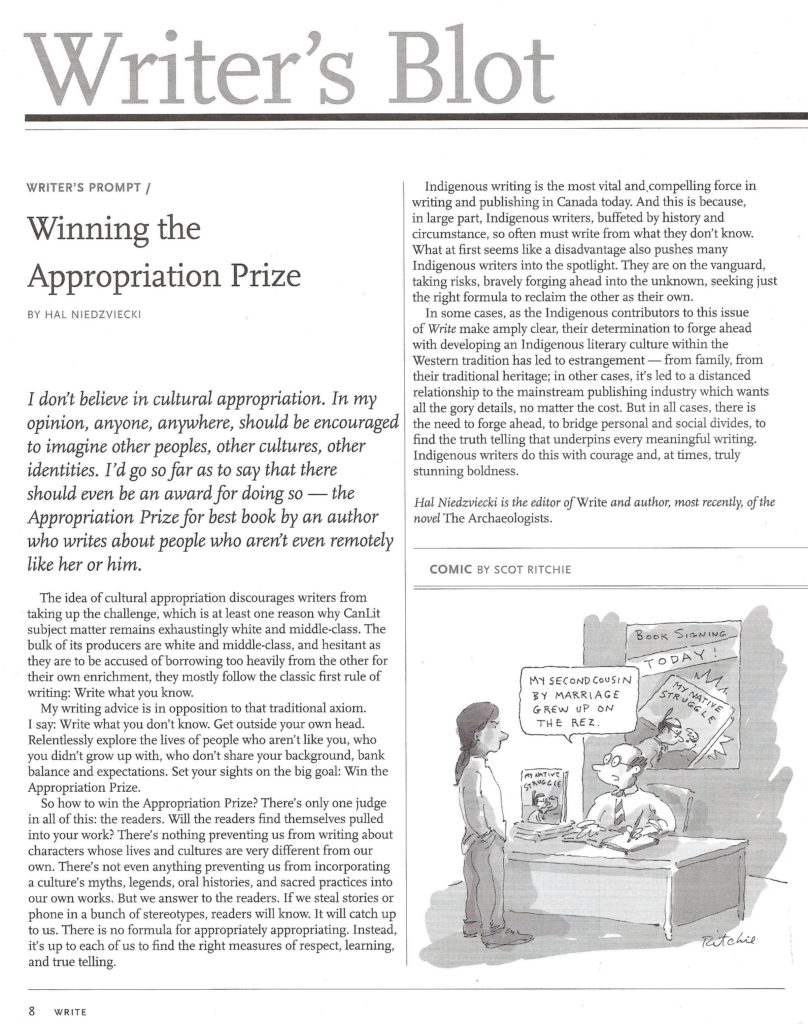
Write Magazine Spring 2017 – Hal Niedzviecki’s – Winning the Appropriation Prize
I still had no doubt when I later saw a list of white publishers, editors, and journalists facetiously jump forward to raise money to start a fictional ‘appropriation prize’ for the writer (assumedly a white one) who could best and most believably write about people, cultures, and races they know nothing about. That late night fundraising effort on Twitter was allegedly in response to protecting free speech – the beneficiary of protections in cases of overt racism always tend to be the thing that is least threatened. In the wake of fallout from the editorial written in the writers’ magazine, the editor resigned. This group of media power brokers voiced their outrage that a member of their clique was punished for something they too view as non-existent. They mocked the suggestion that the editorial harmed anyone. Harm which because of their privileged perches they could never see.
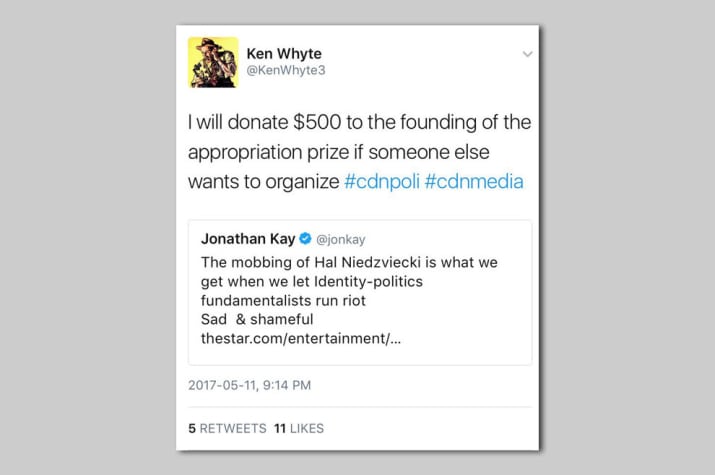
On Glibness And Diversity In Canadian Media – Buzzfeed – May 12 2017

Appropriation Fund – Contributors – Credit to Jake Mooney on Twitter – May 12 2017
I’ve chosen not to write the names of the people involved in this outrageous game of “this is who I really am” because I once held some of them in high esteem. I did, however, include the original offending editorial (above) and links throughout the post to informative articles I read yesterday, as well as additional links to more articles below.
As a Canadian, I’ve been hoping for the better part of a year that what is happening south of the border wouldn’t take hold here. The thing I forgot is that even when you think you have no weeds in a garden, it’s impossible to see what’s rooted below the surface of the dirt.
Editor quits amid outrage after call for ‘Appropriation Prize’ in writers’ magazine – The Star
Cultural appropriation prize fund was the unkindest cut of all: Paradkar – The Star
High-profile Canadian journalists pledge to raise money for ‘appropriation prize’ – The Star
Indigenous literature’s fearless aunties respond on cultural appropriation – Ricochet
André Alexis: The complex issues within cultural appropriation and art – The Globe and Mail
Christie Blatchford: Magazine editor the latest to be silenced for the sin of free speech – National Post
Editor Resigns Over an Article Defending ‘Cultural Appropriation’ – New York Times
In the end, cultural appropriation is about the cash: Walkom – The Star
 My Small Surrenders