Hobbling Across the Pond

Last winter, I took a trip. As much as it was a trip to get away from the frigid cold in the middle of winter to enjoy some tropical sunshine, sandy beaches, and saltwater; it was also a trip to test how well I can handle long-distance travel by air with my ongoing health issues. Overall, I handled it fairly well, so I’m taking another trip.

Even though things went well last year, I’m still somewhat anxious about getting on a plane again. This flight will be eight hours long, which is double the length of the last one; and I will travel 5,700 kilometres (3,550 miles) and cross five time zones over the Atlantic Ocean. Until I land and adjust to the time difference, I don’t think I’ll be able to assess the extent to which I’m affected. During the flight I took last year, my pain wasn’t significantly aggravated, but sitting in an airplane seat for eight hours this time, while feeling intense pain might be different. Add to that the fact that I’ve always been a bit of a nervous flyer and I have to admit that I’m not really looking forward to getting up in the air again.

However, my anxiety doesn’t end with the thought of getting on the plane and sitting through an eight-hour flight. I’m also anxious because I’ll be so far away from home, my doctors, and everything else familiar. During this trip, I’ll be staying with friends I haven’t seen since my last trip across the pond about six years ago. Although my friends are aware that I’m ill, they haven’t seen how the pain and accompanying side effects affect my daily life. I’m already worried about how I’ll cope and how they might react if – or more likely when – I have a pain flare up while I’m staying with them.

I know I shouldn’t expend the energy worrying about “what ifs?” but it’s hard after living with constant pain for this long and knowing that a flare up is never far off. It’s also hard not to worry about how others will react when they see you for the first time struggling to walk or unable to move at all because of pain. It’s hard not to worry about how greatly affected I’ll be by jet lag, especially because I already have a lot of difficulty with sleep and I never sleep well on planes.

It’s hard not to worry about how I’ll cope traveling around a city where public transit is widely used, when I’ve avoided using public transit where I live since becoming ill: how will I handle the sudden stops and starts of the trains or not being able to find a free seat while traveling on one? It’s hard not to worry about how I’ll explain needing to rest for a few days after going out for just a few hours. There are a lot more things I’m worried I’ll have to deal with and explain, but I suppose I’ll cross those bridges when I get to them.

Nevertheless, before I even get to the other side of the pond, there are some things I did in preparation for last year’s trip that I will repeat for this one. The main thing I did last year that was extremely helpful was arranging assistance to get to and from the plane. When I get to the airport, the airline will arrange for someone to take me from the check in counter to the boarding gate by wheelchair and/or golf cart. Then when passengers start to board the plane, I will be among the first to board with assistance from the flight crew. When I arrive at my destination, the same process will happen again. There will be someone waiting for me with a wheelchair when I leave the plane who will help me through customs to the baggage carousel and they will also help me collect my suitcase. Doing this last year helped me conserve a lot of energy and probably went a long way to ensuring that I got off to a relatively good start on my trip.

Knowing that I will have this assistance at the airports goes a long way to help me maintain peace of mind. However, I’m still anxious about the laundry list of things that need to be done before I even get there…


Chantal Kreviazuk – Leaving On A Jet Plane


The Best Intentions Paving The Way To Hell

Doing something with the best intentions doesn’t necessarily mean that what one does is welcomed or perceived as the right thing. Sometimes we get too close to a situation and believe that what we might do in our own best interest is also the right thing to do to resolve issues in another’s life. That doesn’t always work out to be true because some people don’t like feeling as if they are being told what to do or that they are being judged. Even when our intentions come from a compassionate and caring place, if the person on the receiving end cannot see that, nothing that we offer them will be welcome. I’ve come to this realization the hard way.

A recent event that was both emotionally painful and shocking, reminded me that when someone perceives things as negative there is rarely anything that can be done to shift that perception. I reached a disappointing impasse in a relationship where I wrongly believed progress had been made and the work of trying to understand each other had been fruitful. However, as it turns out, my hopefulness blinded me and it clouded the truth: All the work being done to understand was one-sided – on my side alone. In any relationship, positive progress cannot be made unless all parties involved are willing to try. Each party must be willing to look within themselves and face even the least desirable parts of who they are for a chance to become fully accountable for themselves and to the people who care for them.

Without this introspection, we doom ourselves to repeat the same mistakes and bring pain to others, and ourselves. Because when we don’t know what lies within us, even if we don’t intend to, we put the worst parts of ourselves out into the world. When anger and hatred fill us, we put anger and hatred into the world. That anger and hatred will pollute everything with which they come into contact. The people in our lives, whether that includes family, friends, or coworkers, won’t tolerate it forever. Those who do maintain the relationship may do so out of fear or a warped sense of obligation and they will avoid shedding light on the truth to prevent explosive confrontations.

When we accept this we rob the angry, hate filled individual of the opportunity to grow or make positive changes in their lives. The biggest of those changes being taking responsibility for themselves and their actions and no longer blaming others or external factors when things don’t work out in life as they desire them to. Sadly, the longer this behaviour continues without challenge and people avoid calling out the truth, the bigger the problem grows: until it reaches a point, where all interactions with that angry, hate filled person – even the briefest ones – are fraught with anxiety or fear.

At this point in my life, excess anxiety and anger are not conducive to me maintaining any degree of good health. Erratic emotions and outright anger cause me to experience pain flare-ups, so I try my best to keep things on an even keel as much as humanly possible. Being around people who have anger issues won’t and can’t help me keep balanced. Therefore, until they acknowledge and attempt to do the work necessary to identify what triggers their anger and how to manage it – which I’m aware, may never happen – I need to take a giant step back.

Saying this doesn’t mean I believe I’m perfect. I need to continue my introspective work, so I can hold myself accountable for my sh!t in the most truthful way. I need to step back and keep building on my safe and happy place, so I don’t pave my own road to hell with my best intentions towards others.

Zendoodle Hills – Ink – December 2018


Zentangle Is Not So Zen

Last night I visited the “Official Zentangle” website looking for a tangle pattern. Unlike a few years ago, when I first landed on the site, I don’t find it to be a creative repository any longer. I couldn’t find the pattern I was looking for – or any other patterns for that matter – using the search function. I ended up clicking through to their blog because I’ve been lucky in the past to find old posts about patterns there. What I found instead was something that confirmed my belief about the “we’re here to share the Zen gift we’ve created, with you” philosophy the “founders of Zentangle” are always spewing: It’s not a gift. It’s a business.

Instead of finding anything creative – that wasn’t for sale –, what piqued my interest was a recent blog post the self-titled “founders of Zentangle” have up on the site. In this particular post, they are publicly shaming and bullying someone for having a similar idea to their own that monetizes doodling. If you’re at all interested you can read the ridiculous nonsense that does little to veil their contempt for someone doing as they have, posted on their site by clicking this link to the post, which they actually titled “Seriously?…

I can’t believe I’m investing any energy in this but, to start, I need to say that I find this situation the “founders of Zentangle” have posted about SHAMEFUL, on their part and on the part of their followers who are participating in the bullying. Second, the “founders of Zentangle” don’t have the right to decide who can or cannot anoint themselves as experts of doodling. Publicly shaming this woman (Ina Sonnenmoser) for trying to earn a living the way she chooses and encouraging members of your Certified Zentangle Teacher (CZT) clique to pile shame on her is not a flattering look for you, nor is it very Zen.

To the “founders of Zentangle” (Rick and Maria), I’d like to say, you’ve had a good run in your attempt to copyright and ritualize doodling. However, no one has a monopoly on doodling. I think you need a reminder that doodling has been around forever and a day. I agree that doodling can be meditative and I often write on my blog about using it to distract my focus from my chronic pain and I’ve also written about how I use objects I have available to do zentangle according to the way you’ve specified, which I view as an unnecessary limitation. If someone else has invested the time to come up with a way to monetize drawing lines on paper, more power to them. I’m certain there are many more people than Ina out there – including those whom you have anointed as experts in your method – doing the same.

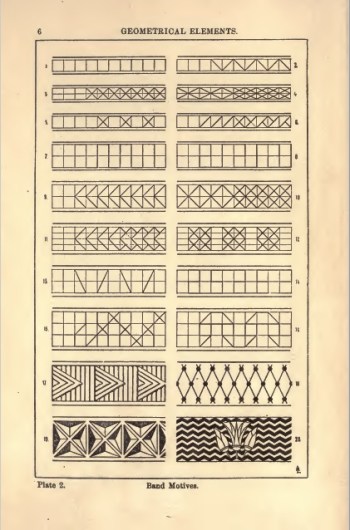
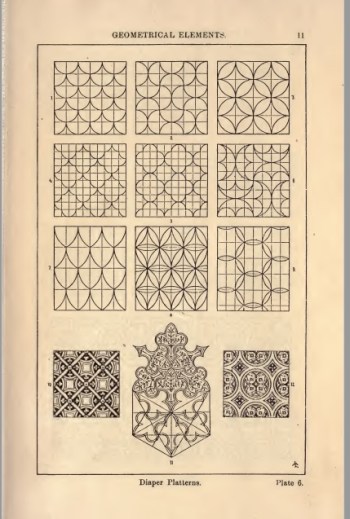
I also have to call out Rick and Maria, for their blatant hypocrisy. For anyone reading my post who wants to see how ancient some of the patterns they claim to be their originally conceived patterns are, there are books available in the public domain from as early as the 17th century that show you the origins of all these patterns (see images of pages below). Look up topics such as decorative design, ornament, ancient ornament, nature in ornament, ornament from specific cultures, and pattern design. There are volumes of material available to learn how to create your own combination of patterns or how to develop them from things in your environment.

Moreover, how many times have Rick and Maria and members of their “CZT family” done what they call “deconstructing a pattern” from an object or artwork to create a tangle. They do this without a moment’s thought of giving credit to the craftspeople who worked tirelessly to create it in the first place. News flash, just because you change a few lines (as you point out to Ina) doesn’t make something original or yours.

As Rick said, sunshine is the best disinfectant. There’s nothing Zen about publicizing this feud. What you’ve shone a light on is the true motive behind Zentangle, which is the same as any business: Making lot$ of money. This is clearly visible in the redesign of your website that no longer shares much free information about how to draw the patterns, whereas, ironically Ina’s site does. You were just hoping your followers would continue to pay thousands of dollars to you, instead of another individual or company, every year to become certified in your “method” of doodling; and more importantly, that people would forever be blinded by your phony claim that you’re giving them a gift.

Finally, for all the Certified Zentangle Teachers and followers participating in bullying Ina Sonnenmoser, take a step back and seriously look at the toxic behaviour the founders of this supposed Zen method are encouraging and taking pleasure in you acting out to support them.


A Handbook of Ornament – Franz Sales Meyer – 1849 – p22 **Click image to see the book**

A Handbook of Ornament – Franz Sales Meyer – 1849 – p27 **Click image to see the book**

Iroha-biki Moncho-Book of Crests and Designs – Kikuo Tanaka – 1800 – p24 **Click image to see the book**


Note: In the comments, I’ve made some additional observations about the cost vs. the benefits of becoming a Certified Zentangle Teacher (CZT)