I decided to participate in InkTober this year. Jake Parker created InkTober in 2009 “as a challenge to improve [his] inking skills and develop positive drawing habits. It has since grown into a worldwide endeavor with thousands of artists taking on the challenge every year.”
According to Jake, anyone can do InkTober, just pick up a pen and start drawing. I’ll be using the challenge to hopefully improve my drawing skills and as a daily mindfulness practice. I find that when I focus my attention on drawing something it distracts me from my pain. I’m so committed to this challenge, I started an Instagram account so I can have my posts counted as part of the InkTober community.
The rules for InkTober are simple
Make a drawing in ink (you can do a pencil under-drawing if you want).
Post it online
Hashtag it with #inktober and #inktober2016
Repeat
Note: you can do it daily, or go the half-marathon route and post every other day, or just do the 5K and post once a week. What ever you decide, just be consistent with it. InkTober is about growing and improving and forming positive habits, so the more you’re consistent the better.
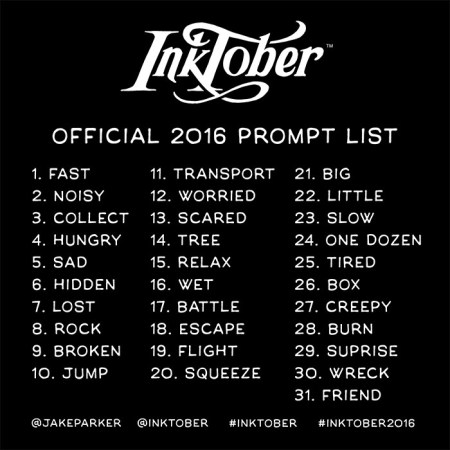
This is the official Prompt List for this year’s challenge
I spent all day trying to think of what I could possibly draw to represent the first prompt: FAST. Well, here’s my first drawing for the challenge. I can only hope that I get better as the month progresses…
A friend, who I love dearly, is losing is wife. She has cancer and she is dying. It started as colorectal cancer, which her doctors believed they had successfully removed and treated the surrounding areas with chemotherapy and radiation. After all that, the cancer still found its way into another area of her body. In her case it was her liver, which means her colorectal cancer became what is referred to as metastatic colorectal cancer. Since then, she has had pieces of her liver removed twice to cut out cancer tumors. Until my friend described the process of waiting for enough of his wife’s liver to grow back to remove the second tumor, I didn’t know what a resilient organ the liver is.
That was earlier this year, in the spring, and while they were waiting for her liver to grow, an MRI that was part of her treatment follow-up found a spot on one of her lungs. The doctors told them the spot was small and there was no need to worry about it at that point. However, my friend worried anyway; and so did I. It didn’t make sense that the doctors wouldn’t try to remove the cancer cells from her lung, or at least treat them, at the same time they planned to remove the tumor from her liver. It didn’t make sense especially because those cancer cells on her lung caused her to develop a terrible cough. According to my friend, she would have severe coughing fits when she talked and all through the nights that made it impossible for her to get a good night’s rest. The doctors prescribed her inhalers – the same kind I use for my asthma – and that gave her a small amount of relief but never stopped the cough.
Fast-forward to earlier this week and a series of appointments. The first was with a targeted therapy oncologist to decide if she meets the requirements for a drug trial, which she didn’t because the cancer has spread to multiple organs. Next, was an appointment with her family doctor to update health insurance benefits forms, where they learned that the doctor had suspected she might not qualify for the drug trial because more than one organ is now affected by cancer. Then lastly, she had an appointment with her personal oncologist. He finally spelled things out clearly for them: she has outlived the life expectancy of the average person with metastatic colorectal cancer also called stage IV (four) cancer, which is an average range of six to 18 months. This immediately put everything about recent steps in her treatment plan in clearer perspective for my friend: there was no urgency to treat the cancer in her lungs because she has survived longer than expected.
Furthermore, “Once cancer spreads, it can be hard to control. Although some types of metastatic cancer can be cured with current treatments, most cannot. Even so, there are treatments for all patients with metastatic cancer. The goal of these treatments is to stop or slow the growth of the cancer or to relieve symptoms caused by it. In some cases, treatments for metastatic cancer may help prolong life.” In this, she has been fortunate because she has had low pain levels throughout the course of the disease, and she is still very active. However, because her cancer keeps growing in different areas, it’s possible that it can no longer be controlled. The literature I read online, states “If you have been told you have metastatic cancer that can no longer be controlled, you, and your loved ones, may want to discuss end-of-life care. Even if you choose to continue receiving treatment to try to shrink the cancer or control its growth, you can always receive palliative care to control the symptoms of cancer and the side effects of treatment.”
My friend’s work schedule has made it difficult for him to go with his wife to all of her appointments, so until this week there have been pieces of information he hasn’t received directly from the doctors. Now that he has all of this information, he is in shock, but his wife seems unshaken by the gravity of her health situation. He believes his wife may not have a full grasp on everything she’s being told or may be in denial and is still hopeful that somewhere there is a cure for her. However, that seems unlikely at this point because the results of her latest tests show cancer again in her liver, more cancer now in both of her lungs, and cancer in some of her lymph nodes.
Outside of another round of chemotherapy that may extend her life for a short time, after she makes it thru the horrible side effects, there isn’t any more the doctors can do for her. The drug trial – that can only go ahead if the chemotherapy successfully treats the tumors – will at best, add months to her life and give the oncologists data about the drugs’ effectiveness for people with metastatic colorectal cancer and at this stage, stage IV, of the disease. Or, there are the treatments his wife has researched on the internet that she could receive in Cuba, Mexico and Eastern Europe that cost tens of thousands of dollars and promise to cure every form of cancer, but have no scientific backing. Knowing about these treatments may be why she can’t accept what she has been told by her many doctors here.
When I heard all of this in the justifiably angry phone call from my friend, I did the only thing I know how to do. I became the strong sober voice and outlined all the things he and his wife need to do before she requires palliative care. I was able to do this because of the many experiences I’ve had in my life losing beloved friends and family members to cancer. I could also tell he was still in shock and hadn’t been able to think straight since having all of this information dumped on him and his wife within 48 hours, so giving him a practical list of things to do helped to slightly dissipate his anger and get his usually ordered mind working again.
My friend, who I love dearly, is losing his wife to cancer. I wish I could do more for them. Sadly, I know that the best and only thing I can do is be his friend and be there to pick up the phone and listen when he calls.
I used to be tough. I had to be. I grew up in a family where being needy was a sign of weakness, and feelings and emotions were things you kept to yourself. My parents separated when I was quite young, which meant I had to learn to depend on myself because neither of them was ever reliably available for me. Repeated disappoints from my parents made me resilient because I had to recover and bounce back from so many situations that need not be a part of a person’s childhood. That learned resilience helped me cope with every obstacle life put in my path and all the crappy things people believe it’s okay to do to each other.
The thing is, the longer I’m sick the less resilient I feel I’m becoming. The unshakeable pain I feel every minute of every day is starting to chip away at my psychological and emotional strength and my ability to bounce back, relatively quickly, from difficult issues that crop up, regardless of the size. That concerns me because I think to survive this illness for an unpredictable amount of time I need the spark of combined toughness and grit I’ve always carried within me. That spark has lit my way and guided me through countless hard and painful situations in my life; and I feel like it might start to fade under the unyielding pressure from my pain. To be truthful, I’m more than concerned, I’m a bit afraid. What if, I can’t hold on to the intangible thing that has kept me grounded and moving forward in life until now; until now, when I need it more than ever.
The strange thing is, the more I question myself about this, the more my mind turns to a TED Talk about grit and resilience – primarily in children – I watched a few years ago. I felt immediately connected, to the theories the speaker, Psychologist, Angela Lee Duckworth raised as she spoke. I understood her ideas about how or, more accurately, what is necessary, beyond intelligence and socioeconomic background for a person to succeed. However, that was three years ago, when I was healthy. Now, I can see that there is so much we don’t see or are unable to measure with tests or studies to chart ‘success’ because my perspective of success is no longer measured in the same ways. Now, my success is rooted in what I can do from day to day, within the limits set by my pain; and I can feel my pain chipping away at my toughness and working to dim my spark every day.
As I thought more about this TED Talk, I wondered if anyone had done any studies on resilience and chronic pain. I found some published psychological studies that I’ll be reading in more detail later. The gist of them all is that resilience does matter and chronic pain patients with greater levels of resilience have a higher survival rate. Now that I know this, the question for me is, how do I keep myself from losing my resilience? I truly hope I’m able to find something in one of these studies that helps me to keep my spark lit.


 My Small Surrenders