Drawing to Cope with Trauma

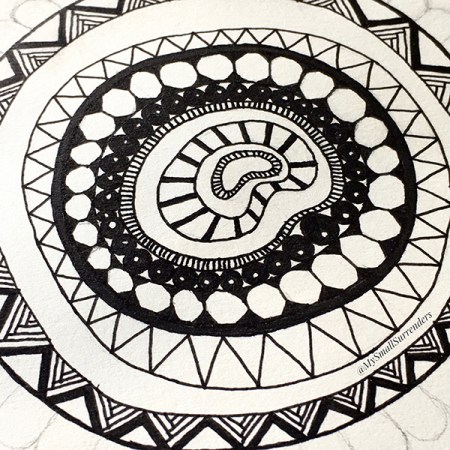
I usually draw and doodle because of the meditative qualities these activities offer that help to lessen my connection with the physical pain I feel every minute of every day.

In recent weeks, I’ve realized that I’m drawing and doodling to escape thinking. There is so much happening in the world around us now and thinking about all of it— or any of it—can be overwhelming. The need to disconnect from streams of information and news for longer periods is becoming greater with each passing day.


Unfortunately, the ability to disconnect is also a luxury that most of us may not have because the information that’s being shared is important to our overall health and safety. We need to know and understand the latest developments with respect to the current Coronavirus pandemic (Link to Mayo Clinic) in order to safeguard our health and the health of everyone around us, especially those who are most vulnerable. Nevertheless, tuning in to hear all of this information daily is becoming dizzying, and at times confusing, but it’s also always frightening.

It’s frightening because the virus at the root of this pandemic keeps presenting new symptoms—or no symptoms at all—once it infects us. It also continues to challenge current medical knowledge about how it’s killing us because of the varied ways it attacks our immune systems. Still, as much as all of this information is overwhelming and continually changing, it’s absolutely necessary for us to engage with it.

It’s also becoming difficult to consume news about the needless and senseless deaths of people within and around our communities in brutal and barbaric situations. Exposure to live-streamed images and graphic reports of murders of people of colour is taking a toll on my mental health. The way I’m feeling makes me certain that everyone being exposed to these same images and reports is also being deeply and negatively affected, even if we all don’t acknowledge it.

The combination of this daily bombardment of necessary but frightening information and unfiltered, brutal news is traumatic.

Trauma that we experience directly, or even vicarious trauma (also called compassion fatigue) from witnessing horrible things that happen to other people, take a toll on each of us in common yet sometimes surprising ways.

When we experience trauma, direct or indirect, we may feel some or all of the things listed below:

  • Isolating yourself
  • Loss of pleasure in life
  • Difficulty concentrating
  • Insomnia
  • Physical and mental fatigue
  • Bottling up your emotions
  • Increased nightmares
  • Feelings of hopelessness or powerlessness
  • Overeating
  • Excessive use of drugs or alcohol
  • Poor self-care

Sadly, we are now living in a time of extreme uncertainty. A time where we are already emotionally and psychologically vulnerable, on top of which, too much information and endless streams of violent images are continuously bombarding our already frazzled senses. Then, as if these factors weren’t enough, we must consider that during this already difficult time most of us are also isolated from the supports of our friends and families that we typically rely on for comfort.

This isolation imposed by Public Health Authorities in response to the current pandemic, means each of us is responsible, more than ever, to find ways to ground and soothe ourselves, so that we can effectively cope and continue to fulfill our basic daily needs.

Good or bad, before the start of this pandemic, I already had years of experience living in socially isolated conditions to learn how to cope with traumatic experiences by myself; and to figure out which activities help me cope best with difficult circumstances. In these times, leaning on my creativity, even if what I create isn’t considered beautiful or interesting to others, is what helps to emotionally ground me and soothe the anxiety that may surface.


Just drawing lines is a meditative exercise that helps calm my senses by allowing me to disengage from the things that cause me anxiety and aggravate my chronic pain. Even if it’s just for a short time.

For each of us the healthy, positive coping tools that might bring us comfort may be different. However, finding them and using them to help us through this and other difficult times, will be what prevents us from becoming so overwhelmed that we can’t get out of bed in the morning.


* * *


Note: To learn more about trauma and vicarious trauma and some tools that may help with coping, please visit the links I included in this post.

I am not affiliated in any way with the organizations whose links I share in this post.


Pain Clinic #11: When A Treatment Complicates Chronic Illness

TRIGGER WARNING

Anyone who has survived a traumatic experience may be familiar with the feeling of separating from one’s body. This naturally occurring physiological process in the body helps a person withstand something terrifying or harmful. It also works to minimize potential psychological damage or outright losing one’s mind. I characterize it as the traveling of one’s mind, or what some might call the consciousness, into another space until it’s safe to return to the body. For someone who has never experienced this, it might sound hokey, but if you have lived through something traumatic, you know exactly what I’m describing.

It’s the moment when a person can see everything around them, but her/his body freezes making it impossible to interact with any of what’s happening. Whether it’s another car slamming into yours as it drives the wrong way down a one-way street, the moment a dog twice your weight pounces on you sinking its teeth into your body; or feeling another person physically overpower and violently assault you; you know the feeling to which I’m referring.

The medical name for this physiological process is dissociation. “In psychology, dissociation is any of a wide array of experiences from mild detachment from immediate surroundings to more severe detachment from physical and emotional experience. The major characteristic of all dissociative phenomena involves a detachment from reality, rather than a loss of reality as in psychosis.”

The medical definition further states that dissociation is usually measured on a continuum from mild to severe. In a mild, non-pathological case, it’s seen as a coping or defense mechanism in cases of extreme stress or conflict; and in its mildest state it’s more commonly called daydreaming. While in severe or pathological cases of dissociation, the experience(s) can include: “a sense that self or the world is unreal; a loss of memory (amnesia); forgetting identity or assuming a new self (fugue); and fragmentation of identity or self into separate streams of consciousness (dissociative identity disorder, formerly termed multiple personality disorder) and complex post-traumatic stress disorder (PTSD).”

As I’ve already mentioned, dissociative disorders are sometimes triggered by trauma. Yet, in many cases, stress, whether unexpected or prolonged, is the trigger. The situation in which I found myself wasn’t unexpected, but it was stressful, and when I realized what I had experienced it scared me.

One of the recent treatments I’ve undergone – in yet another attempt to reduce and ultimately eliminate my chronic pain – deliberately puts the patient in a dissociative state. The idea is to use specific medication(s) to trick the nervous system into feeling (believing?) the pain no longer exists. I haven’t posted details about the treatment or my experience with it yet because I’m still in the midst of sorting through my feelings, researching and writing about all of it. The medication(s) used are meant to make the patient feel a definite separation between body and consciousness, which I strongly felt for about 20 minutes and had no way of stopping without ending the treatment and possibly losing all its potential benefits.

Since this treatment, the problem I’m having is whether I should undergo it for a second time considering the minimal relief it delivered vs. the major psychological effect(s) it’s still having on me. Effects I hadn’t connected with, or begun to understand, until I had a panic attack while thinking about the next scheduled treatment. I don’t know if I can withstand feeling separated from my body while watching – witnessing really – everything around me but feeling as though I’ve given up all conscious control.

Because the first treatment only delivered about five days of low pain levels, I’ve had to weigh whether the mindf@ck I have to withstand during the treatment and process after is worth a week of relief. Although, I’ve been told that an increased dose of the medication(s) could, possibly, last longer: anywhere from a few extra days to weeks or in the ultimate best-case scenario months. Is that enough to justify forcing my mind into a prolonged dissociative state?

All the contemplation I’ve been doing tells me it’s not enough. The likelihood that more treatments with this method, even with higher doses of the medication(s), will be more successful than the first is slim. However, it’s a known fact that the dissociative side-effects will happen with each treatment and may even intensify. Therefore, my Pain Specialists’ search for a long-lasting treatment must continue; and until they find one, I have to keep finding ways to cope with this unceasing pain every minute of every day.


We Repeat What We Learn

Have you ever realized that the answer to a problem or confusing situation you were searching for was in front of you the whole time?

I had one of those epiphanies this afternoon after waking from a nap. For a long while, I’ve been trying to figure out the behaviour of one of my brothers. His actions in response to a situation in his life have left me scratching my head and wondering how it’s possible that he can be so cold and detached. I’ve been trying to understand how he can possibly be okay with the knowledge that another person might be suffering because of him. It hit me today that his behaviour was taught to him through the actions or lack of action taken by adults in our lives when we were children.

I’ve been telling myself that I don’t understand his behaviour because we had similar childhood experiences but I didn’t turn out the same as him. The problem with that statement is that I’m wrong. I did turn out the same. I learned the same behaviours he did. However, because I don’t act out against others, I’ve taken an almost self-righteous attitude about how he is living his life. Instead of hurting others, I choose to act out those same behaviours within some areas of my life, which is just as harmful. I choose to hurt myself – not physically but through certain privations – which doesn’t make my actions any less harmful. And it definitely doesn’t mean that I am better adjusted to life than my brother. The scale of my hypocrisy is enormous.

My brother may be an adult, but his actions are those of a small boy because emotionally – and quite possibly psychologically – he has not matured beyond the stage of a child hurt by so many people in his life. The only difference between us is that I can recognize, although not always, when I am triggered and reacting to a situation because of past traumas and I try to figure out how to break out of that space. My brother doesn’t know that he occupies these vastly different temporal spaces and because of this lack of awareness, he’s creating more pain for himself and others. Unfortunately, he has made it clear to me that he doesn’t want my help or that of anyone else who has offered. I only hope he figures some of this out before the hurt he causes becomes too deep to ever be repaired.


R.E.M. – Everybody Hurts