I’ve been struggling to cope with a pain flare up since last week. The flare up started because I had multiple days of activity. Going out is a struggle for me. The motion in any vehicle I ride in sends pain shooting through my pelvis. Then my recovery depends on how far the ride is and how much walking I have to do when I get to my destination. Sometimes I can recover in a day but other times, like last week, when I have to go to multiple appointments or just out for the sake of leaving the house it takes days.
This pain flare up is compounded by swollen calves, ankles and feet, and more pain in my legs, back, and right hip. The hip pain is new and makes it difficult for me to sit. All of this is disrupting my sleep. So I either can’t sleep or after a couple of days of little sleep I crash and can’t stay awake – think narcolepsy.
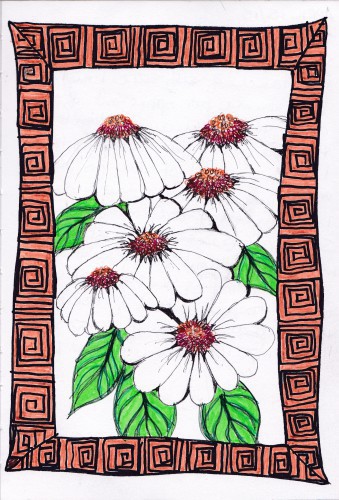
Today, when it became clear that sleep was not an option, I decided to do something to distract me from the pain. A couple of weeks ago I started a doodle in my art/gratitude journal but didn’t know how to finish it. What was on the page was a roughly sketched frame with nothing in it. I decided to draw Gerbera daisies inside it. They are one of my favourite varieties of flowers. The brilliant brightly coloured blooms always put a smile on my face.
Gratitude & Creativity – Daisy with Frame
My art/gratitude journal is reconnecting me to parts of myself that I almost forgot ever existed, while opening me to learning many new things. But because I haven’t drawn much in years it is quite challenging for me to draw flowers. I spent a few hours sketching the daisies with a pencil. Then I used colour markers to fill in the details. I originally planned to fill the petals with bright colour, but as I coloured I felt I should leave them empty – I can always change it later. I had to concentrate hard to produce something I like. Focusing on drawing daisies distracted my mind from the pain for a little while and made the day go by faster.
Last Friday I returned to the pain clinic to discuss my options for more invasive pain management methods because surgery – or a definitive plan to restore my health and eliminate my pain – is now far into the distance. I met with a pain management specialist I hadn’t seen before. His style of interaction was not as comforting or as informative as the doctor I’ve grown quite comfortable with over the last year. At the beginning of our session I had to ask him to slow his speech because it was very clipped and difficult to understand because of what I thought was a fast-moving Australian accent. It turned out that he is a British northerner, which on a good day is a hard accent to understand but was doubly so because of my medication fog.
We spoke for a while. Since, of course, each time you meet with a different doctor or medical practitioner you have to repeat your history and your primary concern of the moment. I explained to him that because I have no idea when or how the surgeon will treat my condition, and because I have no desire to increase the amount of pain medications I take – it would be impossible to function – I believe I need to have my pain treated more aggressively with other methods. I told him my favourite pain specialist – I didn’t actually say that, at least I hope I didn’t – had described the procedures that might be available to me and after a lot of thought I’m ready to try one or both.
He reviewed my chart. He reiterated the possible benefits and risks of each procedure. And especially emphasised that because my case is so “unique” and “complicated” – when I get better I’m going to set up an online dating profile and use those descriptors to snag a prime partner – whichever procedure they use might not work and may actually cause me to have a terrible pain flare up. How’s that for setting someone’s expectations?
He left the examination room to consult with the head pain specialist of the clinic to decide what to do with me. When he returned to the room about 15 minutes later my fate was sealed. I will get the Ganglion Impar Block that “treat[s] chronic, neuropathic perineal pain from visceral and/or sympathetic pain syndromes”. That’s a fancy way of saying they’re going to try to numb my pelvic pain and the associated leg and back pain. It is a delicate procedure for which I will be heavily sedated so they will admit me to the hospital under day surgery. I will need someone to take me to the hospital and take me home. This is the third time in just under a year that I will be heavily sedated on top of the large quantity of pain medications I take.
I don’t have the date for this procedure yet. I will get my notice by phone from one of the pain clinic administrative clerks who are all very lovely; or in the mail with an official-looking, detailed letter about when, where and how it will take place and what I need to do to prepare for the day. I’m not sure it’s a good thing, but I’m getting used to waiting for these notices to arrive so I can transfer the information to my calendar then patiently count down the days to the next procedure, consultation, or examination.
During my last visit to the pain clinic a plan to manage my pain during surgery and post-surgery – if that day ever comes – was laid out for me. There was some discussion in earlier sessions about how difficult they believe it could be to manage my pain down the road because of the high level of pain medications I’m currently taking. That’s also a part of the reason they haven’t increased my pain medications to treat the excessive pain I feel now. Imagine being on such a high level of pain medications that anesthetics might not effectively manage your pain during surgery and then after having your abdomen sliced open there is nothing you can take to relieve the pain. Can you imagine that? I don’t want to.
The pain specialist’s plan for surgical pain management is modular. In the sense that the anesthesiologist can do parts of it or all of it. However, there is one point she feels they should not bypass: an anesthetic review. What this would involve is sending me for a consultation at the Anesthesiology Clinic ahead of surgery. The reason for this is that patients usually meet the anesthesiologist minutes before surgery, but because I am a “complicated case” it would be beneficial for me to go to the Anesthesiology Clinic for a review of my current pain management treatment and its effectiveness to have them create a clear plan for my specific needs. In short, they are going to have a hell of a time helping me cope with pain during and after surgery.
The rest of the plan is where there is room for adjustment. Which recommendations the anesthesiologist uses will depend on the type of cut the surgeon decides to make to do the surgery. According to the pain specialist, if the surgeon chooses to do the resection through a horizontal cut in my lower abdomen I should have a large dose of Gabapentin – about 1200mg – before the start of surgery. This should help to prevent a big pain flare up. I would then have opioids during surgery followed by a Dilaudid button or a Patient-Controlled Analgesia (PCA) post-surgery to manage the pain.
But if the surgeon opts to make a long vertical cut in my abdomen things change. The recommendation is for me to have an epidural to deliver freezing and opioid medications to numb the pain because this is the more painful way to do this surgery. The epidural must be inserted before surgery starts and the catheter would be left in post-surgery to give me pain medications instead of giving me a button/PCA. And in either case (i.e. whichever way they choose to cut) I would most likely get some ketamine and lidocaine during surgery to prevent “low effectiveness” of the opioid medications during and after surgery.
None of this appeals to me. Not just because of the high level of pain anticipated or the long scar I will undoubtedly be left with, but because she told me that I won’t be able to eat or drink for a few days after surgery. Apparently, after having parts of your guts removed your body needs time to relearn a few things, like how to digest food.
But the point of writing about all this is that surgery appears farther away than we all thought. I will be returning to the pain clinic on Friday. It’s time to explore more invasive pain management methods because some days the pain medications barely do their job. We will make a decision about what to do now in light of the delay. I might have steroid injections called Caudal Epidural Steroid Injections that are a “combination of a steroid and a local anesthetic that is delivered to your lower back to treat chronic back and lower extremity pain”. Or I might have nerve blocks known as Ganglion Impar Blocks that “treat chronic, neuropathic perineal pain from visceral and/or sympathetic pain syndromes”.
We discussed these procedures briefly a few months ago to educate me about what is available if I don’t have surgery. They are a temporary patch and I was told that they may not work for me because of the complicated nature of my pain. Regardless, I think the time to try them has arrived because I need more pain relief. So, needles here I come…

 My Small Surrenders