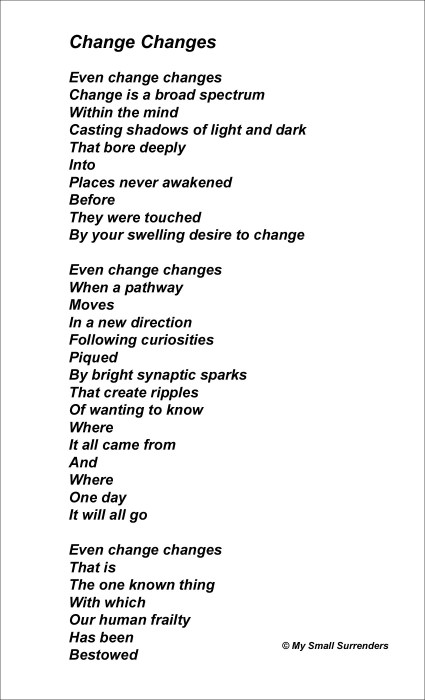
My blessings continue to build. Through this blog, I connect to so many incredible people who inspire me to explore things that improve the condition of my daily life in surprising ways. Inspiration to write more poetry came to me recently from an online friend whose writing prompts me to think outside the fog I live within most days. who is bert wrote a few lines about change and it set off an explosion of writing for me. Thank you Bert.
I feel as if my life is in hyperdrive since I got my surgery date. Yesterday while I was having lunch with a friend I hadn’t seen in eons, our conversation was interrupted by a call from my surgeon’s office telling me that my pre-admission appointment was scheduled for today at 11:00 AM. I know my surgery is just a few weeks away, but everything is moving so quickly I can barely catch my breath.
This morning I went into the Pre-Admission Department at the hospital at 10:45 AM and I didn’t leave until just before 3:00 PM. Seven different people handled my chart. The first was a dry, nondescript, administrative clerk who completed my intake making sure all of my information was current and correct, that I have an emergency contact, and confirming that I understand the reason I need surgery. I found that funny in an “I better know by now why I need surgery or I’m in big trouble” kind of way. She had me sign all the necessary consent forms then directed me to the waiting room from which I was eventually collected by a lovely, bubbly nurse named Jean.
The entire time I was with Jean was light and filled with laughter. She went over some of the same information the clerk had covered then realized that some necessary people in the pre-admission process had not been contacted to come speak to me. She disappeared from the exam room for about ten minutes and walked back in triumphant that she had been able to contact Jo and Joan who were both available to come speak to me about vital post-surgery information. Jean’s responsibility was to record all my medications, confirm any allergies, and cover everything I have to do the day before and the morning of surgery. On the day before surgery, I have to fast all day except for the clear fluids I must drink because I have to do a bowel preparation similar to what you do before a colonoscopy. I did it last year for a colonoscopy and it made me feel awful, so I’m not looking forward to doing it again. I also have to shower with a special antiseptic soap the night before and the morning of the surgery. I had to buy both the soap, which comes with special instructions for the order to wash your body parts, and the bowel preparation solution from the hospital pharmacy on my way home.
The next person I saw was Jo, the Ileostomy Nurse. It is her job to find the best spot on a person’s abdomen for the placement of a stoma. What she actually has to do is draw a mark on your abdomen using a kind of permanent ink pen. Unfortunately, the timing of my surgery falls outside of what she considers an ideal window of time for a mark to still be visible enough for my surgeon to see if I end up needing to have a stoma. I will have to call her the week before my surgery and go into the hospital so she can draw on me – I’m lucky the trip to my hospital is not a long one. Jo will also recommend – if I need one – which of the available types of stomas she believes will work best for my body type and she will teach me how to care for it. As lovely as she was to me, my hope is that the mark she makes on my abdomen will not have to be used.
Then I met with Joan. Joan’s job was to prepare me for what to expect after surgery. When will they make me sit up for the first time? When will I have to get out of bed and walk for the first time and for what distance? How will my deep breathing allow them to gauge my pain level? When will I be allowed to drink something? When I will have my first solid foods – which may not fall within the realm of what’s considered normal because my surgeon has very strict rules for his patients after bowel surgery. She also explained the proven science behind these benchmarks and a few things I had never heard of before. For instance, after surgery, chewing a stick of sugarless gum triggers a reaction in the digestive system that helps you pass gas, which is a sign that your bowels are working. So I have to take a pack of sugarless gum with me to the hospital that I will chew three times a day to get my digestive system working more quickly and easily. This will be interesting because I never chew gum, but I suppose I can make an exception this one time.
Joan was followed by a lab technician whose name I can’t remember, but who had a cheerfully coloured manicure. She had a pleasant demeanor and was sensitive to my need to have her use the butterfly needle usually reserved for children because my veins don’t behave as they should during blood collection, and the children’s needles minimize the pain and bruising. She took five vials of blood for a variety of tests, and although she told me what they were for, the only thing that stands out in my mind is a pregnancy test – HA! The lab technician with the cheerfully coloured manicure also did my ECG, which was finished in less time than it took her to place all the ECG pads and electrodes on my body. I hope the test showed that my heart is still in the fight.
My Anesthetic Clinic consultation was the last act of the day. An Anesthesiology resident came in to see me just as my friend J and I each finished inhaling our lunches of coffee shop sandwiches and warm donut holes. He had a form with mandatory sections that needed information. I had to jump back to two years ago when the ordeal that is my illness started at another hospital, talk about the reason for each of my current medications, detail past surgeries and invasive procedures, and tell him what I already know about the proposed pain management plan so he knew where to start. He started with the night before surgery, which will not go as most do with me fasting because I will be completing my bowel preparation. Then he talked about the general anesthetics I will receive and the epidural option, which I assured him I do not consider an option. Upon hearing that, he launched into the list of benefits and side effects associated with epidurals where the benefits far outweigh the risks for me. He then instructed me to take my current medications on the morning of the surgery. He ended by telling me about the Acute Pain Service. How they will monitor me daily and how transitioning me from the epidural to oral pain medications will depend on how well I am coping with pain. He then left the room to check my blood test results and confer with the lead anesthesiologist.
When the Anesthesiology resident returned, he had the lead anesthesiologist in tow. They had some bad news for me. My hemoglobin levels are low, even though I’m taking an iron supplement. The level is low enough that it could pose a problem for surgery. I will receive a call from the Blood Conservation Team next week to come up with a solution to raise my levels in time for surgery so they won’t have to consider transfusing me. In the meantime, they instructed me to eat as much red meat as possible, which is going to be hard because I hate beef and I eat a mainly vegetarian diet but I’ve come too far to let a little bit of meat stand in the way of recovering my health. Is anyone having a barbeque this weekend?
David Bowie – Space Oddity (Ground Control to Major Tom)
I’m steadily working my way through my pre-surgery appointments. My next appointment at the pain clinic was supposed to happen in August, but because of my upcoming surgery, they moved it up to this past Tuesday. I met with a doctor who recently started his one-year Fellowship in Anesthesiology and Pain Management at the hospital’s pain clinic – there is an annual program rotation that starts at the beginning of every July. I had to catch him up on what’s been happening since I had my nerve block.
I told him that I had dutifully kept my pain log every two hours for 48 hours after the nerve block and sent the log back to the pain clinic as instructed. I also expressed my disappointment that the nerve block didn’t last longer than two weeks, but I tempered that by letting him know that it was still nice to have had a little pain relief even if it was for such a short time. He asked if the nerve block had made it possible for me to reduce my pain medications. Unfortunately, the answer to that question is “no.” I wasn’t able to reduce my pain medications but I believe that during that short period I felt some benefit from them for the first time in a long time. They enabled me to do a bit more than just the basic daily functioning of moving around. For instance, I was able to go out with a friend to a local market where I picked out fruit, vegetables, spices, and cheeses for myself from different shops; and the relief was enough to make it possible for me to cook myself a complete Sunday dinner. It was good to get out of the house and walk through the market for the first time since becoming ill and it was even better to use produce I selected – instead of some anonymous person from my online grocer – to make myself a tasty meal.
After talking about the nerve block, we moved on to my surgical pain management plan. I will have an Anesthetic Clinic consultation during my pre-admission appointment. During that consultation, an anesthesiologist will review my current pain medications, the pain management plan designed for me a few months ago by the pain clinic, and factor in the results of my nerve block to determine the level of pain medications I will need during surgery. My pain specialist believes that the suggested epidural should remain a part of the pain management plan so that I can receive a constant flow of pain medication during surgery and for up to two days after because my surgeon is going to use a vertical abdominal incision, which is of course the more painful technique. Following surgery, I may also have a patient controlled analgesia (PCA) pump so I can control the frequency of the doses of narcotic/opioid pain medications I receive immediately after surgery.
In addition to having my body flooded with pain medications through these invasive methods, I will be closely monitored for the length of my hospitalization by the Acute Pain Service (APS). The job of the APS is to “to ensure patients with pain have individualised, safe and effective therapy” and “to provide safe and effective pain management to patients undergoing surgery…from admission to discharge”. An anesthesiologist will lead the APS team. The team will see me daily to assess my pain management needs, make adjustments as required, and measure my rate of recovery from my surgical pain and chronic pain. The team will also make recommendations about the type and amount of pain medication I’ll need when I’m recovered enough to be discharged from the hospital. Before this conversation, I had no idea that such a service existed and that I would receive this level of pain management care after surgery.
Surprisingly, I left that appointment feeling buoyed with confidence. A few days ago, I didn’t feel that. I instead felt overwhelmed by anxiety and fear. I think the anxiety is starting to shift because as I go from appointment to appointment and make phone call after phone call from the many points on my to-do-list, I’m realizing there is a supportive network of healthcare professionals around me who feel invested in getting me better. To meet that goal they are openly communicating and sharing information with each other and me so all I have to do is show up. I just have to show up and let them worry about the surgery and the post-operative care. Let them worry about the sharpness of the blades of the scalpels; the amount of pressure in surgical suction pumps; the number of stitches and staples needed to close my incision, and when they will reintroduce solids to my diet. I’ll let them worry about those things and the piles of other things rolling around in my head and in the meantime, I’ll work on trying to sleep more, laugh more, and take in the love and support of the many friends and family who want to carry the rest of my worries for me.
Now on to doing the work of making this positive perspective my reality…